
周围神经损伤增加了脊髓 lamina II 中 L 型钙通道对突触传递的贡献:α2δ-1 亚基的作用。
Peripheral nerve injury increases contribution of L-type calcium channels to synaptic transmission in spinal lamina II: Role of α2δ-1 subunits.
机构信息
1 Michael Smith Laboratories, University of British Columbia, Vancouver, BC, Canada.
2 Djavad Mowafaghian Centre for Brain Health, University of British Columbia, Vancouver, BC, Canada.
出版信息
Mol Pain. 2018 Jan-Dec;14:1744806918765806. doi: 10.1177/1744806918765806.
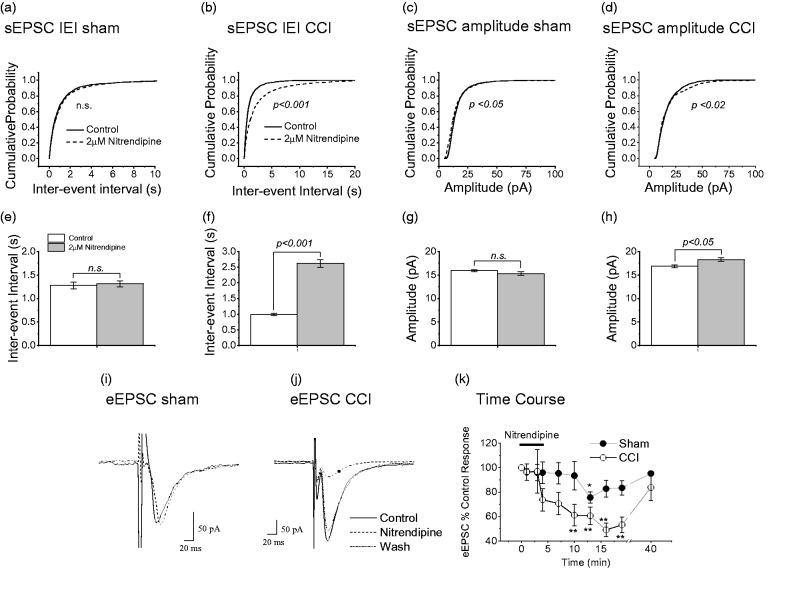
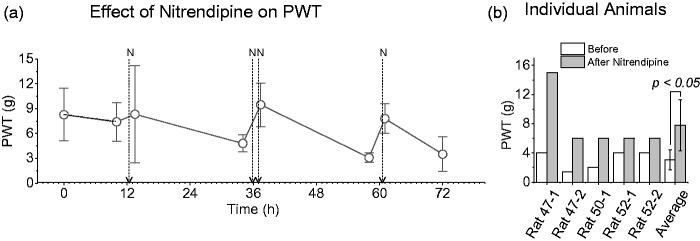
Background Following peripheral nerve chronic constriction injury, the accumulation of the α2δ-1 auxiliary subunit of voltage-gated Ca channels in primary afferent terminals contributes to the onset of neuropathic pain. Overexpression of α2δ-1 in Xenopus oocytes increases the opening properties of Ca1.2 L-type channels and allows Ca influx at physiological membrane potentials. We therefore posited that L-type channels play a role in neurotransmitter release in the superficial dorsal horn in the chronic constriction injury model of neuropathic pain. Results Whole-cell recording from lamina II neurons from rats, subject to sciatic chronic constriction injury, showed that the L-type Ca channel blocker, nitrendipine (2 µM) reduced the frequency of spontaneous excitatory postsynaptic currents. Nitrendipine had little or no effect on spontaneous excitatory postsynaptic current frequency in neurons from sham-operated animals. To determine whether α2δ-1 is involved in upregulating function of Ca1.2 L-type channels, we tested the effect of the α2δ-1 ligand, gabapentin (100 µM) on currents recorded from HEK293F cells expressing Ca1.2/β4/α2δ-1 channels and found a significant decrease in peak amplitude with no effect on control Ca1.2/β4/α2δ-3 expressing cells. In PC-12 cells, gabapentin also significantly reduced the endogenous dihydropyridine-sensitive calcium current. In lamina II, gabapentin reduced spontaneous excitatory postsynaptic current frequency in neurons from animals subject to chronic constriction injury but not in those from sham-operated animals. Intraperitoneal injection of 5 mg/kg nitrendipine increased paw withdrawal threshold in animals subject to chronic constriction injury. Conclusion We suggest that L-type channels show an increased contribution to synaptic transmission in lamina II dorsal horn following peripheral nerve injury. The effect of gabapentin on Cav1.2 via α2δ-1 may contribute to its anti-allodynic action.
背景
在外周神经慢性缩窄损伤后,电压门控钙通道的辅助亚基α2δ-1 在初级传入末梢中的积累导致了神经性疼痛的发作。α2δ-1 在非洲爪蟾卵母细胞中的过表达增加了 Ca1.2 L 型通道的开放特性,并允许 Ca 在内流在生理膜电位下。因此,我们假设 L 型通道在神经性疼痛的慢性缩窄损伤模型中在浅层背角的神经递质释放中起作用。
结果
对坐骨神经慢性缩窄损伤大鼠 II 层神经元进行全细胞记录显示,L 型钙通道阻滞剂硝苯地平(2 μM)降低了自发性兴奋性突触后电流的频率。硝苯地平对假手术动物神经元的自发性兴奋性突触后电流频率几乎没有影响。为了确定 α2δ-1 是否参与上调 Ca1.2 L 型通道的功能,我们测试了 α2δ-1 配体加巴喷丁(100 μM)对表达 Ca1.2/β4/α2δ-1 通道的 HEK293F 细胞记录电流的影响,发现峰值幅度显著降低,但对对照 Ca1.2/β4/α2δ-3 表达细胞没有影响。在 PC-12 细胞中,加巴喷丁也显著降低了内源性二氢吡啶敏感钙电流。在 II 层,加巴喷丁降低了慢性缩窄损伤动物神经元的自发性兴奋性突触后电流频率,但对假手术动物神经元没有影响。腹腔注射 5mg/kg 硝苯地平可增加慢性缩窄损伤动物的足底退缩阈值。
结论
我们认为,在外周神经损伤后,L 型通道在浅层背角的突触传递中显示出更大的贡献。加巴喷丁通过 α2δ-1 对 Cav1.2 的作用可能有助于其抗痛觉过敏作用。



 Zotero 插件