
通过根据前列腺影像报告和数据系统(PI-RADS)及前列腺特异抗原密度(PSA-density)进行分层,并针对显著疾病设置不同阈值,减少主动监测的低风险前列腺癌男性患者的磁共振成像靶向活检。
Reduction of MRI-targeted biopsies in men with low-risk prostate cancer on active surveillance by stratifying to PI-RADS and PSA-density, with different thresholds for significant disease.
作者信息
Schoots Ivo G, Osses Daniel F, Drost Frank-Jan H, Verbeek Jan F M, Remmers Sebastiaan, van Leenders Geert J L H, Bangma Chris H, Roobol Monique J
机构信息
Department of Radiology & Nuclear Medicine, Erasmus MC University Medical Center, Rotterdam, The Netherlands.
Department of Urology, Erasmus MC University Medical Center, Rotterdam, The Netherlands.
出版信息
Transl Androl Urol. 2018 Feb;7(1):132-144. doi: 10.21037/tau.2017.12.29.
BACKGROUND
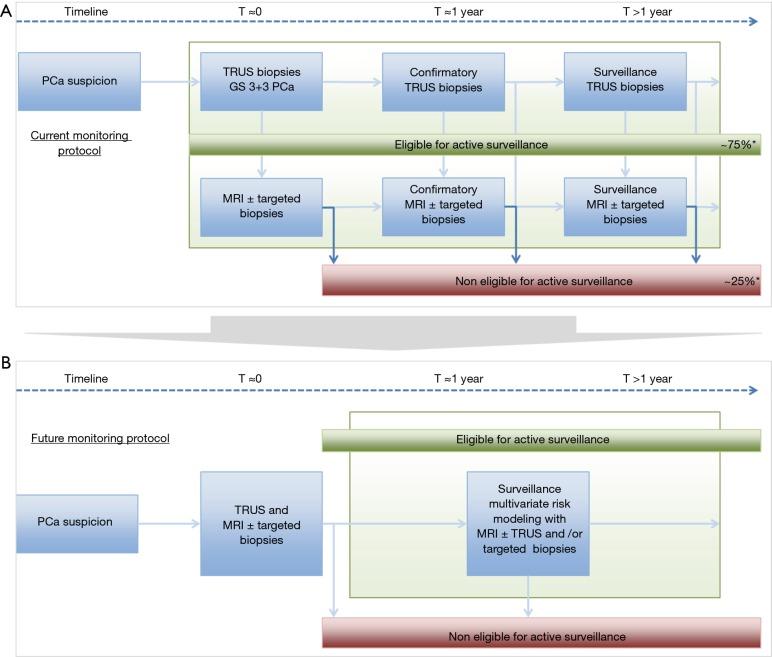
The fear of undergrading prostate cancer (PCa) in men on active surveillance (AS) have led to strict criteria for monitoring, which have resulted in good long-term cancer-specific survival, proving the safety of this approach. Reducing undergrading, MRI-targeted biopsies are increasingly used in men with low-risk disease despite their undefined role yet. The objective of this study is to investigate the rate of upgrading using MRI-targeted biopsies in men with low-risk disease on AS, stratified on the basis of PI-RADS and PSA-density, with the aim to reduce potential unnecessary repeat biopsy procedures.
METHODS
A total of 331 men were prospectively enrolled following the MRI-PRIAS protocol. MR imaging was according to Prostate Imaging Reporting and Data System (PI-RADSv2) guidelines. Suspicious MRI lesions (PI-RADS 3-5) were additionally targeted by MRI-TRUS fusion biopsies. Outcome measure was upgrading to Gleason score (GS) ≥3+4 with MRI-targeted biopsies, stratified for PI-RADS and PSA-density.
RESULTS
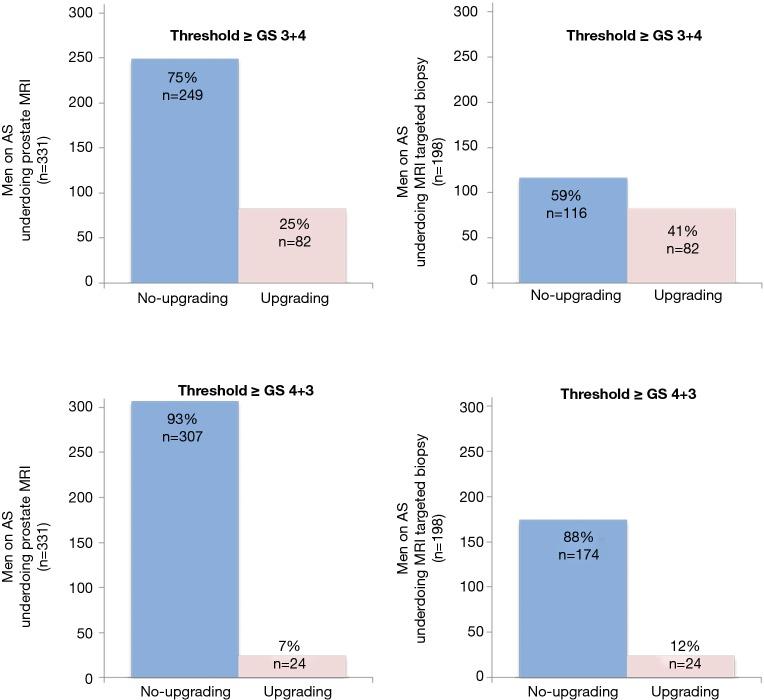
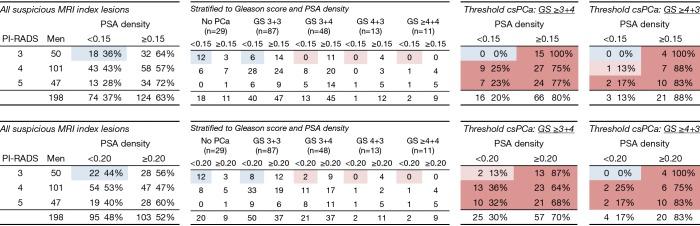
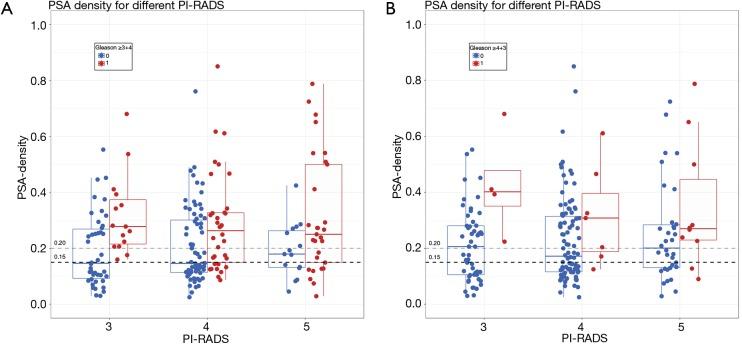
In total, 25% (82/331) of men on AS showed upgrading from GS 3+3. Only 3% (11/331) was upgraded to GS ≥8. In 60% (198/331) a suspicious MRI lesion was identified, but in only 41% (82/198) of men upgrading was confirmed. PI-RADS 3, 4 and 5 categorized index lesions, showed upgrading in 30%, 34% and 66% of men, respectively. Stratification to PI-RADS 4-5, instead of PI-RADS 3-5, would have missed a small number of high volume Gleason 4 PCa in PI-RADS 3 category. However, further stratification into PI-RADS 3 lesions and PSA-density <0.15 ng/mL could result in a safe targeted biopsy reduction of 36% in this category, without missing any upgrades.
CONCLUSIONS
Stratification with the combination of PI-RADS and PSA-density may reduce unnecessary additional MRI biopsy testing. Overall, the high rate of detected upgrading in men on AS may result in an unintended tightening of continuing in AS. Since patients, included under current AS criteria showed extremely favorable outcome, there might be no need to further restrict continuing on AS with MRI and targeted biopsies.
背景
对接受主动监测(AS)的男性前列腺癌(PCa)分级过低的担忧导致了严格的监测标准,这带来了良好的长期癌症特异性生存率,证明了这种方法的安全性。为减少分级过低的情况,MRI靶向活检越来越多地用于低风险疾病的男性患者,尽管其作用尚不明确。本研究的目的是调查在接受AS的低风险疾病男性中,使用MRI靶向活检进行升级的比率,根据前列腺影像报告和数据系统(PI-RADS)和前列腺特异抗原密度(PSA-density)进行分层,旨在减少潜在的不必要的重复活检程序。
方法
按照MRI-PRIAS方案前瞻性纳入331名男性。磁共振成像遵循前列腺影像报告和数据系统(PI-RADSv2)指南。MRI可疑病变(PI-RADS 3-5)通过MRI-超声融合活检进行额外靶向。观察指标是通过MRI靶向活检升级到Gleason评分(GS)≥3+4,并根据PI-RADS和PSA密度进行分层。
结果
总体而言,接受AS的男性中有25%(82/331)从GS 3+3升级。只有3%(11/331)升级到GS≥8。60%(198/331)的男性中发现了MRI可疑病变,但只有41%(82/198)的男性升级得到确认。PI-RADS 3、4和5对索引病变进行分类,分别有30%、34%和66%的男性出现升级。将分层标准设定为PI-RADS 4-5而非PI-RADS 3-5,会遗漏PI-RADS 3类别中少量高体积Gleason 4级PCa。然而,进一步将PI-RADS 3病变和PSA密度<0.15 ng/mL进行分层,可使该类别中安全的靶向活检减少36%,且不会遗漏任何升级情况。
结论
PI-RADS和PSA密度相结合的分层可能会减少不必要的额外MRI活检检测。总体而言,接受AS的男性中升级检测率较高可能会导致AS持续标准意外收紧。由于目前AS标准纳入的患者显示出极其良好的预后,可能无需进一步限制通过MRI和靶向活检继续进行AS。



 Zotero 插件