
越南采用持续与间歇性气管内套管压力控制预防呼吸机相关性呼吸道感染:一项随机对照试验的研究方案
Continuous versus intermittent endotracheal cuff pressure control for the prevention of ventilator-associated respiratory infections in Vietnam: study protocol for a randomised controlled trial.
作者信息
Dat Vu Quoc, Geskus Ronald B, Wolbers Marcel, Loan Huynh Thi, Yen Lam Minh, Binh Nguyen Thien, Chien Le Thanh, Mai Nguyen Thi Hoang, Phu Nguyen Hoan, Lan Nguyen Phu Huong, Hao Nguyen Van, Long Hoang Bao, Thuy Tran Phuong, Kinh Nguyen Van, Trung Nguyen Vu, Phu Vu Dinh, Cap Nguyen Trung, Trinh Dao Tuyet, Campbell James, Kestelyn Evelyne, Wertheim Heiman F L, Wyncoll Duncan, Thwaites Guy Edward, van Doorn H Rogier, Thwaites C Louise, Nadjm Behzad
机构信息
Wellcome Trust Asia Programme, Oxford University Clinical Research Unit, Hanoi, Vietnam.
Department of Infectious Diseases, Hanoi Medical University, Hanoi, Vietnam.
出版信息
Trials. 2018 Apr 4;19(1):217. doi: 10.1186/s13063-018-2587-6.
BACKGROUND
Ventilator-associated respiratory infection (VARI) comprises ventilator-associated pneumonia (VAP) and ventilator-associated tracheobronchitis (VAT). Although their diagnostic criteria vary, together these are the most common hospital-acquired infections in intensive care units (ICUs) worldwide, responsible for a large proportion of antibiotic use within ICUs. Evidence-based strategies for the prevention of VARI in resource-limited settings are lacking. Preventing the leakage of oropharyngeal secretions into the lung using continuous endotracheal cuff pressure control is a promising strategy. The aim of this study is to investigate the efficacy of automated, continuous endotracheal cuff pressure control in preventing the development of VARI and reducing antibiotic use in ICUs in Vietnam.
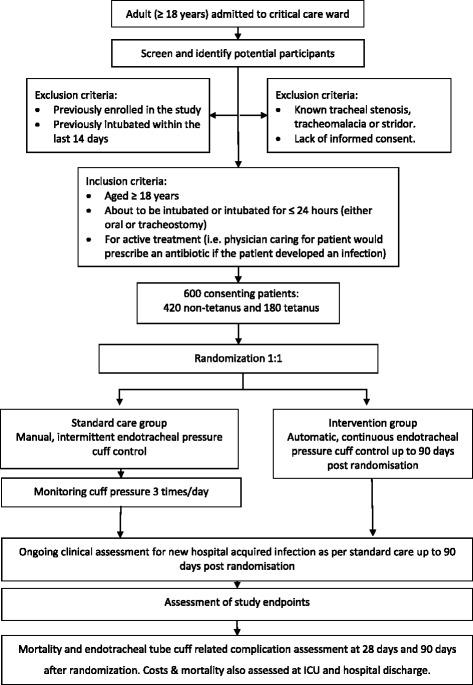
METHODS/DESIGN: This is an open-label randomised controlled multicentre trial. We will enrol 600 adult patients intubated for ≤ 24 h at the time of enrolment. Eligible patients will be stratified according to admission diagnosis (180 tetanus, 420 non-tetanus) and site and will be randomised in a 1:1 ratio to receive either (1) automated, continuous control of endotracheal cuff pressure or (2) intermittent measurement and control of endotracheal cuff pressure using a manual cuff pressure meter. The primary outcome is the occurrence of VARI, defined as either VAP or VAT during the ICU admission up to a maximum of 90 days after randomisation. Patients in both groups who are at risk for VARI will receive a standardised battery of investigations if their treating physician feels a new infection has occurred, the results of which will be used by an endpoint review committee, blinded to the allocated arm and independent of patient care, to determine the primary outcome. All enrolled patients will be followed for mortality and endotracheal tube cuff-related complications at 28 days and 90 days after randomisation. Other secondary outcomes include antibiotic use; days ventilated, in ICU and in hospital; inpatient mortality; costs of antibiotics in ICU; duration of ICU stay; and duration of hospital stay.
DISCUSSION
This study will provide high-quality evidence concerning the use of continuous endotracheal cuff pressure control as a method to reduce VARI, antibiotic use and hospitalisation costs and to shorten stay.
TRIAL REGISTRATION
ClinicalTrials.gov, NCT02966392 . Registered on November 9, 2016. Protocol version: 2.0; issue date March 3, 2017.
背景
呼吸机相关性呼吸道感染(VARI)包括呼吸机相关性肺炎(VAP)和呼吸机相关性气管支气管炎(VAT)。尽管它们的诊断标准有所不同,但二者共同构成了全球重症监护病房(ICU)中最常见的医院获得性感染,在ICU使用的抗生素中占很大比例。在资源有限的环境中,缺乏基于证据的预防VARI的策略。使用持续气管内套管压力控制来防止口咽分泌物漏入肺部是一种很有前景的策略。本研究的目的是调查自动、持续气管内套管压力控制在预防越南ICU中VARI的发生及减少抗生素使用方面的疗效。
方法/设计:这是一项开放标签的随机对照多中心试验。我们将纳入600名在入组时已插管≤24小时的成年患者。符合条件的患者将根据入院诊断(180例破伤风患者,420例非破伤风患者)和地点进行分层,并按1:1的比例随机分组,分别接受:(1)气管内套管压力的自动、持续控制;或(2)使用手动套管压力计进行气管内套管压力的间歇性测量和控制。主要结局是VARI的发生,定义为随机分组后最多90天内ICU住院期间发生的VAP或VAT。如果治疗医生认为两组中存在VARI风险的患者发生了新的感染,将接受一系列标准化检查,终点审查委员会将使用这些检查结果来确定主要结局,该委员会对分配的分组不知情且独立于患者护理。所有入组患者将在随机分组后28天和90天随访死亡率和气管导管套管相关并发症。其他次要结局包括抗生素使用情况;通气天数、ICU住院天数和住院天数;住院死亡率;ICU抗生素费用;ICU住院时间;以及住院时间。
讨论
本研究将提供关于使用持续气管内套管压力控制作为减少VARI、抗生素使用和住院费用以及缩短住院时间的方法的高质量证据。
试验注册
ClinicalTrials.gov,NCT02966392。于2016年11月9日注册。方案版本:2.0;发布日期2017年3月3日。

 Zotero 插件