
认知行为疗法与重度抑郁症和创伤后应激障碍的认知控制网络活动增强有关。
Cognitive Behavioral Therapy Is Associated With Enhanced Cognitive Control Network Activity in Major Depression and Posttraumatic Stress Disorder.
机构信息
Center for Neuromodulation in Depression and Stress, Department of Psychiatry, University of Pennsylvania, Philadelphia, Pennsylvania.
Department of Biostatistics, Epidemiology, and Informatics, University of Pennsylvania, Philadelphia, Pennsylvania.
出版信息
Biol Psychiatry Cogn Neurosci Neuroimaging. 2018 Apr;3(4):311-319. doi: 10.1016/j.bpsc.2017.12.006. Epub 2017 Dec 28.
BACKGROUND
Both major depressive disorder (MDD) and posttraumatic stress disorder (PTSD) are characterized by depressive symptoms, abnormalities in brain regions important for cognitive control, and response to cognitive behavioral therapy (CBT). However, whether a common neural mechanism underlies CBT response across diagnoses is unknown.
METHODS
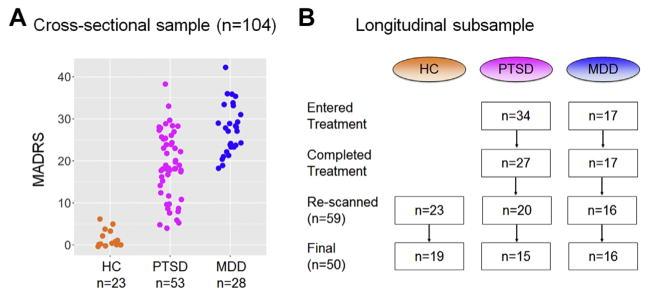
Brain activity during a cognitive control task was measured using functional magnetic resonance imaging in 104 participants: 28 patients with MDD, 53 patients with PTSD, and 23 healthy control subjects; depression and anxiety symptoms were determined on the same day. A patient subset (n = 31) entered manualized CBT and, along with controls (n = 19), was rescanned at 12 weeks. Linear mixed effects models assessed the relationship between depression and anxiety symptoms and brain activity before and after CBT.
RESULTS
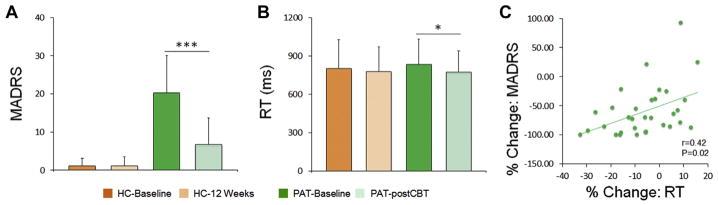
At baseline, activation of the left dorsolateral prefrontal cortex was negatively correlated with Montgomery-Åsberg Depression Rating Scale scores across all participants; this brain-symptom association did not differ between MDD and PTSD. Following CBT treatment of patients, regions within the cognitive control network, including ventrolateral prefrontal cortex and dorsolateral prefrontal cortex, showed a significant increase in activity.
CONCLUSIONS
Our results suggest that dimensional abnormalities in the activation of cognitive control regions were associated primarily with symptoms of depression (with or without controlling for anxious arousal). Furthermore, following treatment with CBT, activation of cognitive control regions was similarly increased in both MDD and PTSD. These results accord with the Research Domain Criteria conceptualization of mental disorders and implicate improved cognitive control activation as a transdiagnostic mechanism for CBT treatment outcome.
背景
重度抑郁症(MDD)和创伤后应激障碍(PTSD)的特征均为抑郁症状、对认知控制重要的大脑区域异常以及对认知行为疗法(CBT)的反应。然而,在诊断之间,CBT 反应是否存在共同的神经机制尚不清楚。
方法
使用功能磁共振成像测量了 104 名参与者在认知控制任务期间的大脑活动:28 名 MDD 患者、53 名 PTSD 患者和 23 名健康对照者;同一天确定抑郁和焦虑症状。一部分患者(n=31)接受了标准化的 CBT,与对照组(n=19)一起在 12 周时重新扫描。线性混合效应模型评估了 CBT 前后抑郁和焦虑症状与大脑活动之间的关系。
结果
在基线时,所有参与者的左背外侧前额叶皮层的激活与蒙哥马利-阿斯伯格抑郁评定量表评分呈负相关;这种大脑-症状关联在 MDD 和 PTSD 之间没有差异。在对患者进行 CBT 治疗后,认知控制网络内的区域,包括腹外侧前额叶皮层和背外侧前额叶皮层,显示出显著的活动增加。
结论
我们的结果表明,认知控制区域激活的维度异常主要与抑郁症状相关(无论是否控制焦虑唤醒)。此外,在接受 CBT 治疗后,MDD 和 PTSD 患者的认知控制区域的激活均得到类似的增加。这些结果与精神障碍的研究领域标准概念化一致,并暗示改善认知控制激活是 CBT 治疗结果的一种跨诊断机制。


 Zotero 插件