
无家可归的吸烟者在生存困难方面与戒烟障碍更多、戒断效果更差有关:来自马萨诸塞州波士顿的两项研究的证据。
Subsistence difficulties are associated with more barriers to quitting and worse abstinence outcomes among homeless smokers: evidence from two studies in Boston, Massachusetts.
机构信息
Division of General Internal Medicine, Massachusetts General Hospital, Boston, MA, USA.
Tobacco Research & Treatment Center, Massachusetts General Hospital, Boston, MA, USA.
出版信息
BMC Public Health. 2018 Apr 10;18(1):463. doi: 10.1186/s12889-018-5375-z.
BACKGROUND
Three-quarters of homeless people smoke cigarettes. Competing priorities for shelter, food, and other subsistence needs may be one explanation for low smoking cessation rates in this population. We analyzed data from two samples of homeless smokers to examine the associations between subsistence difficulties and 1) smoking cessation readiness, confidence, and barriers in a cross-sectional study, and 2) smoking abstinence during follow-up in a longitudinal study.
METHODS
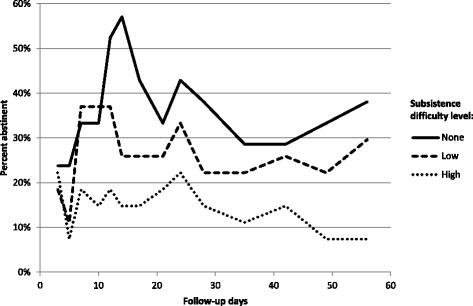
We conducted a survey of homeless smokers (N = 306) in 4/2014-7/2014 and a pilot randomized controlled trial (RCT) for homeless smokers (N = 75) in 10/2015-6/2016 at Boston Health Care for the Homeless Program. In both studies, subsistence difficulties were characterized as none, low, or high based on responses to a 5-item scale assessing the frequency of past-month difficulty finding shelter, food, clothing, a place to wash, and a place to go to the bathroom. Among survey participants, we used linear regression to assess the associations between subsistence difficulty level and readiness to quit, confidence to quit, and a composite measure of perceived barriers to quitting. Among RCT participants, we used repeated-measures logistic regression to examine the association between baseline subsistence difficulty level and carbon monoxide-defined brief smoking abstinence assessed 14 times over 8 weeks of follow-up. Analyses adjusted for demographic characteristics, substance use, mental illness, and nicotine dependence.
RESULTS
Subsistence difficulties were common in both study samples. Among survey participants, greater subsistence difficulties were associated with more perceived barriers to quitting (p < 0.001) but not with cessation readiness or confidence. A dose-response relationship was observed for most barriers, particularly psychosocial barriers. Among RCT participants, greater baseline subsistence difficulties predicted less smoking abstinence during follow-up in a dose-response fashion. In adjusted analyses, individuals with the highest level of subsistence difficulty had one-third the odds of being abstinent during follow-up compared to those without subsistence difficulties (OR 0.33, 95% CI 0.11-0.93) despite making a similar number of quit attempts.
CONCLUSIONS
Homeless smokers with greater subsistence difficulties perceive more barriers to quitting and are less likely to do so despite similar readiness, confidence, and attempts. Future studies should assess whether addressing subsistence difficulties improves cessation outcomes in this population.
TRIAL REGISTRATION
ClinicalTrials.gov: NCT02565381 .
背景
四分之三的无家可归者吸烟。在这个群体中,住房、食物和其他生存需求的优先事项相互竞争,这可能是戒烟率低的一个解释。我们分析了来自两组无家可归吸烟者的数据,以在横断面研究中检验生存困难与 1)戒烟准备、信心和障碍之间的关系,以及 2)在纵向研究中随访期间的吸烟戒断情况。
方法
我们于 2014 年 4 月至 7 月对无家可归的吸烟者(N=306)进行了一项调查,并于 2015 年 10 月至 2016 年 6 月对波士顿医疗保健无家可归计划的 75 名无家可归的吸烟者进行了一项试点随机对照试验(RCT)。在这两项研究中,生存困难程度根据过去一个月寻找住所、食物、衣物、洗澡场所和上厕所场所的困难程度来评估,使用 5 项评分来确定,分为无、低或高。在调查参与者中,我们使用线性回归来评估生存困难程度与戒烟准备、戒烟信心和戒烟障碍综合衡量标准之间的关系。在 RCT 参与者中,我们使用重复测量逻辑回归来检验基线生存困难程度与一氧化碳定义的短暂吸烟戒断之间的关系,该戒断在 8 周的随访期间通过 14 次评估。分析调整了人口统计学特征、物质使用、精神疾病和尼古丁依赖。
结果
在两个研究样本中,生存困难都很常见。在调查参与者中,更大的生存困难与更多的戒烟障碍有关(p<0.001),但与戒烟准备或信心无关。大多数障碍,尤其是心理社会障碍,观察到了剂量反应关系。在 RCT 参与者中,基线生存困难程度越高,在随访期间的吸烟戒断率越低,呈剂量反应关系。在调整分析中,与没有生存困难的人相比,生存困难程度最高的人在随访期间戒烟的可能性要低三分之一(OR 0.33,95%CI 0.11-0.93),尽管他们尝试戒烟的次数相似。
结论
生存困难较大的无家可归吸烟者戒烟时面临更多的障碍,尽管准备、信心和尝试相似,但戒烟的可能性较小。未来的研究应评估解决生存困难是否能改善该人群的戒烟效果。
试验注册
ClinicalTrials.gov:NCT02565381。


 Zotero 插件