
供体端粒长度与骨髓衰竭患者无关造血细胞移植后死亡原因。
Donor telomere length and causes of death after unrelated hematopoietic cell transplantation in patients with marrow failure.
机构信息
Clinical Genetics Branch, Division of Cancer Epidemiology and Genetics, National Cancer Institute, National Institutes of Health, Bethesda, MD.
Terry Fox Laboratory, BC Cancer Agency, Vancouver, BC, Canada.
出版信息
Blood. 2018 May 24;131(21):2393-2398. doi: 10.1182/blood-2017-10-812735. Epub 2018 Apr 9.
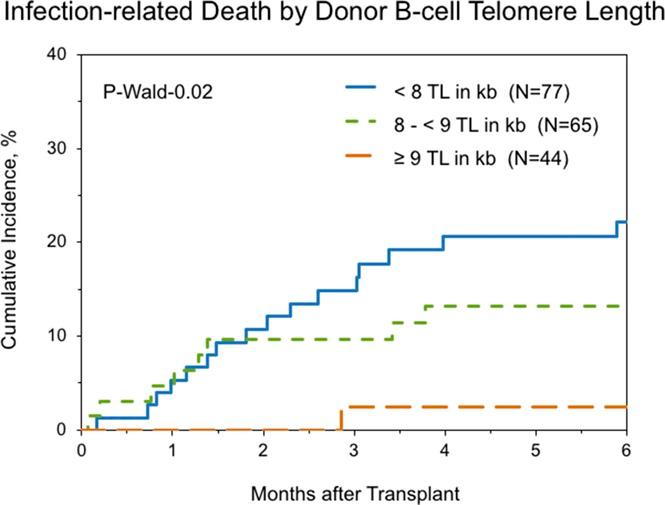
Previous studies have suggested that longer donor leukocyte telomere length (TL) is associated with improved survival after hematopoietic cell transplantation (HCT) in severe aplastic anemia (SAA). This study aimed to determine whether cell-specific lymphocyte TL is associated with certain post-HCT causes of death. We used flow cytometry and fluorescence in situ hybridization to measure TL in donor total lymphocytes and subsets: naïve enriched T cells (CD45RACD20), memory enriched T cells (CD45RACD20), natural killer (NK) fully differentiated T cells (CD45RACD57), and B cells (CD45RACD20). Competing risk survival regression was used for cause-specific death analyses. Clinical data and biospecimens were available from the Center for International Blood and Marrow Transplant Research database and biorepository. The study included 197 patients who underwent unrelated-donor HCT for SAA between 1988 and 2004. The median age at HCT was 15 years (range, 0.5-40 years), and the median follow-up was 5 years (range, <1 month to 20.7 years). Longer donor TL in all cell subsets was associated with lower risk of all-cause mortality ( < .01). In cause-specific mortality analyses, longer TL in B cells (hazard ratio [HR], 0.63; 95% confidence interval [CI], 0.46-0.87; = .006) and possibly NK fully differentiated T cells (HR, 0.7; 95% CI, 0.51 to 0.97; = .03) was associated with lower risk of infection-related death. Donor TL in other tested lymphocyte subsets was not statistically significantly associated with death resulting from graft-versus-host disease or graft failure ( > .05). However, a trend toward excess risk of graft-versus-host mortality was noted (HR for total lymphocyte TL, 1.26; = .15). In conclusion, longer donor TL was associated with reduced rate of infection-related deaths after HCT for SAA.
先前的研究表明,供体白细胞端粒长度(TL)较长与重型再生障碍性贫血(SAA)患者造血细胞移植(HCT)后生存改善有关。本研究旨在确定特定的 HCT 后死亡原因是否与细胞特异性淋巴细胞 TL 有关。我们使用流式细胞术和荧光原位杂交来测量供体总淋巴细胞和亚群中的 TL:幼稚型 T 细胞(CD45RACD20)、记忆型 T 细胞(CD45RACD20)、自然杀伤(NK)完全分化 T 细胞(CD45RACD57)和 B 细胞(CD45RACD20)。采用竞争风险生存回归分析特定原因死亡分析。临床数据和生物样本可从国际血液和骨髓移植研究中心数据库和生物库获得。该研究纳入了 197 例 1988 年至 2004 年间接受无关供体 HCT 治疗的 SAA 患者。HCT 时的中位年龄为 15 岁(范围,0.5-40 岁),中位随访时间为 5 年(范围,<1 个月至 20.7 年)。所有细胞亚群中供体 TL 较长与全因死亡率降低相关( <.01)。在特定原因死亡率分析中,B 细胞(HR,0.63;95%CI,0.46-0.87; =.006)和 NK 完全分化 T 细胞(HR,0.7;95%CI,0.51 至 0.97; =.03)中 TL 较长与感染相关死亡风险降低相关。其他测试的淋巴细胞亚群中的供体 TL 与移植物抗宿主病或移植物失败导致的死亡无统计学显著相关性( >.05)。然而,注意到移植物抗宿主病死亡率过高的趋势(总淋巴细胞 TL 的 HR,1.26; =.15)。总之,SAA 患者 HCT 后,供体 TL 较长与感染相关死亡发生率降低有关。
 Zotero 插件