
一种在大规模协作多中心研究的设计和测量中严格应用探索、准备、实施、维持(EPIS)框架的模型。
A model for rigorously applying the Exploration, Preparation, Implementation, Sustainment (EPIS) framework in the design and measurement of a large scale collaborative multi-site study.
作者信息
Becan Jennifer E, Bartkowski John P, Knight Danica K, Wiley Tisha R A, DiClemente Ralph, Ducharme Lori, Welsh Wayne N, Bowser Diana, McCollister Kathryn, Hiller Matthew, Spaulding Anne C, Flynn Patrick M, Swartzendruber Andrea, Dickson Megan F, Fisher Jacqueline Horan, Aarons Gregory A
机构信息
Institute of Behavioral Research, Texas Christian University, Box 298740, Fort Worth, TX, 76129, USA.
Department of Sociology, University of Texas at San Antonio, San Antonio, TX, USA.
出版信息
Health Justice. 2018 Apr 13;6(1):9. doi: 10.1186/s40352-018-0068-3.
BACKGROUND
This paper describes the means by which a United States National Institute on Drug Abuse (NIDA)-funded cooperative, Juvenile Justice-Translational Research on Interventions for Adolescents in the Legal System (JJ-TRIALS), utilized an established implementation science framework in conducting a multi-site, multi-research center implementation intervention initiative. The initiative aimed to bolster the ability of juvenile justice agencies to address unmet client needs related to substance use while enhancing inter-organizational relationships between juvenile justice and local behavioral health partners.
METHODS
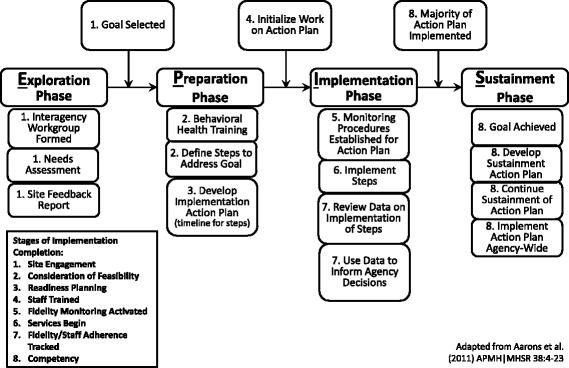
The EPIS (Exploration, Preparation, Implementation, Sustainment) framework was selected and utilized as the guiding model from inception through project completion; including the mapping of implementation strategies to EPIS stages, articulation of research questions, and selection, content, and timing of measurement protocols. Among other key developments, the project led to a reconceptualization of its governing implementation science framework into cyclical form as the EPIS Wheel. The EPIS Wheel is more consistent with rapid-cycle testing principles and permits researchers to track both progressive and recursive movement through EPIS. Moreover, because this randomized controlled trial was predicated on a bundled strategy method, JJ-TRIALS was designed to rigorously test progress through the EPIS stages as promoted by facilitation of data-driven decision making principles. The project extended EPIS by (1) elucidating the role and nature of recursive activity in promoting change (yielding the circular EPIS Wheel), (2) by expanding the applicability of the EPIS framework beyond a single evidence-based practice (EBP) to address varying process improvement efforts (representing varying EBPs), and (3) by disentangling outcome measures of progression through EPIS stages from the a priori established study timeline.
DISCUSSION
The utilization of EPIS in JJ-TRIALS provides a model for practical and applied use of implementation frameworks in real-world settings that span outer service system and inner organizational contexts in improving care for vulnerable populations.
TRIAL REGISTRATION
NCT02672150 . Retrospectively registered on 22 January 2016.
背景
本文介绍了一个由美国国立药物滥用研究所(NIDA)资助的合作项目——少年司法系统中青少年干预措施的转化研究(JJ-TRIALS),该项目如何利用一个既定的实施科学框架开展一项多地点、多研究中心的实施干预计划。该计划旨在增强少年司法机构满足与物质使用相关的未满足客户需求的能力,同时加强少年司法机构与当地行为健康合作伙伴之间的组织间关系。
方法
从项目启动到完成,选择并使用了EPIS(探索、准备、实施、维持)框架作为指导模型;包括将实施策略映射到EPIS阶段、阐述研究问题以及测量方案的选择、内容和时间安排。在其他关键进展中,该项目将其主导的实施科学框架重新概念化为循环形式,即EPIS轮。EPIS轮更符合快速循环测试原则,使研究人员能够跟踪通过EPIS的渐进和递归运动。此外,由于这项随机对照试验基于捆绑策略方法,JJ-TRIALS旨在通过促进数据驱动决策原则来严格测试在EPIS各阶段的进展情况。该项目对EPIS进行了扩展,(1)阐明递归活动在促进变革中的作用和性质(产生循环的EPIS轮),(2)将EPIS框架的适用性扩展到单一循证实践(EBP)之外,以应对不同的过程改进努力(代表不同的EBP),(3)将通过EPIS阶段的进展结果测量与预先确定的研究时间表分开。
讨论
JJ-TRIALS中对EPIS的使用为在跨越外部服务系统和内部组织环境的现实环境中实际应用实施框架以改善对弱势群体的护理提供了一个模型。
试验注册
NCT02672150。于2016年1月22日进行回顾性注册。


 Zotero 插件