
伊朗食草动物的泰勒虫病现状:系统评价与荟萃分析
Status of theileriosis among herbivores in Iran: A systematic review and meta-analysis.
作者信息
Soosaraei Masoud, Haghi Mousa Motavalli, Etemadifar Fariborz, Fakhar Mahdi, Teshnizi Saeed Hosseini, Hezarjaribi Hajar Ziaei, Asfaram Shabnam
机构信息
Student Research Committee, Department of Parasitology, School of Medicine, Mazandaran University of Medical Sciences, Sari, Iran.
Student Research Committee, Department of Parasitology and Mycology, School of Medicine, Hamadan University of Medical Sciences, Hamadan, Iran.
出版信息
Vet World. 2018 Mar;11(3):332-341. doi: 10.14202/vetworld.2018.332-341. Epub 2018 Mar 19.
AIM
Theileriosis is a protozoal disease caused by spp. mostly in warm-blooded vertebrates worldwide. It is one of the common tick-borne diseases among domestic animals in tropical and sub-tropical regions, which have a variety of unlikable effects on health economy and animal welfare. In the present study, the prevalence of theileriosis among domestic farm animals in Iran was systematically evaluated.
METHODS
To identify the related papers, 10 English and Persian databases, including PubMed, Science Direct, Scopus, Web of Science, Medical Subject Headings, Google Scholar, Magiran, Barakatns (formerly Iranmedex), Elm net, and Scientific Information Database, were appraised for articles published throughout 1999-2017.
RESULTS
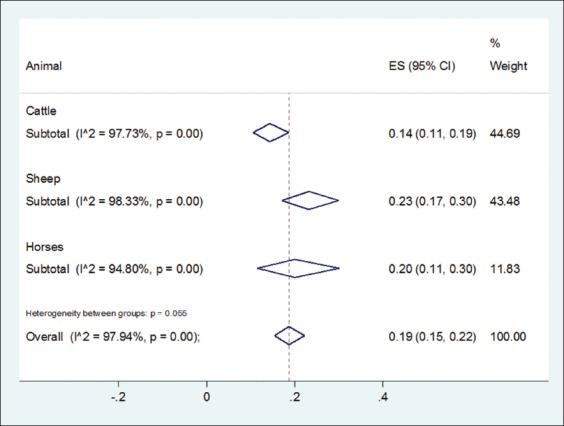
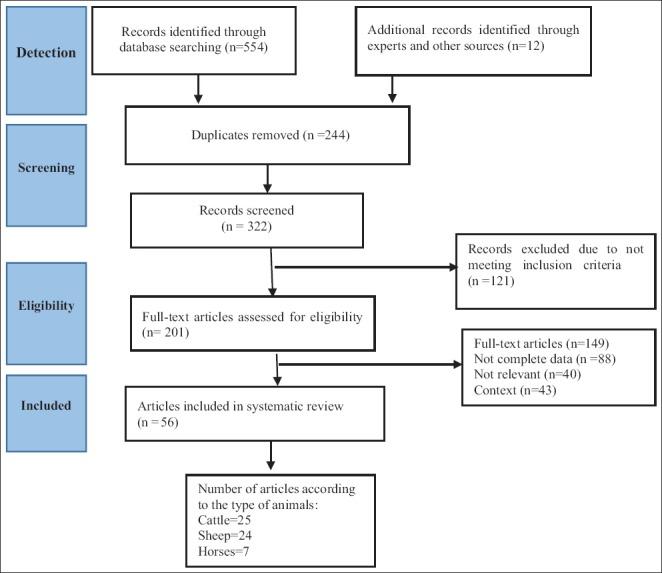
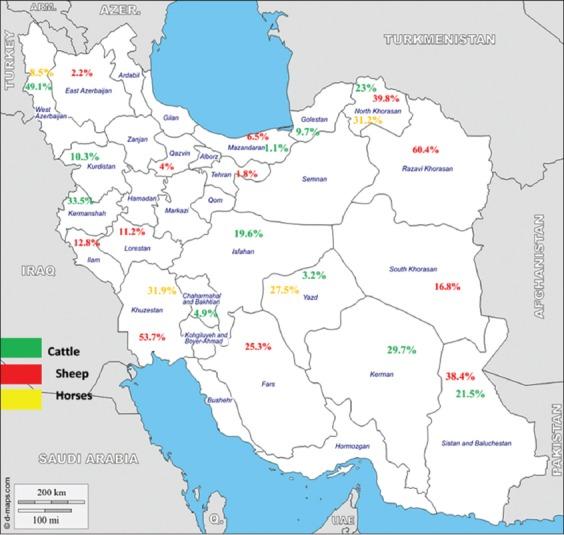
A total of 56 papers, providing the examination of 11,317 cattle, 9394 sheep, 2991 buffaloes, 1504 horses, 600 goats, and 212 donkeys were analyzed, matching for the prevalence of theileriosis from different parts of Iran were permitted for our allowing checklist. The overall prevalence of theileriosis among domestic herbivores was expected to be 19% (95% confidence interval: 15%, 22%). Our findings highlighted the average of the maximum prevalence in Razavi Khorasan (60.4%) and West Azerbaijan (49.1%) and the minimum in Mazandaran (1.1%) and East Azerbaijan provinces (2.2%), respectively. The high prevalence of infection in the herbivores (mainly sheep) verifies the well-known enzootic episode of theileriosis in Iran, predominantly in northeastern and western parts of the country.
CONCLUSION
Our results suggested updated and imperative information on the true burden of theileriosis in Iran. Moreover, it could be supporting the gaps among monitoring, prevention, and control arrangements to improve the health economy, particularly among dairy farm animals.
目的
泰勒虫病是一种由泰勒虫属原虫引起的疾病,主要感染全球范围内的温血脊椎动物。它是热带和亚热带地区家畜中常见的蜱传疾病之一,对健康、经济和动物福利有多种不良影响。在本研究中,系统评估了伊朗家养农场动物中泰勒虫病的流行情况。
方法
为识别相关论文,对10个英文和波斯文数据库进行了评估,包括PubMed、Science Direct、Scopus、Web of Science、医学主题词表、谷歌学术、Magiran、Barakatns(原Iranmedex)、Elm net和科学信息数据库,以查找1999年至2017年期间发表的文章。
结果
共分析了56篇论文,这些论文对11317头牛、9394只羊、2991头水牛、1504匹马、600只山羊和212头驴进行了检测,符合我们允许清单的来自伊朗不同地区的泰勒虫病流行率匹配情况。预计家养食草动物中泰勒虫病的总体流行率为19%(95%置信区间:15%,22%)。我们的研究结果突出显示,拉扎维霍拉桑省(60.4%)和西阿塞拜疆省(49.1%)的最高流行率平均值分别为最高,而马赞德兰省(1.1%)和东阿塞拜疆省(2.2%)的最低。食草动物(主要是绵羊)中感染的高流行率证实了伊朗泰勒虫病众所周知的地方流行情况,主要在该国的东北部和西部。
结论
我们的结果提供了有关伊朗泰勒虫病实际负担的最新且必要的信息。此外,它可以支持监测、预防和控制安排之间的差距,以改善健康经济,特别是在奶牛场动物中。
 Zotero 插件