
用于诊断胰腺导管腺癌的可能分子标志物。
Possible Molecular Markers for the Diagnosis of Pancreatic Ductal Adenocarcinoma.
机构信息
Department of Hepatobiliary Pancreatic Surgery, Henan Provincial People's Hospital, Zhengzhou, Henan, China (mainland).
出版信息
Med Sci Monit. 2018 Apr 19;24:2368-2376. doi: 10.12659/msm.906313.
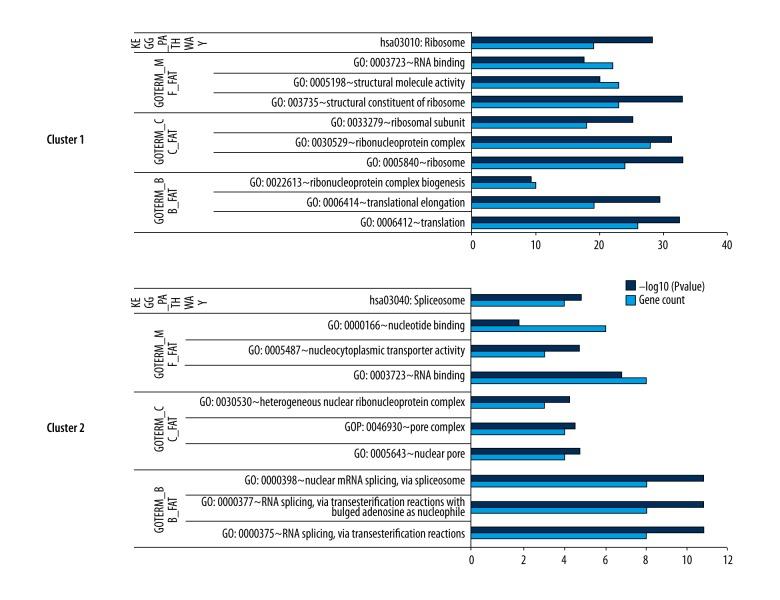
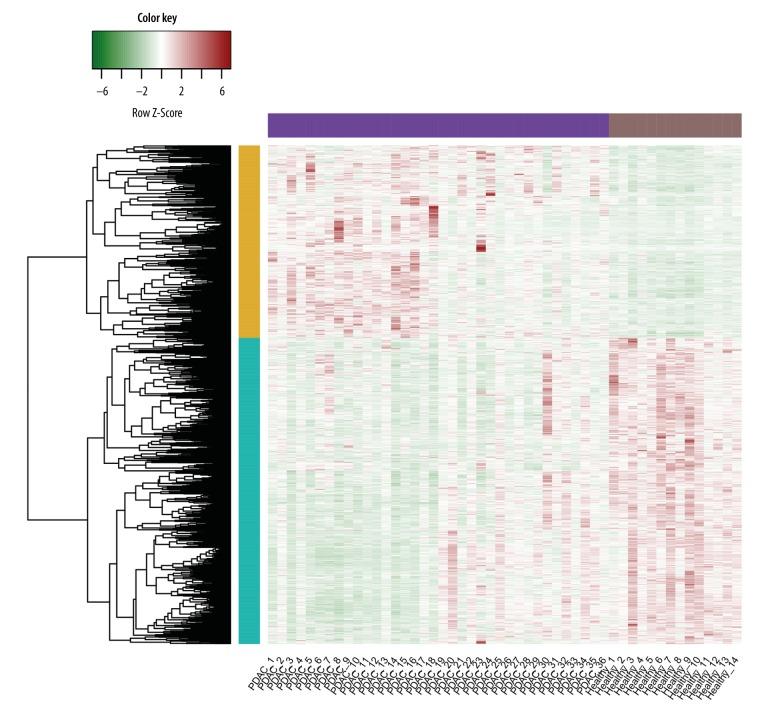
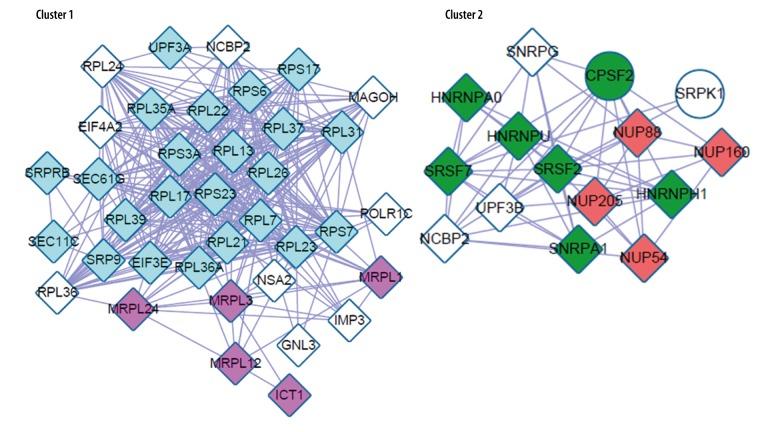
BACKGROUND We aimed to identify pivotal genes and pathways involved in pancreatic ductal adenocarcinoma (PDAC), and explore possible molecular markers for the early diagnosis of the disease. MATERIAL AND METHODS The array data of GSE74629, including 34 PDAC samples and 16 healthy samples, was downloaded from GEO (Gene Expression Omnibus) database. Then, the DEGs (differentially expressed genes) in PDAC samples were compared with healthy samples using limma (linear models for microarray). Gene functional interaction networks were analyzed with Cytoscape and ReactomeFIViz. PPI networks were constructed with Cytoscape software. In addition, PPI (protein-protein interaction) network clustering modules were analyzed with ClusterONE, and the KEGG (Kyoto Encyclopedia of Genes and Genomes) pathway enrichment analyses for modules were performed. RESULTS A total of 630 upregulated and 1,002 downregulated DEGs were identified in PDAC samples compared with healthy samples. Some ribosomal protein genes with higher average correlation in module 0 were enriched in the ribosome pathway. NUP107 (nucleoporin 107 kDa) and NUP160 (nucleoporin 160 kDa) were enriched in module 3. HNRNPU (heterogeneous nuclear ribonucleoprotein U) with higher average correlation in module 8 was enriched in the spliceosome pathway. The ribosome pathway and the spliceosome pathway were significantly enriched in cluster 1 and cluster 2, respectively. CONCLUSIONS Ribosomal protein genes Nup170, Nup160, and HNRNPU, and the ribosome pathway as well as the spliceosome pathway may play important roles in PDAC progression. In addition, ribosomal protein genes Nup170, Nup160, and HNRNPU may be used as possible molecular markers for the early diagnosis of the disease.
背景
本研究旨在鉴定胰腺癌(PDAC)相关的关键基因和通路,并探索该疾病早期诊断的潜在分子标志物。
材料与方法
从 GEO(基因表达综合数据库)数据库中下载了包含 34 个 PDAC 样本和 16 个健康样本的 GSE74629 芯片数据集。然后,使用 limma(线性模型用于微阵列)比较 PDAC 样本和健康样本中的差异表达基因(DEGs)。使用 Cytoscape 和 ReactomeFIViz 分析基因功能互作网络。使用 Cytoscape 软件构建 PPI 网络。此外,使用 ClusterONE 分析 PPI 网络聚类模块,并对模块进行京都基因与基因组百科全书(KEGG)通路富集分析。
结果
与健康样本相比,PDAC 样本中共有 630 个上调和 1002 个下调的 DEGs。模块 0 中平均相关性较高的一些核糖体蛋白基因富集在核糖体通路中。模块 3 中富集了核孔蛋白 107kDa(NUP107)和核孔蛋白 160kDa(NUP160)。模块 8 中平均相关性较高的异质核核糖核蛋白 U(HNRNPU)在剪接体通路中富集。核糖体通路和剪接体通路分别在聚类 1 和聚类 2 中显著富集。
结论
核糖体蛋白基因 Nup170、Nup160 和 HNRNPU,以及核糖体通路和剪接体通路可能在 PDAC 进展中发挥重要作用。此外,核糖体蛋白基因 Nup170、Nup160 和 HNRNPU 可能作为该疾病早期诊断的潜在分子标志物。


 Zotero 插件