
8 岁儿童自闭症谱系障碍患病率 - 自闭症及发育障碍监测网,美国 11 个监测点,2014 年。
Prevalence of Autism Spectrum Disorder Among Children Aged 8 Years - Autism and Developmental Disabilities Monitoring Network, 11 Sites, United States, 2014.
出版信息
MMWR Surveill Summ. 2018 Apr 27;67(6):1-23. doi: 10.15585/mmwr.ss6706a1.
PROBLEM/CONDITION: Autism spectrum disorder (ASD).
PERIOD COVERED
DESCRIPTION OF SYSTEM
The Autism and Developmental Disabilities Monitoring (ADDM) Network is an active surveillance system that provides estimates of the prevalence of autism spectrum disorder (ASD) among children aged 8 years whose parents or guardians reside within 11 ADDM sites in the United States (Arizona, Arkansas, Colorado, Georgia, Maryland, Minnesota, Missouri, New Jersey, North Carolina, Tennessee, and Wisconsin). ADDM surveillance is conducted in two phases. The first phase involves review and abstraction of comprehensive evaluations that were completed by professional service providers in the community. Staff completing record review and abstraction receive extensive training and supervision and are evaluated according to strict reliability standards to certify effective initial training, identify ongoing training needs, and ensure adherence to the prescribed methodology. Record review and abstraction occurs in a variety of data sources ranging from general pediatric health clinics to specialized programs serving children with developmental disabilities. In addition, most of the ADDM sites also review records for children who have received special education services in public schools. In the second phase of the study, all abstracted information is reviewed systematically by experienced clinicians to determine ASD case status. A child is considered to meet the surveillance case definition for ASD if he or she displays behaviors, as described on one or more comprehensive evaluations completed by community-based professional providers, consistent with the Diagnostic and Statistical Manual of Mental Disorders, Fourth Edition, Text Revision (DSM-IV-TR) diagnostic criteria for autistic disorder; pervasive developmental disorder-not otherwise specified (PDD-NOS, including atypical autism); or Asperger disorder. This report provides updated ASD prevalence estimates for children aged 8 years during the 2014 surveillance year, on the basis of DSM-IV-TR criteria, and describes characteristics of the population of children with ASD. In 2013, the American Psychiatric Association published the Diagnostic and Statistical Manual of Mental Disorders, Fifth Edition (DSM-5), which made considerable changes to ASD diagnostic criteria. The change in ASD diagnostic criteria might influence ADDM ASD prevalence estimates; therefore, most (85%) of the records used to determine prevalence estimates based on DSM-IV-TR criteria underwent additional review under a newly operationalized surveillance case definition for ASD consistent with the DSM-5 diagnostic criteria. Children meeting this new surveillance case definition could qualify on the basis of one or both of the following criteria, as documented in abstracted comprehensive evaluations: 1) behaviors consistent with the DSM-5 diagnostic features; and/or 2) an ASD diagnosis, whether based on DSM-IV-TR or DSM-5 diagnostic criteria. Stratified comparisons of the number of children meeting either of these two case definitions also are reported.
RESULTS
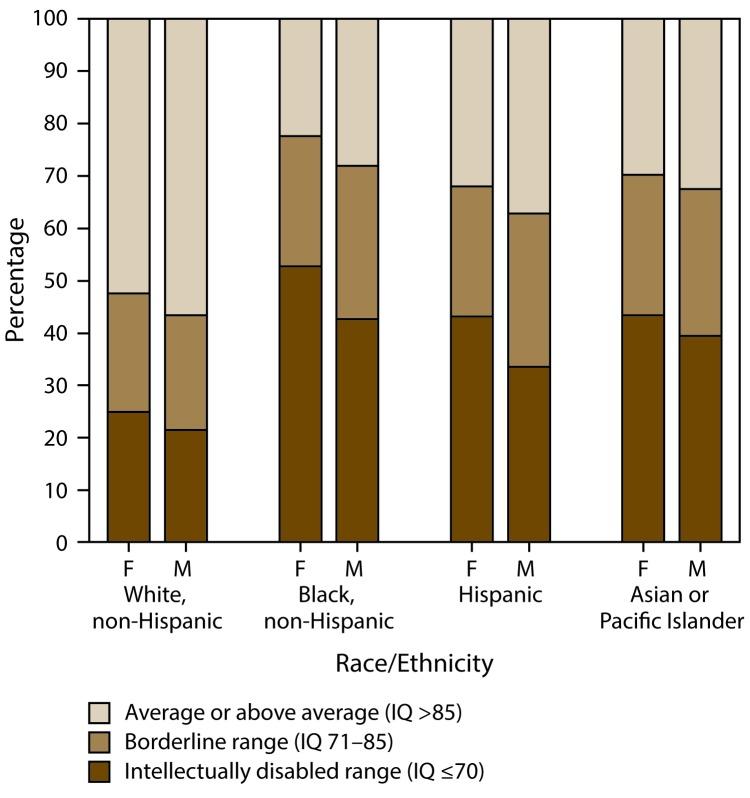
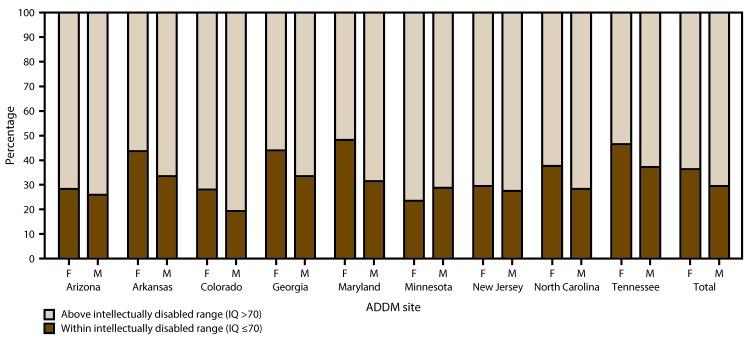
For 2014, the overall prevalence of ASD among the 11 ADDM sites was 16.8 per 1,000 (one in 59) children aged 8 years. Overall ASD prevalence estimates varied among sites, from 13.1-29.3 per 1,000 children aged 8 years. ASD prevalence estimates also varied by sex and race/ethnicity. Males were four times more likely than females to be identified with ASD. Prevalence estimates were higher for non-Hispanic white (henceforth, white) children compared with non-Hispanic black (henceforth, black) children, and both groups were more likely to be identified with ASD compared with Hispanic children. Among the nine sites with sufficient data on intellectual ability, 31% of children with ASD were classified in the range of intellectual disability (intelligence quotient [IQ] <70), 25% were in the borderline range (IQ 71-85), and 44% had IQ scores in the average to above average range (i.e., IQ >85). The distribution of intellectual ability varied by sex and race/ethnicity. Although mention of developmental concerns by age 36 months was documented for 85% of children with ASD, only 42% had a comprehensive evaluation on record by age 36 months. The median age of earliest known ASD diagnosis was 52 months and did not differ significantly by sex or race/ethnicity. For the targeted comparison of DSM-IV-TR and DSM-5 results, the number and characteristics of children meeting the newly operationalized DSM-5 case definition for ASD were similar to those meeting the DSM-IV-TR case definition, with DSM-IV-TR case counts exceeding DSM-5 counts by less than 5% and approximately 86% overlap between the two case definitions (kappa = 0.85).
INTERPRETATION
Findings from the ADDM Network, on the basis of 2014 data reported from 11 sites, provide updated population-based estimates of the prevalence of ASD among children aged 8 years in multiple communities in the United States. The overall ASD prevalence estimate of 16.8 per 1,000 children aged 8 years in 2014 is higher than previously reported estimates from the ADDM Network. Because the ADDM sites do not provide a representative sample of the entire United States, the combined prevalence estimates presented in this report cannot be generalized to all children aged 8 years in the United States. Consistent with reports from previous ADDM surveillance years, findings from 2014 were marked by variation in ASD prevalence when stratified by geographic area, sex, and level of intellectual ability. Differences in prevalence estimates between black and white children have diminished in most sites, but remained notable for Hispanic children. For 2014, results from application of the DSM-IV-TR and DSM-5 case definitions were similar, overall and when stratified by sex, race/ethnicity, DSM-IV-TR diagnostic subtype, or level of intellectual ability.
PUBLIC HEALTH ACTION
Beginning with surveillance year 2016, the DSM-5 case definition will serve as the basis for ADDM estimates of ASD prevalence in future surveillance reports. Although the DSM-IV-TR case definition will eventually be phased out, it will be applied in a limited geographic area to offer additional data for comparison. Future analyses will examine trends in the continued use of DSM-IV-TR diagnoses, such as autistic disorder, PDD-NOS, and Asperger disorder in health and education records, documentation of symptoms consistent with DSM-5 terminology, and how these trends might influence estimates of ASD prevalence over time. The latest findings from the ADDM Network provide evidence that the prevalence of ASD is higher than previously reported estimates and continues to vary among certain racial/ethnic groups and communities. With prevalence of ASD ranging from 13.1 to 29.3 per 1,000 children aged 8 years in different communities throughout the United States, the need for behavioral, educational, residential, and occupational services remains high, as does the need for increased research on both genetic and nongenetic risk factors for ASD.
问题/状况:自闭症谱系障碍(ASD)。
涵盖时期
2014 年。
描述
自闭症和发育障碍监测(ADDM)网络是一个主动监测系统,为美国 11 个 ADDM 地点(亚利桑那州、阿肯色州、科罗拉多州、佐治亚州、马里兰州、明尼苏达州、密苏里州、新泽西州、北卡罗来纳州、田纳西州和威斯康星州)的 8 岁儿童自闭症谱系障碍(ASD)的患病率提供估计。ADDM 监测分两个阶段进行。第一阶段涉及对社区专业服务提供者完成的全面评估进行审查和摘录。完成记录审查和摘录的工作人员接受广泛的培训和监督,并根据严格的可靠性标准进行评估,以证明有效的初始培训、确定持续的培训需求,并确保遵守规定的方法。记录审查和摘录发生在各种数据源中,从一般儿科保健诊所到专门为发育障碍儿童服务的项目。此外,大多数 ADDM 地点还审查在公立学校接受特殊教育服务的儿童的记录。在研究的第二阶段,所有摘录的信息都由经验丰富的临床医生进行系统审查,以确定 ASD 病例状态。如果他或她在社区专业提供者完成的一项或多项全面评估中表现出与自闭症诊断标准相符的行为,那么儿童被认为符合 ASD 的监测病例定义;广泛性发育障碍-未特定(PDD-NOS,包括非典型自闭症);或阿斯伯格障碍。本报告根据 DSM-IV-TR 标准提供了 2014 年监测年度自闭症谱系障碍儿童的最新患病率估计,并描述了自闭症谱系障碍儿童的人口特征。2013 年,美国精神病学协会出版了《精神疾病诊断与统计手册》第五版(DSM-5),该手册对自闭症谱系障碍的诊断标准进行了重大修改。DSM-5 诊断标准的改变可能会影响 ADDM 自闭症谱系障碍的患病率估计;因此,大多数(85%)用于确定基于 DSM-IV-TR 标准的患病率估计的记录根据与 DSM-5 诊断标准一致的新操作化的自闭症谱系障碍监测病例定义进行了额外审查。符合这一新监测病例定义的儿童可能符合以下标准之一:1)符合 DSM-5 诊断特征的行为;和/或 2)自闭症诊断,无论基于 DSM-IV-TR 还是 DSM-5 诊断标准。还报告了这两个病例定义中任何一个的儿童数量的分层比较。
结果
2014 年,11 个 ADDM 地点的自闭症谱系障碍总体患病率为每 1000 名 8 岁儿童 16.8 例(每 59 名儿童中有 1 例)。站点之间的 ASD 患病率估计存在差异,从每 1000 名 8 岁儿童 13.1-29.3 例不等。自闭症谱系障碍的患病率估计也因性别和种族/族裔而异。男性被诊断为自闭症的可能性是女性的四倍。与非西班牙裔黑人(以下简称黑人)儿童相比,白人(以下简称白人)儿童的患病率更高,与西班牙裔儿童相比,这两个群体被诊断为自闭症的可能性更大。在九个有足够智力能力数据的地点中,31%的自闭症谱系障碍儿童被归类为智力残疾(智商[IQ]<70),25%的儿童处于边缘智力范围(IQ71-85),44%的儿童智商得分在平均到高于平均范围(即 IQ>85)。智力能力的分布因性别和种族/族裔而异。尽管 85%的自闭症谱系障碍儿童在 36 个月大时都有发育问题的记录,但只有 42%的儿童在 36 个月时有全面的评估记录。最早已知的自闭症谱系障碍诊断的中位年龄为 52 个月,性别和种族/族裔之间没有显著差异。对于 DSM-IV-TR 和 DSM-5 结果的针对性比较,符合新操作化的 DSM-5 自闭症谱系障碍病例定义的儿童的数量和特征与符合 DSM-IV-TR 病例定义的儿童相似,DSM-IV-TR 病例计数比 DSM-5 病例计数少不到 5%,并且两个病例定义之间有大约 86%的重叠(kappa=0.85)。
解释
来自 11 个地点的 2014 年数据的 ADDM 网络的结果提供了美国多个社区 8 岁儿童自闭症谱系障碍的最新基于人群的患病率估计。2014 年每 1000 名 8 岁儿童自闭症谱系障碍的总体患病率为 16.8,高于之前来自 ADDM 网络的报告。由于 ADDM 地点不能代表整个美国的代表性样本,因此本报告中提出的综合患病率估计不能推广到美国所有 8 岁儿童。与之前的 ADDM 监测年度的报告一致,2014 年的发现以地理区域、性别和智力能力水平分层时自闭症谱系障碍的患病率存在差异为特征。黑人和白人儿童之间的患病率差异在大多数地点有所缩小,但在西班牙裔儿童中仍很明显。对于 2014 年,DSM-IV-TR 和 DSM-5 病例定义的应用结果总体上以及按性别、种族/族裔、DSM-IV-TR 诊断亚型或智力能力水平分层时相似。
公共卫生行动
从 2016 年监测年开始,DSM-5 病例定义将成为未来监测报告中自闭症谱系障碍患病率的 ADDM 估计依据。尽管 DSM-IV-TR 病例定义最终将被逐步淘汰,但它将在一个有限的地理区域内应用,以提供比较的额外数据。未来的分析将研究在健康和教育记录中继续使用 DSM-IV-TR 诊断(如自闭症、PDD-NOS 和阿斯伯格障碍)、DSM-5 术语记录的症状以及这些趋势如何随时间影响自闭症谱系障碍患病率的趋势。ADDM 网络的最新发现提供了证据,表明自闭症的患病率高于之前的报告,并继续在某些种族/族裔群体和社区之间存在差异。在美国各地不同社区,自闭症谱系障碍的患病率从每 1000 名 8 岁儿童 13.1 到 29.3 不等,因此,包括行为、教育、居住和职业服务在内的需求仍然很高,对自闭症谱系障碍的遗传和非遗传风险因素的研究也需要增加。
 Zotero 插件