
RAS/BRAF 循环肿瘤 DNA 突变作为预测转移性结直肠癌患者一线化疗反应的标志物。
RAS/BRAF Circulating Tumor DNA Mutations as a Predictor of Response to First-Line Chemotherapy in Metastatic Colorectal Cancer Patients.
机构信息
Department of Oncology, Beijing Chao-Yang Hospital, Capital Medical University, Beijing, China.
Beijing Novogene Bioinformatics Technology Co., Ltd., Beijing, China.
出版信息
Can J Gastroenterol Hepatol. 2018 Mar 7;2018:4248971. doi: 10.1155/2018/4248971. eCollection 2018.
BACKGROUND
Since circulating tumor DNA (ctDNA) offers clear advantages as a minimally invasive method for tumor monitoring compared with tumor tissue, we aimed to evaluate genotyping ctDNA using a next-generation sequencing- (NGS-) based panel to identify the prognostic value of mutation status in metastatic colorectal cancer (mCRC) patients with primary tumor resected and with subsequent lines of treatment in this study.
METHODS
76 mCRC patients treated in Beijing Chao-Yang Hospital from 2011 to 2017 were enrolled. Genotyping of RAS/BRAF in tumor tissue and ctDNA was determined by ARMS PCR and with a 40-gene panel using NGS, respectively. Patient clinicopathologic features and RAS/BRAF gene mutation status were evaluated by survival analysis for disease-free survival (DFS) and progression-free survival (PFS).
RESULTS
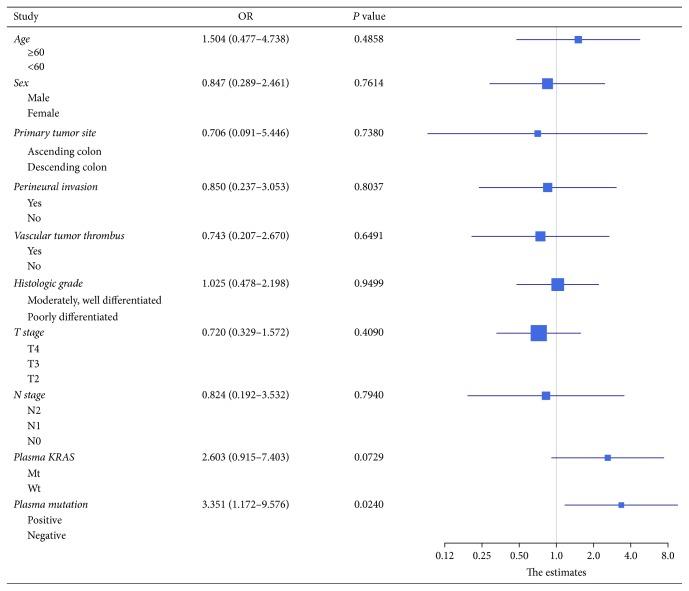
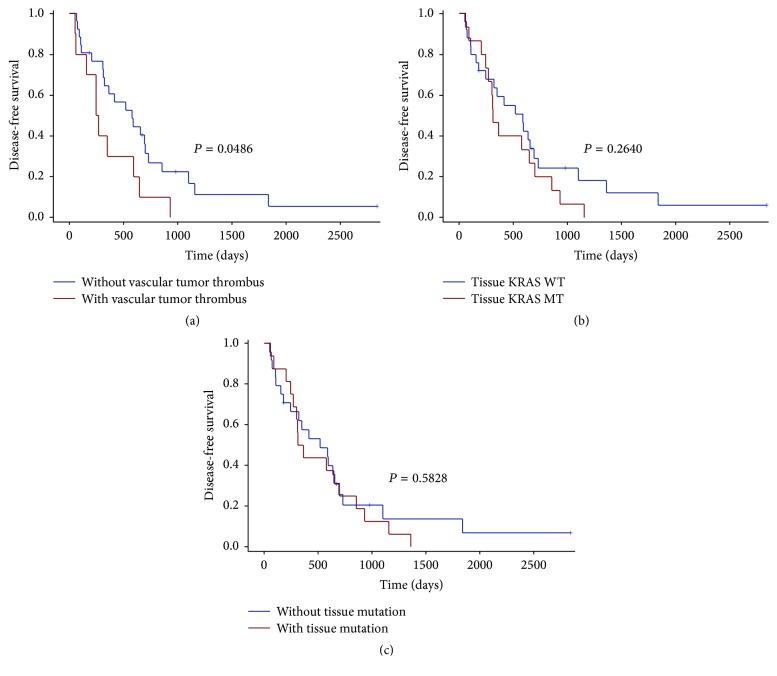
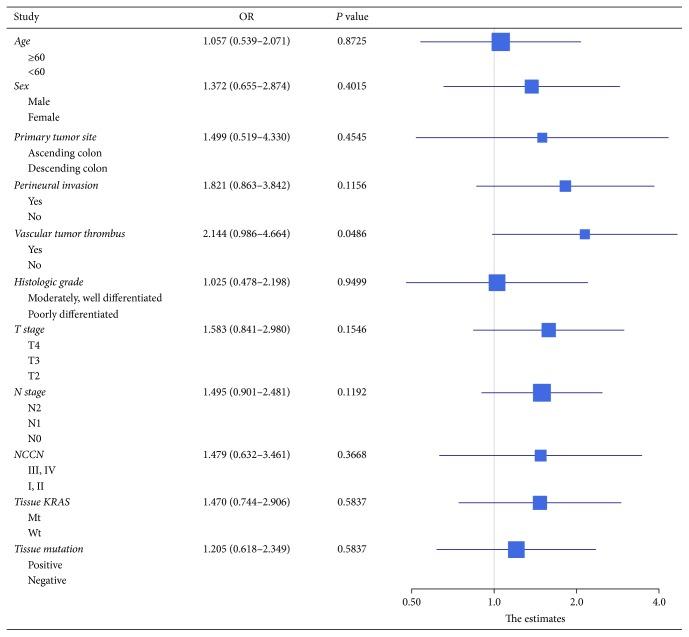
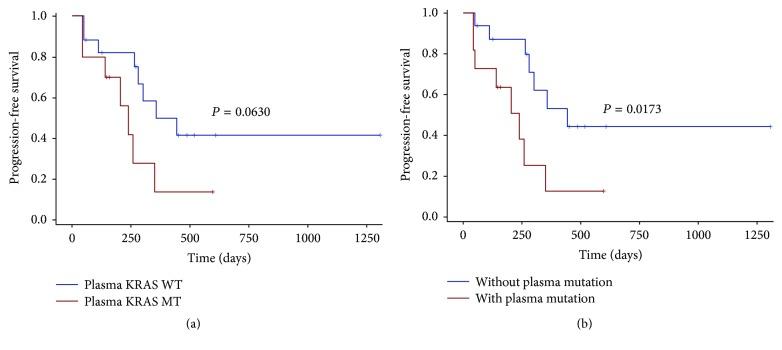
Among 76 patients, KRAS distributions were not significantly correlated with any clinicopathologic features. The concordance between tumor tissue and ctDNA KRAS mutation was 81.25%. Mutations of RAS/BRAF had no significant impact on DFS after surgery (hazard ratio (HR), 1.205; 95% CI, 0.618 to 2.349; = 0.5837) but prognosticated poorer PFS in subsequent first-line therapy (HR, 3.351; 95% CI, 1.172 to 9.576; = 0.024).
CONCLUSION
ctDNA was comparable with tumor tissue for mutation detection. RAS/BRAF mutations detected in ctDNA predict a worse PFS in mCRC patients with first-line chemotherapy. Our results provide support for the prognostic value of RAS/BRAF ctDNA mutation detection in mCRC patients.
背景
与肿瘤组织相比,循环肿瘤 DNA(ctDNA)作为一种微创的肿瘤监测方法具有明显优势,因此,我们旨在评估使用基于下一代测序(NGS)的panel 对 ctDNA 进行基因分型,以确定本研究中接受过原发肿瘤切除和后续治疗的转移性结直肠癌(mCRC)患者的突变状态的预后价值。
方法
本研究纳入了 2011 年至 2017 年在北京朝阳医院治疗的 76 例 mCRC 患者。采用 ARMS-PCR 和 NGS 40 基因 panel 分别对肿瘤组织和 ctDNA 中的 RAS/BRAF 进行基因分型。通过生存分析评估患者的临床病理特征和 RAS/BRAF 基因突变状态,以评估无病生存期(DFS)和无进展生存期(PFS)。
结果
在 76 例患者中,KRAS 分布与任何临床病理特征均无显著相关性。肿瘤组织和 ctDNA 中 KRAS 突变的一致性为 81.25%。RAS/BRAF 突变对手术后的 DFS 没有显著影响(风险比(HR),1.205;95%置信区间,0.618 至 2.349;P=0.5837),但在后续一线治疗中预后更差的 PFS(HR,3.351;95%置信区间,1.172 至 9.576;P=0.024)。
结论
ctDNA 与肿瘤组织相比可用于检测突变。ctDNA 中检测到的 RAS/BRAF 突变预测 mCRC 患者接受一线化疗时 PFS 更差。我们的结果为 mCRC 患者中 RAS/BRAF ctDNA 突变检测的预后价值提供了支持。

 Zotero 插件