
(S)WASH-D 驱虫:一项针对学校和社区综合控制方案对肠道蠕虫病的差异影响的试点研究。
(S)WASH-D for Worms: A pilot study investigating the differential impact of school- versus community-based integrated control programs for soil-transmitted helminths.
机构信息
Research School of Population Health, Australian National University, Canberra, Australia.
QIMR Berghofer Medical Research Institute, Brisbane, Australia.
出版信息
PLoS Negl Trop Dis. 2018 May 3;12(5):e0006389. doi: 10.1371/journal.pntd.0006389. eCollection 2018 May.
BACKGROUND
Soil-transmitted helminths (STH) infect nearly 1.5 billion individuals globally, and contribute to poor physical and cognitive development in children. STH control programs typically consist of regular delivery of anthelminthic drugs, targeting school-aged children. Expanding STH control programs community-wide may improve STH control among school-aged children, and combining deworming with improvements to water, sanitation and hygiene (WASH) may further reduce transmission. The (S)WASH-D for Worms pilot study aims to compare the differential impact of integrated WASH and deworming programs when implemented at primary schools only versus when additionally implemented community-wide.
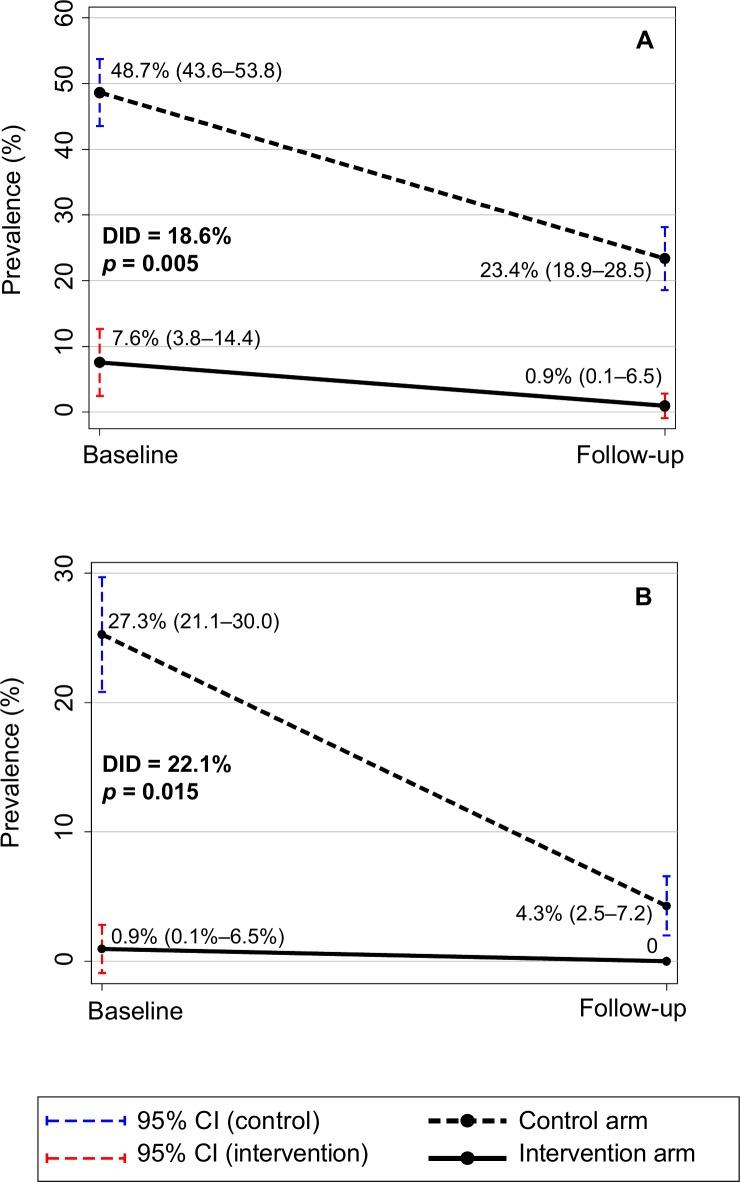
METHODOLOGY/PRINCIPAL FINDINGS: A two-arm, non-randomized cluster intervention study was conducted. Six communities were identified by partner WASH agencies and enrolled in the study. All communities received a school-based WASH and deworming program, while three additionally received a community-based WASH and deworming program. STH infections were measured in school-aged children at baseline and six months after deworming. Over 90% of eligible children were recruited for the study, of whom 92.3% provided stool samples at baseline and 88.9% at follow-up. The school WASH intervention improved school sanitation, while the community WASH intervention reduced open defecation from 50.4% (95% CI 41.8-59.0) to 23.5% (95% CI 16.7-32.0). There was a trend towards reduced odds of N. americanus infection among children who received the community-wide intervention (OR 0.42, 95% CI 0.07-2.36, p = 0.32).
CONCLUSIONS
This pilot study provides proof of principle for testing the hypothesis that community-wide STH control programs have a greater impact on STH infections among children than school-based programs, and supports the rationale for conducting a full-scale cluster randomized controlled trial. High recruitment and participation rates and successful implementation of school WASH programs demonstrate study feasibility and acceptability. However, eliminating open defecation remains a challenge; ongoing work is required to develop community sanitation programs that achieve high and sustainable latrine coverage.
TRIAL REGISTRATION
Australian New Zealand Clinical Trials Registry (ANZCTR) ACTRN12615001012561.
背景
土壤传播的蠕虫(STH)感染了全球近 15 亿人,导致儿童身体和认知发育不良。STH 控制计划通常包括定期为学龄儿童提供驱虫药物。在社区范围内扩大 STH 控制计划可能会改善学龄儿童的 STH 控制效果,并且将驱虫与改善水、环境卫生和个人卫生(WASH)相结合可能会进一步减少传播。(S)WASH-D for Worms 试点研究旨在比较仅在小学实施综合 WASH 和驱虫计划与在社区范围内额外实施时的差异影响。
方法/主要发现:进行了一项双臂、非随机群组干预研究。合作伙伴 WASH 机构确定了六个社区并将其纳入研究。所有社区都接受了以学校为基础的 WASH 和驱虫计划,而其中三个社区还接受了以社区为基础的 WASH 和驱虫计划。在基线和驱虫后六个月测量学龄儿童的 STH 感染情况。超过 90%的符合条件的儿童被招募参加了这项研究,其中 92.3%的儿童提供了基线时的粪便样本,88.9%的儿童在随访时提供了粪便样本。学校 WASH 干预措施改善了学校环境卫生,而社区 WASH 干预措施将露天排便从 50.4%(95%CI 41.8-59.0)减少到 23.5%(95%CI 16.7-32.0)。接受社区范围干预的儿童中,感染 N. americanus 的几率呈下降趋势(OR 0.42,95%CI 0.07-2.36,p = 0.32)。
结论
这项试点研究为测试以下假设提供了初步证据,即社区范围内的 STH 控制计划对儿童 STH 感染的影响大于以学校为基础的计划,并且支持开展全面的群组随机对照试验的理由。高招募和参与率以及成功实施学校 WASH 计划表明了研究的可行性和可接受性。然而,消除露天排便仍然是一个挑战;需要继续努力制定社区卫生计划,以实现高且可持续的厕所覆盖率。
试验注册
澳大利亚新西兰临床试验注册中心(ANZCTR)ACTRN12615001012561。


 Zotero 插件