
一项关于新生儿耐甲氧西林金黄色葡萄球菌携带情况的前瞻性队列研究:母亲携带情况以及表型和分子特征的作用
A prospective cohort study of and methicillin-resistant carriage in neonates: the role of maternal carriage and phenotypic and molecular characteristics.
作者信息
Lin Jialing, Wu Chuanan, Yan Chunrong, Ou Qianting, Lin Dongxin, Zhou Junli, Ye Xiaohua, Yao Zhenjiang
机构信息
Department of Epidemiology and Health Statistics, School of Public Health, Guangdong Pharmaceutical University, Guangzhou, China.
Maternal and Child Health Care Center of Longhua District, Shenzhen, China.
出版信息
Infect Drug Resist. 2018 Apr 24;11:555-565. doi: 10.2147/IDR.S157522. eCollection 2018.
BACKGROUND
, particularly methicillin-resistant (MRSA), in mothers can cause serious outcomes in neonates. We aimed to elucidate the associations of and MRSA carriage between mothers and neonates.
METHODS
A prospective cohort study was conducted between August and November 2015 in two hospitals in Shenzhen, China. Chinese pregnant women and their neonates who met the inclusion criteria were included in this study; samples and relevant information were collected. We assessed maternal-neonatal associations by using Poisson regression models.
RESULTS
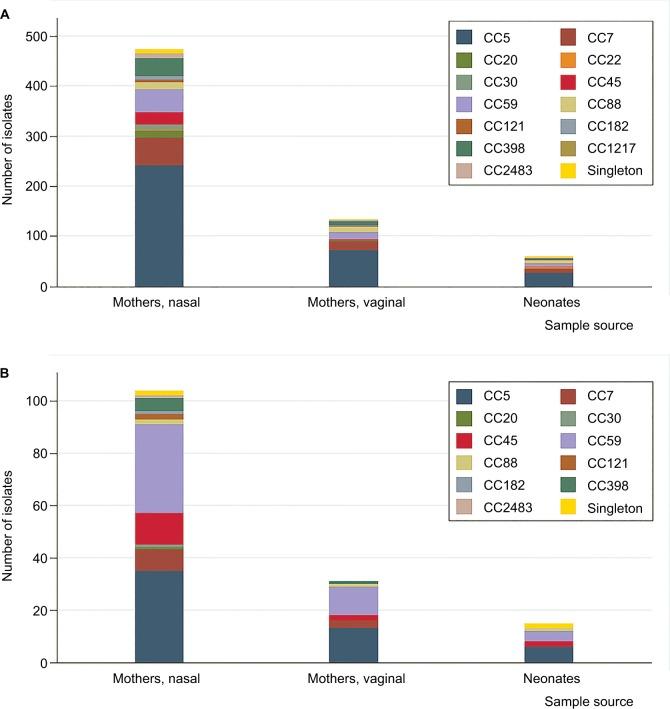
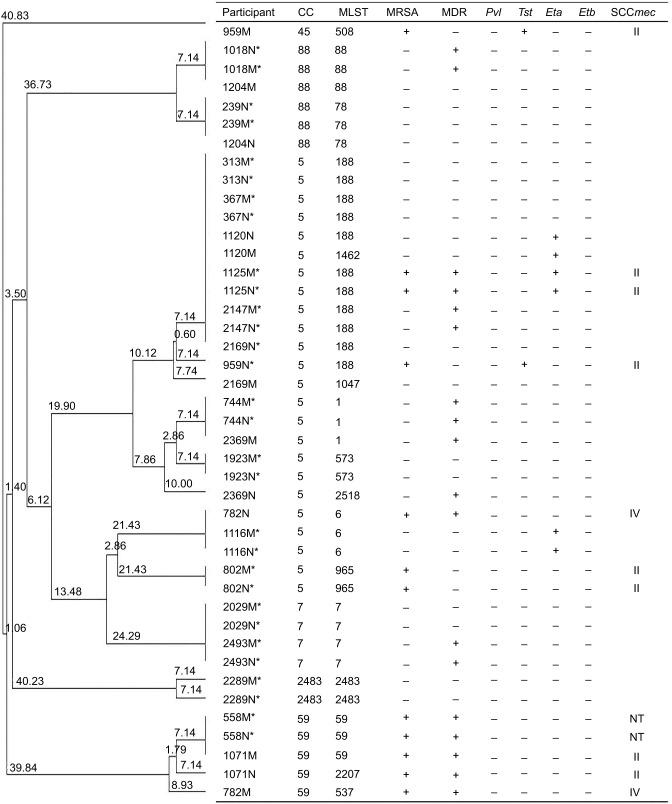
Overall, 1834 mothers and their neonates were included in this study. The prevalence of isolate carriage among the mothers was as follows: (nasal, 25.8%; vaginal, 7.3%; and nasal and vaginal, 3.3%) and MRSA (nasal, 5.7%; vaginal, 1.7%; and nasal and vaginal, 0.5%). The incidences of and MRSA carriage among neonates were 3.3% and 0.8%, respectively. Of the 21 maternal-neonatal pairs with carriage, 14 were concordant pairs with the same phenotypic and molecular characteristics. After adjustment, the relative risks and 95% confidence intervals (CIs) between the carriage of neonates and nasal carriage, vaginal carriage, and both nasal and vaginal carriage of mothers were 2.8 (95% CI, 1.6-4.8), 7.1 (95% CI, 4.1-12.4), and 9.6 (95% CI, 4.2-22.4), respectively.
CONCLUSION
carriage in mothers increases the risk for neonates.
背景
母亲体内的细菌,尤其是耐甲氧西林金黄色葡萄球菌(MRSA),可导致新生儿出现严重后果。我们旨在阐明母亲与新生儿之间金黄色葡萄球菌及MRSA携带情况的关联。
方法
2015年8月至11月在中国深圳的两家医院进行了一项前瞻性队列研究。符合纳入标准的中国孕妇及其新生儿纳入本研究;收集样本及相关信息。我们使用泊松回归模型评估母婴关联。
结果
总体而言,本研究纳入了1834名母亲及其新生儿。母亲中分离株携带率如下:金黄色葡萄球菌(鼻腔,25.8%;阴道,7.3%;鼻腔和阴道,3.3%)和MRSA(鼻腔,5.7%;阴道,1.7%;鼻腔和阴道,0.5%)。新生儿中金黄色葡萄球菌和MRSA携带率分别为3.3%和0.8%。在21对携带金黄色葡萄球菌的母婴对中,14对具有相同表型和分子特征的一致对。调整后,新生儿金黄色葡萄球菌携带与母亲鼻腔金黄色葡萄球菌携带、阴道金黄色葡萄球菌携带以及鼻腔和阴道金黄色葡萄球菌携带之间的相对风险及95%置信区间(CI)分别为2.8(95%CI,1.6 - 4.8)、7.1(95%CI,4.1 - 12.4)和9.6(95%CI,4.2 - 22.4)。
结论
母亲携带金黄色葡萄球菌会增加新生儿感染风险。
 Zotero 插件