
针对向父母宣传或教育幼儿疫苗接种情况的面对面干预措施。
Face-to-face interventions for informing or educating parents about early childhood vaccination.
作者信息
Kaufman Jessica, Ryan Rebecca, Walsh Louisa, Horey Dell, Leask Julie, Robinson Priscilla, Hill Sophie
机构信息
Centre for Health Communication and Participation, School of Psychology and Public Health, La Trobe University, Bundoora, VIC, Australia, 3086.
出版信息
Cochrane Database Syst Rev. 2018 May 8;5(5):CD010038. doi: 10.1002/14651858.CD010038.pub3.
BACKGROUND
Early childhood vaccination is an essential global public health practice that saves two to three million lives each year, but many children do not receive all the recommended vaccines. To achieve and maintain appropriate coverage rates, vaccination programmes rely on people having sufficient awareness and acceptance of vaccines.Face-to-face information or educational interventions are widely used to help parents understand why vaccines are important; explain where, how and when to access services; and address hesitancy and concerns about vaccine safety or efficacy. Such interventions are interactive, and can be adapted to target particular populations or identified barriers.This is an update of a review originally published in 2013.
OBJECTIVES
To assess the effects of face-to-face interventions for informing or educating parents about early childhood vaccination on vaccination status and parental knowledge, attitudes and intention to vaccinate.
SEARCH METHODS
We searched the CENTRAL, MEDLINE, Embase, five other databases, and two trial registries (July and August 2017). We screened reference lists of relevant articles, and contacted authors of included studies and experts in the field. We had no language or date restrictions.
SELECTION CRITERIA
We included randomised controlled trials (RCTs) and cluster-RCTs evaluating the effects of face-to-face interventions delivered to parents or expectant parents to inform or educate them about early childhood vaccination, compared with control or with another face-to-face intervention. The World Health Organization recommends that children receive all early childhood vaccines, with the exception of human papillomavirus vaccine (HPV), which is delivered to adolescents.
DATA COLLECTION AND ANALYSIS
We used standard methodological procedures expected by Cochrane. Two authors independently reviewed all search results, extracted data and assessed the risk of bias of included studies.
MAIN RESULTS
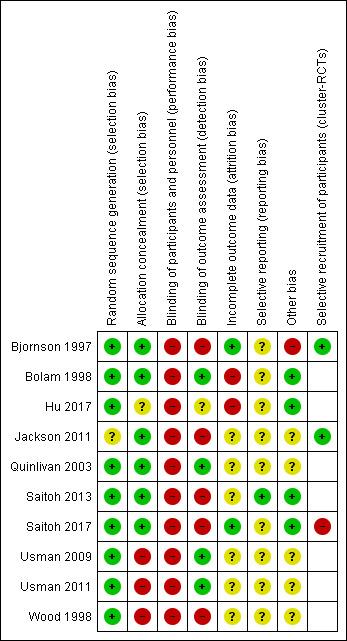
In this update, we found four new studies, for a total of ten studies. We included seven RCTs and three cluster-RCTs involving a total of 4527 participants, although we were unable to pool the data from one cluster-RCT. Three of the ten studies were conducted in low- or middle- income countries.All included studies compared face-to-face interventions with control. Most studies evaluated the effectiveness of a single intervention session delivered to individual parents. The interventions were an even mix of short (ten minutes or less) and longer sessions (15 minutes to several hours).Overall, elements of the study designs put them at moderate to high risk of bias. All studies but one were at low risk of bias for sequence generation (i.e. used a random number sequence). For allocation concealment (i.e. the person randomising participants was unaware of the study group to which participant would be allocated), three were at high risk and one was judged at unclear risk of bias. Due to the educational nature of the intervention, blinding of participants and personnel was not possible in any studies. The risk of bias due to blinding of outcome assessors was judged as low for four studies. Most studies were at unclear risk of bias for incomplete outcome data and selective reporting. Other potential sources of bias included failure to account for clustering in a cluster-RCT and significant unexplained baseline differences between groups. One cluster-RCT was at high risk for selective recruitment of participants.We judged the certainty of the evidence to be low for the outcomes of children's vaccination status, parents' attitudes or beliefs, intention to vaccinate, adverse effects (e.g. anxiety), and immunisation cost, and moderate for parents' knowledge or understanding. All studies had limitations in design. We downgraded the certainty of the evidence where we judged that studies had problems with randomisation or allocation concealment, or when outcomes were self-reported by participants who knew whether they'd received the intervention or not. We also downgraded the certainty for inconsistency (vaccination status), imprecision (intention to vaccinate and adverse effects), and indirectness (attitudes or beliefs, and cost).Low-certainty evidence from seven studies (3004 participants) suggested that face-to-face interventions to inform or educate parents may improve vaccination status (risk ratio (RR) 1.20, 95% confidence interval (CI) 1.04 to 1.37). Moderate-certainty evidence from four studies (657 participants) found that face-to-face interventions probably slightly improved parent knowledge (standardised mean difference (SMD) 0.19, 95% CI 0.00 to 0.38), and low-certainty evidence from two studies (179 participants) suggested they may slightly improve intention to vaccinate (SMD 0.55, 95% CI 0.24 to 0.85). Low-certainty evidence found the interventions may lead to little or no change in parent attitudes or beliefs about vaccination (SMD 0.03, 95% CI -0.20 to 0.27; three studies, 292 participants), or in parents' anxiety (mean difference (MD) -1.93, 95% CI -7.27 to 3.41; one study, 90 participants). Only one study (365 participants) measured the intervention cost of a case management strategy, reporting that the estimated additional cost per fully immunised child for the intervention was approximately eight times higher than usual care (low-certainty evidence). No included studies reported outcomes associated with parents' experience of the intervention (e.g. satisfaction).
AUTHORS' CONCLUSIONS: There is low- to moderate-certainty evidence suggesting that face-to-face information or education may improve or slightly improve children's vaccination status, parents' knowledge, and parents' intention to vaccinate.Face-to-face interventions may be more effective in populations where lack of awareness or understanding of vaccination is identified as a barrier (e.g. where people are unaware of new or optional vaccines). The effect of the intervention in a population where concerns about vaccines or vaccine hesitancy is the primary barrier is less clear. Reliable and validated scales for measuring more complex outcomes, such as attitudes or beliefs, are necessary in order to improve comparisons of the effects across studies.
背景
幼儿疫苗接种是一项重要的全球公共卫生实践,每年可挽救200万至300万人的生命,但许多儿童并未接种所有推荐疫苗。为了实现并维持适当的接种率,疫苗接种计划依赖于人们对疫苗有足够的认识和接受度。面对面的信息或教育干预措施被广泛用于帮助家长理解疫苗为何重要;解释获取服务的地点、方式和时间;以及解决对疫苗安全性或有效性的犹豫和担忧。此类干预措施具有互动性,并且可以针对特定人群或已识别的障碍进行调整。这是对2013年首次发表的一篇综述的更新。
目的
评估面对面干预措施在向家长宣传或教育幼儿疫苗接种方面对疫苗接种状况以及家长的知识、态度和接种意愿的影响。
检索方法
我们检索了Cochrane中心对照试验注册库(CENTRAL)、医学期刊数据库(MEDLINE)、荷兰医学文摘数据库(Embase)、其他五个数据库以及两个试验注册库(2017年7月和8月)。我们筛选了相关文章的参考文献列表,并联系了纳入研究的作者和该领域的专家。我们没有语言或日期限制。
入选标准
我们纳入了随机对照试验(RCT)和整群随机对照试验(cluster-RCT),这些试验评估了与对照组或另一种面对面干预措施相比向家长或准家长提供的面对面干预措施在宣传或教育幼儿疫苗接种方面的效果。世界卫生组织建议儿童接种所有幼儿疫苗,但人乳头瘤病毒疫苗(HPV)除外,该疫苗是针对青少年接种的。
数据收集与分析
我们采用了Cochrane预期的标准方法程序。两位作者独立审查了所有检索结果,提取数据并评估纳入研究的偏倚风险。
主要结果
在本次更新中,我们发现了四项新研究,共计十项研究。我们纳入了七项RCT和三项cluster-RCT,共涉及4527名参与者,不过我们无法汇总一项cluster-RCT的数据。十项研究中有三项在低收入或中等收入国家进行。所有纳入研究均将面对面干预措施与对照组进行了比较。大多数研究评估了向个体家长提供的单次干预课程的有效性。这些干预措施在短时间(十分钟或更短)和较长时间(15分钟至数小时)的课程中分布均匀。总体而言,研究设计的因素使它们存在中度至高偏倚风险。除一项研究外,所有研究在序列生成方面(即使用随机数字序列)的偏倚风险较低。对于分配隐藏(即随机分配参与者的人不知道参与者将被分配到哪个研究组),三项研究存在高偏倚风险,一项研究的偏倚风险被判定为不明确。由于干预措施具有教育性质,在任何研究中都不可能对参与者和工作人员进行盲法。四项研究中,结果评估者盲法导致的偏倚风险被判定为低。大多数研究在不完整结果数据和选择性报告方面的偏倚风险不明确。其他潜在的偏倚来源包括在cluster-RCT中未考虑聚类以及组间存在重大且无法解释的基线差异。一项cluster-RCT在参与者的选择性招募方面存在高风险。我们判定儿童疫苗接种状况、家长态度或信念、接种意愿、不良反应(如焦虑)和免疫成本等结果的证据确定性为低,而家长知识或理解方面的证据确定性为中等。所有研究在设计上都存在局限性。当我们判定研究在随机化或分配隐藏方面存在问题,或者结果由知道自己是否接受了干预的参与者自我报告时,我们降低了证据的确定性。我们还因不一致性(疫苗接种状况)、不精确性(接种意愿和不良反应)和间接性(态度或信念以及成本)而降低了确定性。七项研究(3004名参与者)的低确定性证据表明,向家长宣传或教育的面对面干预措施可能会改善疫苗接种状况(风险比(RR)1.20,95%置信区间(CI)1.04至1.37)。四项研究(657名参与者)的中等确定性证据发现,面对面干预措施可能会略微提高家长知识(标准化均数差(SMD)0.19,95%CI 0.00至0.38),两项研究(179名参与者)的低确定性证据表明,这些措施可能会略微提高接种意愿(SMD 0.55,95%CI 0.24至0.85)。低确定性证据发现,这些干预措施可能导致家长对疫苗接种的态度或信念几乎没有变化(SMD 0.03,95%CI -0.20至0.27;三项研究,292名参与者),或者家长焦虑几乎没有变化(均数差(MD)-1.93,95%CI -7.27至3.41;一项研究,90名参与者)。只有一项研究(365名参与者)测量了病例管理策略的干预成本,报告称该干预措施使每个完全免疫儿童的估计额外成本比常规护理高出约八倍(低确定性证据)。没有纳入研究报告与家长对干预措施的体验相关的结果(如满意度)。
作者结论
有低至中等确定性的证据表明,面对面的信息或教育可能会改善或略微改善儿童的疫苗接种状况、家长的知识以及家长的接种意愿。面对面干预措施在将缺乏对疫苗接种的认识或理解视为障碍的人群中(例如人们不知道新疫苗或非强制性疫苗的情况)可能更有效。在将对疫苗的担忧或疫苗犹豫视为主要障碍的人群中,干预措施的效果不太明确。为了更好地比较不同研究的效果,需要可靠且经过验证的量表来测量更复杂的结果,如态度或信念。


 Zotero 插件