
印度住院治疗的特定疾病自付费用和灾难性卫生支出:印度家庭面临困境性卫生筹资吗?
Disease-specific out-of-pocket and catastrophic health expenditure on hospitalization in India: Do Indian households face distress health financing?
机构信息
Department of Fertility Studies, International Institute for Population Sciences (IIPS), Deonar, Mumbai, India.
出版信息
PLoS One. 2018 May 10;13(5):e0196106. doi: 10.1371/journal.pone.0196106. eCollection 2018.
BACKGROUND
Rising non-communicable diseases (NCDs) coupled with increasing injuries have resulted in a significant increase in health spending in India. While out-of-pocket expenditure remains the major source of health care financing in India (two-thirds of the total health spending), the financial burden varies enormously across diseases and by the economic well-being of the households. Though prior studies have examined the variation in disease pattern, little is known about the financial risk to the families by type of diseases in India. In this context, the present study examines disease-specific out-of-pocket expenditure (OOPE), catastrophic health expenditure (CHE) and distress health financing.
METHODS AND MATERIALS
Unit data from the 71st round of the National Sample Survey Organization (2014) was used for this study. OOPE is defined as health spending on hospitalization net of reimbursement, and CHE is defined as household health spending exceeding 10% of household consumption expenditure. Distress health financing is defined as a situation when a household has to borrow money or sell their property/assets or when it gets contributions from friends/relatives to meet its health care expenses. OOPE was estimated for 16 selected diseases and across three broad categories- communicable diseases, NCDs and injuries. Multivariate logistic regression was used to understand the determinants of distress financing and CHE.
RESULTS
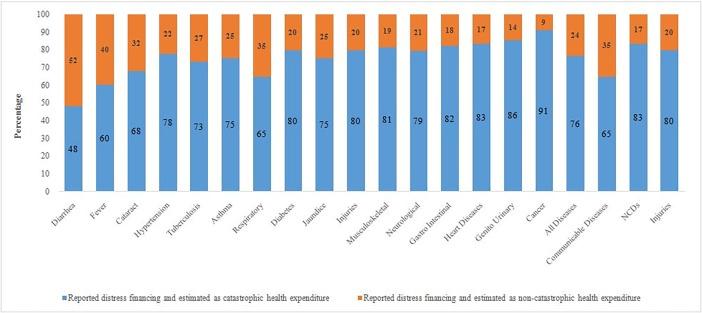
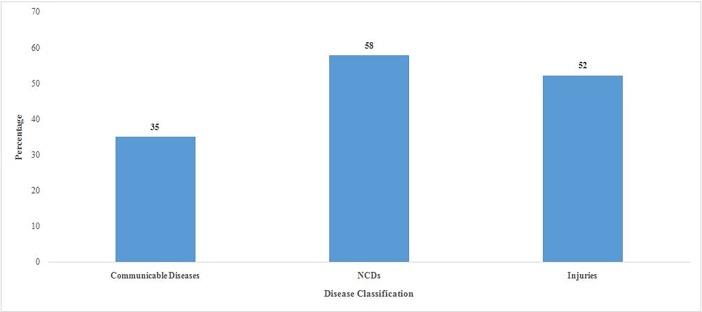
Mean OOPE on hospitalization was INR 19,210 and was the highest for cancer (INR 57,232) followed by heart diseases (INR 40,947). About 28% of the households incurred CHE and faced distress financing. Among all the diseases, cancer caused the highest CHE (79%) and distress financing (43%). More than one-third of the inpatients reported distressed financing for heart diseases, neurological disorders, genito urinary problems, musculoskeletal diseases, gastro-intestinal problems and injuries. The likelihood of incurring distress financing was 3.2 times higher for those hospitalized for cancer (OR 3.23; 95% CI: 2.62-3.99) and 2.6 times for tuberculosis patients (OR 2.61; 95% CI: 2.06-3.31). A large proportion of households who had reported distress financing also incurred CHE.
RECOMMENDATIONS
Free treatment for cancer and heart diseases is recommended for the vulnerable sections of the society. Risk-pooling and social security mechanisms based on contributions from both households as well as the central and state governments can reduce the financial burden of diseases and avert households from distress health financing.
背景
不断增加的非传染性疾病(NCDs)和意外伤害导致印度的医疗保健支出大幅增加。虽然自付支出仍然是印度医疗保健融资的主要来源(占总医疗支出的三分之二),但家庭的经济状况不同,疾病的经济负担也有很大差异。尽管先前的研究已经检查了疾病模式的变化,但对于印度特定疾病类型对家庭的财务风险知之甚少。在这种情况下,本研究考察了特定疾病的自付支出(OOPE)、灾难性医疗支出(CHE)和困难的医疗融资。
方法和材料
本研究使用了第 71 轮国家抽样调查组织(2014 年)的单位数据。OOPE 定义为住院治疗的净医疗费用减去报销,而 CHE 定义为家庭医疗支出超过家庭消费支出的 10%。困难的医疗融资定义为家庭不得不借钱或出售财产/资产,或者从朋友/亲戚那里获得捐款以支付其医疗费用的情况。对 16 种选定的疾病和传染病、非传染性疾病和伤害这三个广泛类别进行了 OOPE 估计。使用多元逻辑回归来了解困难融资和 CHE 的决定因素。
结果
住院治疗的平均 OOPE 为 19210 卢比,癌症(57232 卢比)和心脏病(40947 卢比)的 OOPE 最高。约 28%的家庭发生 CHE 并面临困难的融资。在所有疾病中,癌症导致的 CHE(79%)和困难融资(43%)最高。超过三分之一的住院患者因心脏病、神经系统疾病、生殖泌尿系统问题、肌肉骨骼疾病、胃肠道问题和伤害而报告困难融资。因癌症住院的患者发生困难融资的可能性是因其他疾病住院的患者的 3.2 倍(OR 3.23;95%CI:2.62-3.99),结核病患者的可能性是因其他疾病住院的患者的 2.6 倍(OR 2.61;95%CI:2.06-3.31)。报告困难融资的家庭中,很大一部分也发生了 CHE。
建议
建议为社会弱势群体提供癌症和心脏病的免费治疗。基于家庭以及中央和邦政府的缴款的风险分担和社会保障机制可以减轻疾病的经济负担,并避免家庭陷入困难的医疗融资。

 Zotero 插件