
2010 年至 2013 年期间墨西哥 A 型和 B 型流感的负担:基于流行病学总局数据库记录的观察性、回顾性数据库研究。
The burden of influenza A and B in Mexico from the year 2010 to 2013: An observational, retrospective, database study, on records from the Directorate General of Epidemiology database.
机构信息
a GSK, Calz México-Xochimilco 4900, Col. San Lorenzo Huipulco , Mexico City , Mexico.
b GSK, Av. Fleming 20 , 1300 Wavre , Belgium.
出版信息
Hum Vaccin Immunother. 2018;14(8):1890-1898. doi: 10.1080/21645515.2018.1456281. Epub 2018 May 10.
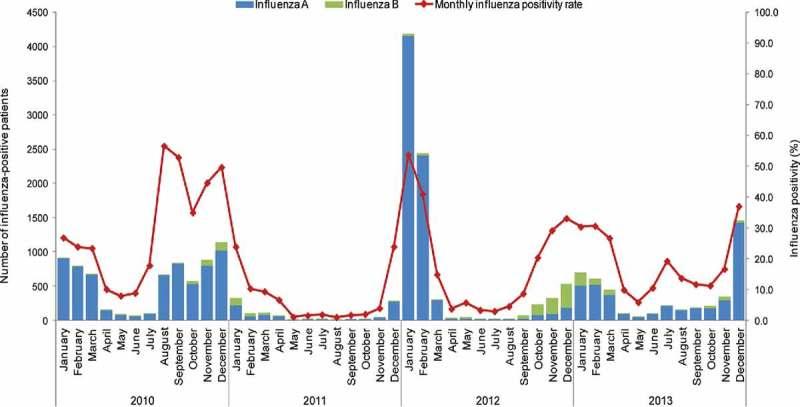
Despite vaccination programs, influenza still represents a significant disease burden in Mexico. We conducted an observational, retrospective analysis to better understand the epidemiological situation of the influenza virus in Mexico. Analysis of the seasonal patterns of influenza A and B were based on the Directorate General of Epidemiology dataset of influenza-like illness(ILI), and severe acute respiratory infection(SARI) that were recorded between January 2010 and December 2013. Our objectives were 1) to describe influenza A and B activity, by age group, and subtype and, 2) to analyze the number of laboratory-confirmed cases presenting with ILI by influenza type, the regional distribution of influenza, and its clinical features. Three periods of influenza activity were captured: August 2010-January 2011, December 2011-March 2012, and October 2012-March 2013. Cases were reported throughout Mexico, with 50.3% (n = 10,320) of cases found in 18-49 year olds. Over the entire capture period, a total of 76,085 ILI/SARI episodes had swab samples analyzed for influenza, 27% were positive. During the same period, influenza A cases were higher in the 18-49 years old, and influenza B cases in both 5-17 and 18-49 age groups. Peak activity occurred in January 2012 (n = 4,159) and December 2012 (n = 348) for influenza A and B respectively. This analysis confirms that influenza is an important respiratory pathogen for children and adults in Mexico despite vaccination recommendations. School-age children and adolescents were more prone to influenza B infection; while younger adults were susceptible to both influenza A and B viruses. Over the seasons, influenza A and B co-circulated.
尽管有疫苗接种计划,但流感在墨西哥仍然是一个重大的疾病负担。我们进行了一项观察性、回顾性分析,以更好地了解墨西哥流感病毒的流行病学情况。流感 A 和 B 的季节性模式分析基于 2010 年 1 月至 2013 年 12 月记录的疾病预防控制中心(Directorate General of Epidemiology)的流感样疾病(ILI)和严重急性呼吸道感染(SARI)数据集。我们的目标是 1)按年龄组和亚型描述流感 A 和 B 的活动情况,2)分析流感类型引起的ILI 实验室确诊病例数、流感的区域分布及其临床特征。我们共捕获了三个流感活动期:2010 年 8 月至 2011 年 1 月、2011 年 12 月至 2012 年 3 月和 2012 年 10 月至 2013 年 3 月。病例报告遍布墨西哥各地,18-49 岁人群占病例的 50.3%(n=10320)。在整个捕获期间,共有 76085 例 ILI/SARI 病例的咽拭子样本进行了流感分析,其中 27%为阳性。同期,18-49 岁人群中甲型流感病例较多,5-17 岁和 18-49 岁人群中乙型流感病例较多。甲型流感的发病高峰出现在 2012 年 1 月(n=4159)和 2012 年 12 月(n=348),乙型流感的发病高峰分别出现在 2012 年 1 月(n=4159)和 2012 年 12 月(n=348)。这一分析证实,尽管有疫苗接种建议,但流感仍是墨西哥儿童和成人的重要呼吸道病原体。学龄儿童和青少年更容易感染乙型流感;而年轻成年人容易感染甲型和乙型流感病毒。在整个季节中,流感 A 和 B 同时流行。


 Zotero 插件