
沙特阿拉伯不同膝关节骨关节炎严重程度老年患者的膝关节疼痛与健康相关生活质量。
Knee pain and health-related quality of life among older patients with different knee osteoarthritis severity in Saudi Arabia.
机构信息
Department of Rehabilitation Sciences, College of Applied Medical Sciences, King Saud University, Riyadh, Saudi Arabia.
Physical Therapy Department, General Directorate of Medical Services, Riyadh, Saudi Arabia.
出版信息
PLoS One. 2018 May 15;13(5):e0196150. doi: 10.1371/journal.pone.0196150. eCollection 2018.
OBJECTIVE
There is a lack of knowledge about health-related quality of life (HRQoL) in Saudi patients with musculoskeletal impairment, particularly among older adult populations. Thus, the current research aimed to determine the association of knee osteoarthritis (OA) severity with knee pain (KP) and HRQoL among older patients in Riyadh, Saudi Arabia.
METHODS
In a multicenter cross-sectional study, we recruited 209 consecutive males and females aged ≥55 years with radiographically diagnosed knee OA from five hospitals across Riyadh, Saudi Arabia. According to the Kellgren & Lawrence classification, patients were classified into two groups: mild/moderate knee OA (n = 126) and severe knee OA (n = 83). KP and HRQoL were assessed using the pain visual analogue scale (VAS) and the 36-Item Short Form Health Survey (SF-36), respectively. A higher score on the pain VAS and the SF-36 represented worse KP and better HRQoL, respectively.
RESULTS
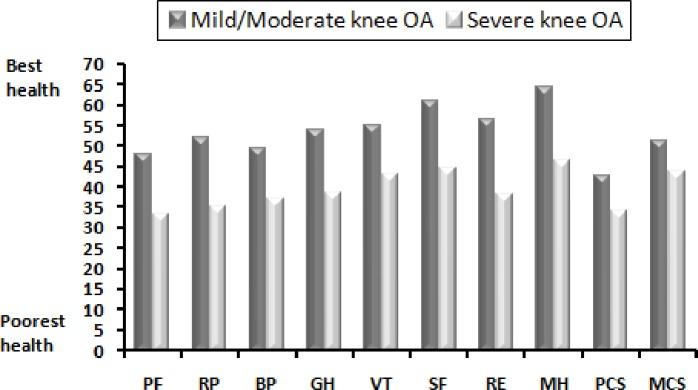
Severe knee OA was significantly associated with an increased score of 3.47 (p <.0001) points on the pain VAS compared with the score reported by patients with mild/moderate knee OA. Additionally, it was significantly associated with reduced scores of 6.83 and 5.82 (both: p <.0001) points on the physical and mental composite summary subscales of the SF-36, respectively, compared with the scores of patients with mild/moderate knee OA, even after adjusting for all covariates.
CONCLUSION
Older patients with severe knee OA had significantly worse KP and reduced HRQoL compared to patients with mild/moderate knee conditions, even after controlling for confounders.
目的
沙特患有肌肉骨骼障碍的患者,尤其是老年人群体,对健康相关生活质量(HRQoL)的了解有限。因此,本研究旨在确定沙特利雅得的老年患者中膝骨关节炎(OA)严重程度与膝痛(KP)和 HRQoL 的关系。
方法
在一项多中心横断面研究中,我们招募了 209 名来自沙特阿拉伯利雅得五家医院的年龄≥55 岁且经影像学诊断为膝 OA 的连续男性和女性。根据 Kellgren & Lawrence 分类,患者分为两组:轻度/中度膝 OA(n = 126)和重度膝 OA(n = 83)。使用疼痛视觉模拟量表(VAS)和 36 项简短健康调查(SF-36)评估 KP 和 HRQoL。VAS 上的疼痛评分越高和 SF-36 上的评分越高,分别代表 KP 越差和 HRQoL 越好。
结果
与轻度/中度膝 OA 患者报告的评分相比,重度膝 OA 患者的 VAS 疼痛评分显著增加 3.47 分(p <.0001)。此外,与轻度/中度膝 OA 患者相比,重度膝 OA 患者在 SF-36 的身体和心理综合摘要子量表上的评分分别显著降低了 6.83 和 5.82 分(均:p <.0001),即使在调整了所有协变量后也是如此。
结论
与轻度/中度膝 OA 患者相比,重度膝 OA 的老年患者的 KP 明显更差,HRQoL 降低,即使在控制混杂因素后也是如此。
 Zotero 插件