
考洛菲兰、高剂量阿糖胞苷和脂质体柔红霉素治疗儿科复发/难治性急性髓系白血病的初步研究
Clofarabine, high-dose cytarabine and liposomal daunorubicin in pediatric relapsed/refractory acute myeloid leukemia: a phase IB study.
机构信息
Department of Pediatric Oncology/Hematology, Erasmus MC-Sophia Children's Hospital, Rotterdam, the Netherlands.
Department of Pediatric Oncology, Princess Máxima Center for Pediatric Oncology, Utrecht, the Netherlands.
出版信息
Haematologica. 2018 Sep;103(9):1484-1492. doi: 10.3324/haematol.2017.187153. Epub 2018 May 17.
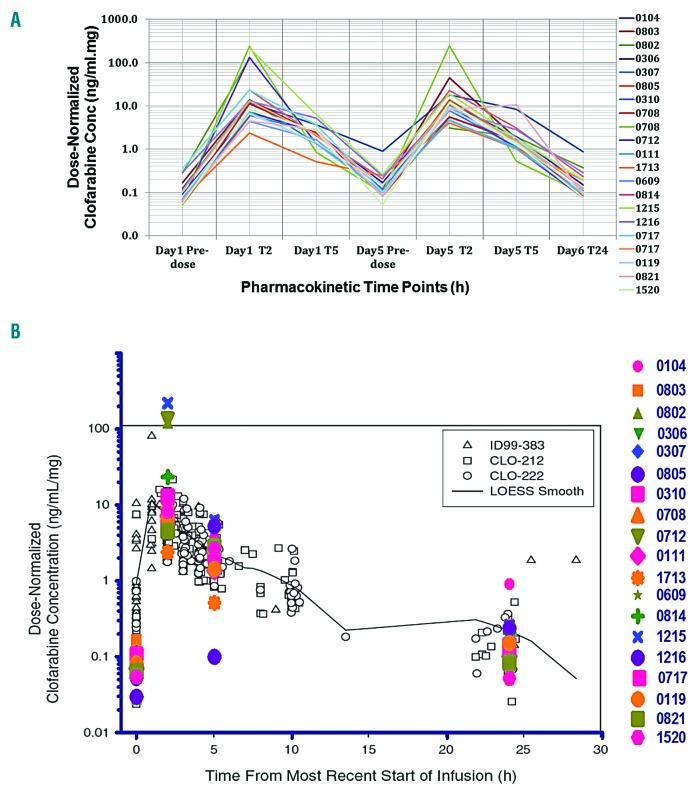
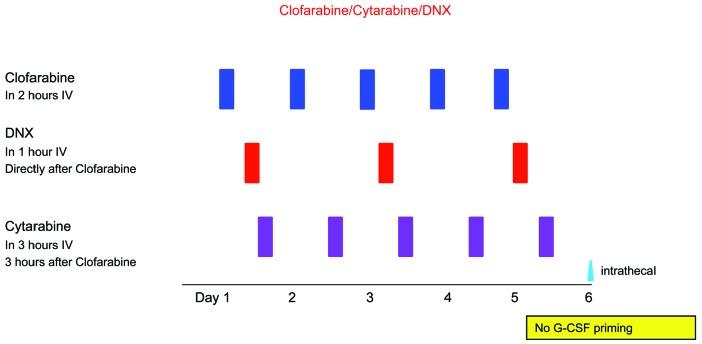
Survival in children with relapsed/refractory acute myeloid leukemia is unsatisfactory. Treatment consists of one course of fludarabine, cytarabine and liposomal daunorubicin, followed by fludarabine and cytarabine and stem-cell transplantation. Study ITCC 020/I-BFM 2009-02 aimed to identify the recommended phase II dose of clofarabine replacing fludarabine in the abovementioned combination regimen (3+3 design). Escalating dose levels of clofarabine (20-40 mg/m/day × 5 days) and liposomal daunorubicin (40-80 mg/m/day) were administered with cytarabine (2 g/m/day × 5 days). Liposomal DNR was given on day 1, 3 and 5 only. The cohort at the recommended phase II dose was expanded to make a preliminary assessment of anti-leukemic activity. Thirty-four children were enrolled: refractory 1 (n=11), early 1st (n=15), ≥2 relapse (n=8). Dose level 3 (30 mg/mclofarabine; 60 mg/mliposomal daunorubicin) appeared to be safe only in patients without subclinical fungal infections. Infectious complications were dose-limiting. The recommended phase II dose was 40 mg/m clofarabine with 60 mg/m liposomal daunorubicin. Side-effects mainly consisted of infections. The overall response rate was 68% in 31 response evaluable patients, and 80% at the recommended phase II dose (n=10); 22 patients proceeded to stem cell transplantation. The 2-year probability of event-free survival (pEFS) was 26.5±7.6 and probability of survival (pOS) 32.4±8.0%. In the 21 responding patients, the 2-year pEFS was 42.9±10.8 and pOS 47.6±10.9%. Clofarabine exposure in plasma was not significantly different from that in single-agent studies. In conclusion, clofarabine was well tolerated and showed high response rates in relapsed/refractory pediatric acute myeloid leukemia. Patients with (sub) clinical fungal infections should be treated with caution. Clofarabine has been taken forward in the Berlin-Frankfurt-Münster study for newly diagnosed acute myeloid leukemia. The Study ITCC-020 was registered as EUDRA-CT 2009-009457-13; Dutch Trial Registry number 1880.
在复发/难治性急性髓系白血病患儿中,生存情况并不理想。治疗方法包括一疗程氟达拉滨、阿糖胞苷和脂质体柔红霉素,随后是氟达拉滨和阿糖胞苷以及干细胞移植。ITCC 020/I-BFM 2009-02 研究旨在确定在上述联合方案中用氯法拉滨替代氟达拉滨的推荐 II 期剂量(3+3 设计)。递增氯法拉滨剂量水平(20-40mg/m/天×5 天)和脂质体柔红霉素(40-80mg/m/天)与阿糖胞苷(2g/m/天×5 天)联合使用。仅在第 1、3 和 5 天给予脂质体 DNR。在推荐的 II 期剂量水平上扩大队列,以初步评估抗白血病活性。共纳入 34 名患儿:难治性 1 例(n=11),早期 1 例(n=15),≥2 次复发(n=8)。30mg/m 氯法拉滨(n=34);60mg/ml 脂质体柔红霉素)似乎仅在无亚临床真菌感染的患者中是安全的。感染并发症是剂量限制因素。推荐的 II 期剂量为 40mg/m 氯法拉滨和 60mg/m 脂质体柔红霉素。主要副作用为感染。31 例可评估反应患者的总反应率为 68%,推荐的 II 期剂量组(n=10)为 80%;22 例患者进行了干细胞移植。2 年无事件生存(pEFS)率为 26.5%±7.6%,生存率(pOS)为 32.4%±8.0%。在 21 例有反应的患者中,2 年 pEFS 为 42.9%±10.8%,pOS 为 47.6%±10.9%。氯法拉滨在血浆中的暴露与单药研究无显著差异。总之,氯法拉滨在复发/难治性儿童急性髓系白血病中耐受性良好,反应率高。有(亚)临床真菌感染的患者应谨慎治疗。氯法拉滨已在柏林-法兰克福-明斯特研究中用于新诊断的急性髓系白血病。ITCC-020 研究在 EUDRA-CT 2009-009457-13 注册;荷兰试验登记号 1880。

 Zotero 插件