
2 型糖尿病的联合降糖治疗方案:基于案例的思考。
Combination Glucose-Lowering Therapy Plans in T2DM: Case-Based Considerations.
机构信息
Frank Riddick Diabetes Institute, Department of Endocrinology, Ochsner Medical Center, New Orleans, LA, USA.
Arizona Grand Medical Center, Phoenix, AZ, USA.
出版信息
Adv Ther. 2018 Jul;35(7):939-965. doi: 10.1007/s12325-018-0694-0. Epub 2018 May 18.
UNLABELLED
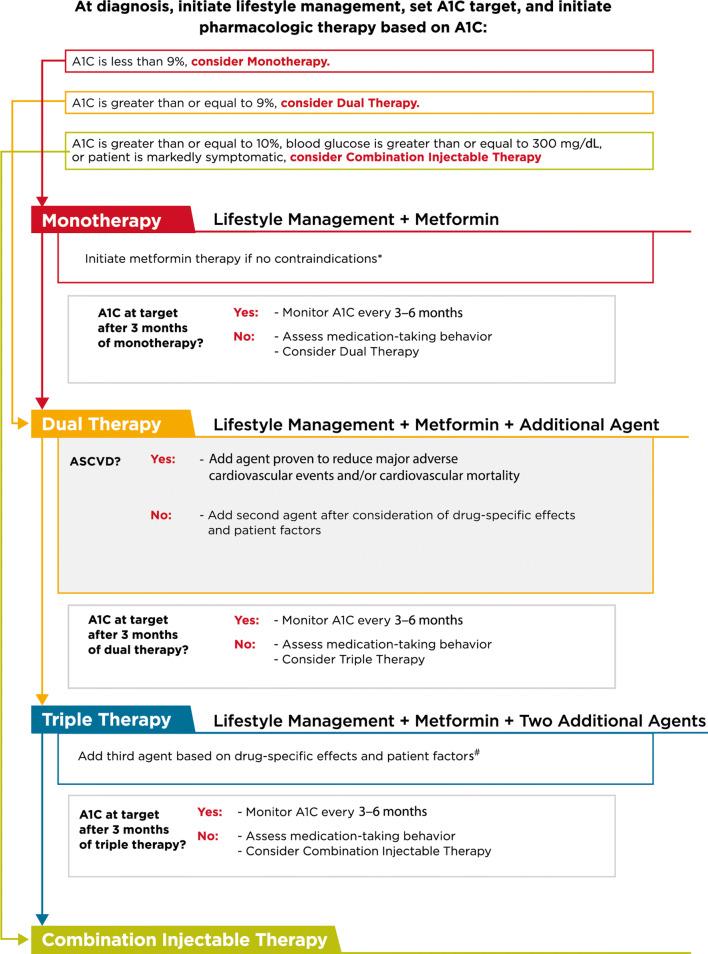
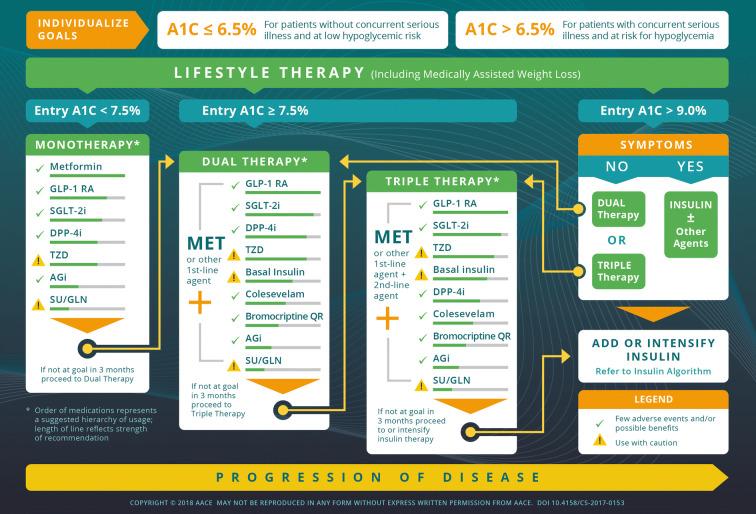
Type 2 diabetes mellitus (T2DM) is a complex disease, and while lifestyle interventions remain the cornerstone of therapy, most patients will also require pharmacotherapy. Current diabetes treatment guidelines and algorithms recommend an individualized approach to setting glycemic goals and selecting treatment. Although a single antihyperglycemic agent may be appropriate as the initial T2DM pharmacotherapy, the progressive nature of the disease due to declining pancreatic β-cell function will result in the vast majority of T2DM patients eventually requiring two or more antihyperglycemic agents. The American Association of Clinical Endocrinologists/American College of Clinical Endocrinology T2DM management algorithm recommends initial dual agent combination therapy when a single agent is unlikely to achieve their target glycemia, i.e., for those patients with an HbA1c ≥ 7.5 and an individualized HbA1c target of < 7.5%. The American Diabetes Association Standards of Care recommend combination pharmacotherapy for those patients presenting with very elevated HbA1c levels (e.g., ≥ 9% and < 10%). Metformin (if well tolerated and not contraindicated) is the initial pharmacologic choice for most patients; selection of another antihyperglycemic agent to the regimen will depend on the presence of atherosclerotic cardiovascular disease and other patient-specific factors (e.g., age, known duration of T2DM, history of or risk for hypoglycemia and/or adverse consequences from hypoglycemia, other comorbidities, and available resources), along with drug-specific factors (e.g., risk for hypoglycemia, potential effects on weight, drug adverse event profiles, and cost). Combination therapy may be administered as a multi-pill regimen, a single-pill combination (i.e., fixed-dose combination oral therapy), or as a combination of oral and/or injectable therapies. This paper provides two illustrative case presentations to demonstrate how current treatment recommendations and algorithms can be used to guide the selection of non-insulin-based combination therapy for patients with T2DM in primary care settings and discusses the relative merits of several possible approaches for each patient.
FUNDING
Boehringer Ingelheim Pharmaceuticals, Inc.
目的
2 型糖尿病(T2DM)是一种复杂的疾病,尽管生活方式干预仍然是治疗的基石,但大多数患者还需要药物治疗。目前的糖尿病治疗指南和算法建议采用个体化方法来设定血糖目标并选择治疗方法。虽然单一的抗高血糖药物可能适合作为初始 T2DM 药物治疗,但由于胰腺β细胞功能下降,疾病的进展性质将导致绝大多数 T2DM 患者最终需要两种或更多种抗高血糖药物。美国临床内分泌医师协会/美国临床内分泌医师学会 T2DM 管理算法建议,当单一药物不太可能达到目标血糖时,即对于那些 HbA1c≥7.5 且个体化 HbA1c 目标<7.5%的患者,初始采用双重药物联合治疗。美国糖尿病协会标准护理建议,对于那些 HbA1c 水平非常高(例如≥9%且<10%)的患者,采用联合药物治疗。二甲双胍(如果耐受良好且无禁忌证)是大多数患者的初始药物选择;治疗方案中另一种抗高血糖药物的选择将取决于是否存在动脉粥样硬化性心血管疾病和其他患者特定因素(例如年龄、已知 T2DM 持续时间、低血糖和/或低血糖不良后果的病史或风险、其他合并症和可用资源),以及药物特定因素(例如低血糖风险、对体重的潜在影响、药物不良事件谱和成本)。联合治疗可以作为多丸剂方案、单一丸剂组合(即固定剂量组合口服治疗)或口服和/或注射治疗的组合进行。本文提供了两个说明性病例介绍,以演示如何在初级保健环境中使用当前的治疗建议和算法来指导 T2DM 患者选择非胰岛素基础联合治疗,并讨论了每种患者的几种可能方法的相对优势。
经费
勃林格殷格翰制药公司。
 Zotero 插件