
一项全基因组关联研究揭示了肉鸡脂肪沉积的新基因组区域和位置候选基因。
A genome-wide association study reveals novel genomic regions and positional candidate genes for fat deposition in broiler chickens.
机构信息
Department of Animal Science, University of São Paulo (USP) / Luiz de Queiroz College of Agriculture (ESALQ), Piracicaba, São Paulo, 13418-900, Brazil.
Department of Animal Science, Iowa State University (ISU), Ames, Iowa, USA.
出版信息
BMC Genomics. 2018 May 21;19(1):374. doi: 10.1186/s12864-018-4779-6.
BACKGROUND
Excess fat content in chickens has a negative impact on poultry production. The discovery of QTL associated with fat deposition in the carcass allows the identification of positional candidate genes (PCGs) that might regulate fat deposition and be useful for selection against excess fat content in chicken's carcass. This study aimed to estimate genomic heritability coefficients and to identify QTLs and PCGs for abdominal fat (ABF) and skin (SKIN) traits in a broiler chicken population, originated from the White Plymouth Rock and White Cornish breeds.
RESULTS
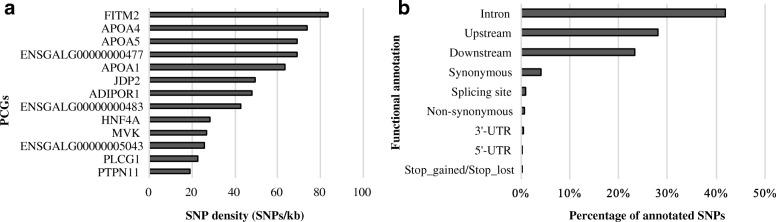
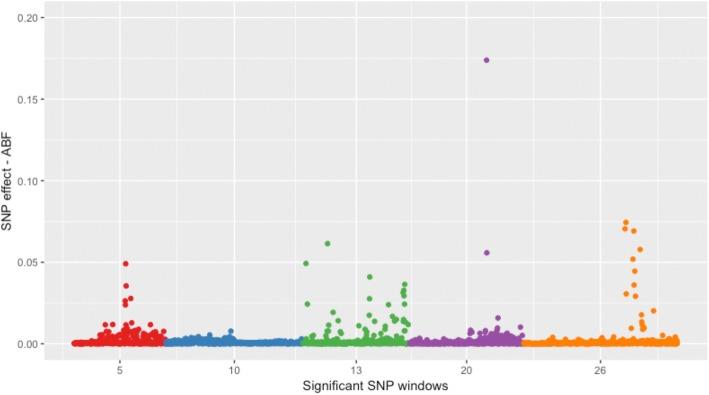
ABF and SKIN are moderately heritable traits in our broiler population with estimates ranging from 0.23 to 0.33. Using a high density SNP panel (355,027 informative SNPs), we detected nine unique QTLs that were associated with these fat traits. Among these, four QTL were novel, while five have been previously reported in the literature. Thirteen PCGs were identified that might regulate fat deposition in these QTL regions: JDP2, PLCG1, HNF4A, FITM2, ADIPOR1, PTPN11, MVK, APOA1, APOA4, APOA5, ENSGALG00000000477, ENSGALG00000000483, and ENSGALG00000005043. We used sequence information from founder animals to detect 4843 SNPs in the 13 PCGs. Among those, two were classified as potentially deleterious and two as high impact SNPs.
CONCLUSIONS
This study generated novel results that can contribute to a better understanding of fat deposition in chickens. The use of high density array of SNPs increases genome coverage and improves QTL resolution than would have been achieved with low density. The identified PCGs were involved in many biological processes that regulate lipid storage. The SNPs identified in the PCGs, especially those predicted as potentially deleterious and high impact, may affect fat deposition. Validation should be undertaken before using these SNPs for selection against carcass fat accumulation and to improve feed efficiency in broiler chicken production.
背景
鸡体内脂肪含量过高会对家禽生产产生负面影响。与胴体脂肪沉积相关的 QTL 的发现,使得鉴定可能调节脂肪沉积的位置候选基因(PCGs)成为可能,这对于鸡胴体脂肪含量的选择具有重要意义。本研究旨在估计肉鸡群体腹部脂肪(ABF)和皮肤(SKIN)性状的基因组遗传力系数,并鉴定与这些脂肪性状相关的 QTL 和 PCGs。
结果
ABF 和 SKIN 是我们肉鸡群体中中度遗传的性状,遗传力估计值在 0.23 到 0.33 之间。使用高密度 SNP 面板(355,027 个信息性 SNP),我们检测到与这些脂肪性状相关的 9 个独特的 QTL。其中,4 个 QTL 是新的,而 5 个 QTL 之前已在文献中报道过。鉴定出 13 个可能调节这些 QTL 区域脂肪沉积的 PCGs:JDP2、PLCG1、HNF4A、FITM2、ADIPOR1、PTPN11、MVK、APOA1、APOA4、APOA5、ENSGALG00000000477、ENSGALG00000000483 和 ENSGALG00000005043。我们使用创始动物的序列信息,在 13 个 PCGs 中检测到 4843 个 SNP。其中,有 2 个被归类为潜在有害,2 个被归类为高影响 SNP。
结论
本研究产生了新的结果,有助于更好地理解鸡的脂肪沉积。与低密度 SNP 相比,高密度 SNP 阵列的使用增加了基因组覆盖度,提高了 QTL 分辨率。鉴定出的 PCGs 参与了许多调节脂质储存的生物学过程。在 PCGs 中鉴定出的 SNP,特别是那些预测为潜在有害和高影响的 SNP,可能会影响脂肪沉积。在使用这些 SNP 来选择胴体脂肪积累和提高肉鸡生产的饲料效率之前,应该进行验证。

 Zotero 插件