
黑人及白人 2 型糖尿病患者慢性肾脏病的发病和进展。
Incidence and Progression of Chronic Kidney Disease in Black and White Individuals with Type 2 Diabetes.
机构信息
Center for Translational Metabolism and Health, Institute for Public Health and Medicine.
Division of Nephrology and Hypertension, Department of Medicine, and.
出版信息
Clin J Am Soc Nephrol. 2018 Jun 7;13(6):884-892. doi: 10.2215/CJN.11871017. Epub 2018 May 24.
BACKGROUND AND OBJECTIVES
Type 2 diabetes and associated CKD disproportionately affect blacks. It is uncertain if racial disparities in type 2 diabetes-associated CKD are driven by biologic factors that influence propensity to CKD or by differences in type 2 diabetes care.
DESIGN, SETTING, PARTICIPANTS, & MEASUREMENTS: We conducted a analysis of 1937 black and 6372 white participants of the Action to Control Cardiovascular Risk in Diabetes (ACCORD) trial to examine associations of black race with change in eGFR and risks of developing microalbuminuria, macroalbuminuria, incident CKD (eGFR<60 ml/min per 1.73m, ≥25% decrease from baseline eGFR, and eGFR slope <-1.6 ml/min per 1.73 m per year), and kidney failure or serum creatinine >3.3 mg/dl.
RESULTS
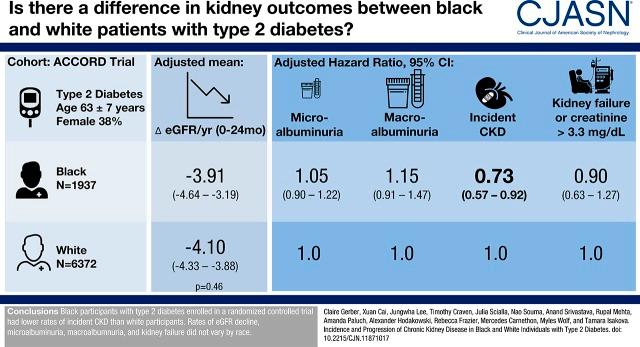
During a median follow-up that ranged between 4.4 and 4.7 years, 278 black participants (58 per 1000 person-years) and 981 white participants (55 per 1000 person-years) developed microalbuminuria, 122 black participants (16 per 1000 person-years) and 374 white participants (14 per 1000 person-years) developed macroalbuminuria, 111 black participants (21 per 1000 person-years) and 499 white participants (28 per 1000 person-years) developed incident CKD, and 59 black participants (seven per 1000 person-years) and 178 white participants (six per 1000 person-years) developed kidney failure or serum creatinine >3.3 mg/dl. Compared with white participants, black participants had lower risks of incident CKD (hazard ratio, 0.73; 95% confidence intervals, 0.57 to 0.92). There were no significant differences by race in eGFR decline or in risks of microalbuminuria, macroalbuminuria, and kidney failure or of serum creatinine >3.3 mg/dl.
CONCLUSIONS
Black participants enrolled in a randomized controlled trial had lower rates of incident CKD compared with white participants. Rates of eGFR decline, microalbuminuria, macroalbuminuria, and kidney failure did not vary by race.
背景与目的
2 型糖尿病和相关的 CKD 在黑人群体中发病率更高。尚不清楚 2 型糖尿病相关 CKD 的种族差异是由影响 CKD 易感性的生物学因素驱动,还是由 2 型糖尿病治疗的差异驱动。
设计、地点、参与者和测量:我们对 ACCORD 试验的 1937 名黑人和 6372 名白人参与者进行了分析,以研究黑种人种族与 eGFR 变化以及发生微量白蛋白尿、大量白蛋白尿、新发 CKD(eGFR<60 ml/min/1.73m,基线 eGFR 下降≥25%,eGFR 斜率<-1.6 ml/min/1.73 m/年)、肾衰竭或血清肌酐>3.3 mg/dl 的风险之间的关联。
结果
在中位数为 4.4 至 4.7 年的随访期间,278 名黑人参与者(每 1000 人年 58 例)和 981 名白人参与者(每 1000 人年 55 例)发生微量白蛋白尿,122 名黑人参与者(每 1000 人年 16 例)和 374 名白人参与者(每 1000 人年 14 例)发生大量白蛋白尿,111 名黑人参与者(每 1000 人年 21 例)和 499 名白人参与者(每 1000 人年 28 例)发生新发 CKD,59 名黑人参与者(每 1000 人年 7 例)和 178 名白人参与者(每 1000 人年 6 例)发生肾衰竭或血清肌酐>3.3 mg/dl。与白人参与者相比,黑人参与者发生新发 CKD 的风险较低(风险比,0.73;95%置信区间,0.57 至 0.92)。在 eGFR 下降或微量白蛋白尿、大量白蛋白尿、肾衰竭或血清肌酐>3.3 mg/dl 的风险方面,种族间无显著差异。
结论
参加随机对照试验的黑人参与者与白人参与者相比,新发 CKD 的发生率较低。eGFR 下降、微量白蛋白尿、大量白蛋白尿和肾衰竭的发生率不因种族而异。
 Zotero 插件