
1946 年英国出生队列研究中的肥胖模式、血管表型与认知功能。
Patterns of adiposity, vascular phenotypes and cognitive function in the 1946 British Birth Cohort.
机构信息
National Centre for Cardiovascular Prevention and Outcomes, Institute of Cardiovascular Science, University College London, 1 St Martin le Grande, London, EC1A 4NP, UK.
Department of Clinical and Experimental Medicine, University of Pisa, Pisa, Italy.
出版信息
BMC Med. 2018 May 28;16(1):75. doi: 10.1186/s12916-018-1059-x.
BACKGROUND
The relationship between long-term exposure to whole body or central obesity and cognitive function, as well as its potential determinants, remain controversial. In this study, we assessed (1) the potential impact of 30 years exposure to different patterns of whole body and central adiposity on cognitive function at 60-64 years, (2) whether trajectories of central adiposity can provide additional information on later cognitive function compared to trajectories of whole body adiposity, and (3) the influence of vascular phenotypes on these associations.
METHODS
The study included 1249 participants from the prospective cohort MRC National Survey of Health and Development. Body mass index (BMI), waist circumference (WC), and vascular (carotid intima-media thickness, carotid-femoral pulse wave velocity) and cognitive function (memory, processing speed, reaction time) data, at 60-64 years, were used to assess the associations between different patterns of adult WC or BMI (from 36 years of age) and late midlife cognitive performance, as well as the proportion of this association explained by cardiovascular phenotypes.
RESULTS
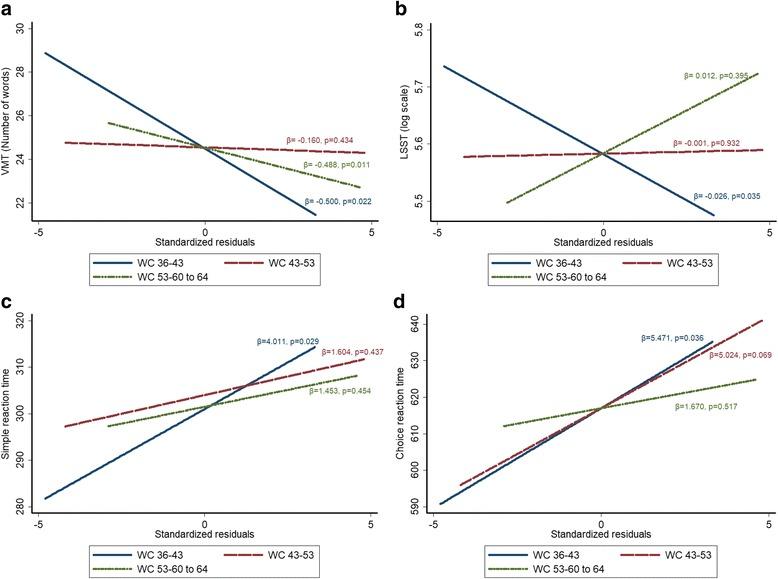
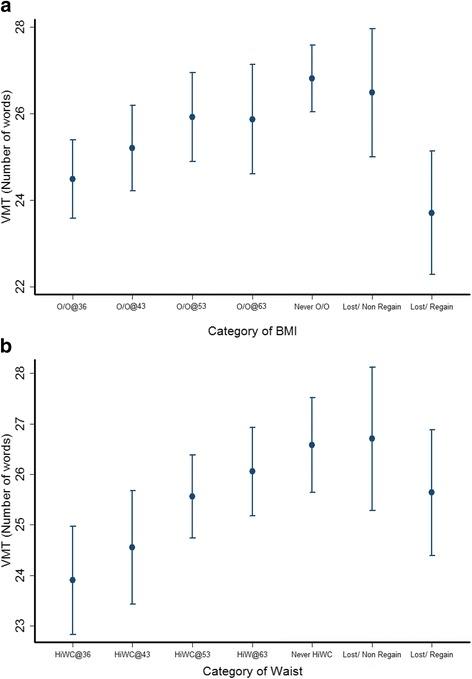
Longer exposure to elevated WC was related to lower memory performance (p < 0.001 for both) and longer choice reaction time (p = 0.003). A faster gain of WC between 36 and 43 years of age was associated with the largest change in reaction time and memory test (P < 0.05 for all). Similar associations were observed when patterns of WC were substituted with patterns of BMI, but when WC and BMI were included in the same model, only patterns of WC remained significantly associated with cognitive function. Participants who dropped one BMI category and maintained a lower BMI had similar memory performance to those of normal weight during the whole follow-up. Conversely, those who dropped and subsequently regained one BMI category had a memory function similar to those with 30 years exposure to elevated BMI. Adjustment for vascular phenotypes, levels of cardiovascular risk factors, physical activity, education, childhood cognition and socioeconomic position did not affect these associations.
CONCLUSIONS
Longer exposure to elevated WC or BMI and faster WC or BMI gains between 36 and 43 years are related to lower cognitive function at 60-64 years. Patterns of WC in adulthood could provide additional information in predicting late midlife cognitive function than patterns of BMI. The acquisition of an adverse cardiovascular phenotype associated with adiposity is unlikely to account for these relationships.
背景
长期暴露于全身或中心性肥胖与认知功能之间的关系,以及其潜在的决定因素,仍存在争议。在这项研究中,我们评估了:(1)30 年暴露于全身和中心性肥胖的不同模式对 60-64 岁时认知功能的潜在影响;(2)与全身脂肪量的轨迹相比,中心性肥胖的轨迹是否能提供更多关于后期认知功能的信息;(3)血管表型对这些关联的影响。
方法
本研究纳入了前瞻性队列 MRC 国家健康与发展调查中的 1249 名参与者。使用 60-64 岁时的身体质量指数(BMI)、腰围(WC)、血管(颈动脉内膜中层厚度、颈动脉-股动脉脉搏波速度)和认知功能(记忆、处理速度、反应时间)数据,评估了成年 WC 或 BMI 的不同模式(从 36 岁开始)与晚年中期认知表现之间的关系,以及心血管表型解释这种关联的比例。
结果
较长时间暴露于升高的 WC 与较低的记忆表现相关(均为 p<0.001)和更长的选择反应时间(p=0.003)。36 至 43 岁之间 WC 增加较快与反应时间和记忆测试的最大变化相关(均为 p<0.05)。当 WC 模式取代 BMI 模式时,观察到类似的关联,但当 WC 和 BMI 同时纳入同一模型时,只有 WC 模式仍与认知功能显著相关。体重指数下降一个类别并保持较低体重指数的参与者在整个随访期间的记忆表现与正常体重的参与者相似。相反,体重指数下降后又恢复的参与者的记忆功能与 30 年暴露于升高的体重指数相似。调整血管表型、心血管危险因素水平、体育活动、教育、儿童认知和社会经济地位并不影响这些关联。
结论
较长时间暴露于升高的 WC 或 BMI 以及 36 至 43 岁之间 WC 或 BMI 增加较快与 60-64 岁时较低的认知功能有关。成年期 WC 模式比 BMI 模式更能提供预测晚年中期认知功能的额外信息。与肥胖相关的不良心血管表型的获得不太可能导致这些关系。
 Zotero 插件