
新型防滥用剂型吗啡ARER的鼻内药代动力学:在非依赖阿片类药物的有经验受试者中进行的随机、双盲、四交叉研究结果
Intranasal Pharmacokinetics of Morphine ARER, a Novel Abuse-Deterrent Formulation: Results from a Randomized, Double-Blind, Four-Way Crossover Study in Nondependent, Opioid-Experienced Subjects.
作者信息
Webster Lynn R, Pantaleon Carmela, Iverson Matthew, Smith Michael D, Kinzler Eric R, Aigner Stefan
机构信息
PRA Health Sciences, Salt Lake City, UT, USA.
Inspirion Delivery Sciences LLC, Morristown, NJ, USA.
出版信息
Pain Res Manag. 2018 Apr 23;2018:7276021. doi: 10.1155/2018/7276021. eCollection 2018.
OBJECTIVE
To investigate the pharmacokinetics (PK) of Morphine ARER, an extended-release (ER), abuse-deterrent formulation of morphine sulfate after oral and intranasal administration.
METHODS
This randomized, double-blind, double-dummy, placebo-controlled, four-way crossover study assessed the PK of morphine and its active metabolite, M6G, from crushed intranasal Morphine ARER and intact oral Morphine ARER compared with crushed intranasal ER morphine following administration to nondependent, recreational opioid users. The correlation between morphine PK and the pharmacodynamic parameter of drug liking, a measure of abuse potential, was also evaluated.
RESULTS
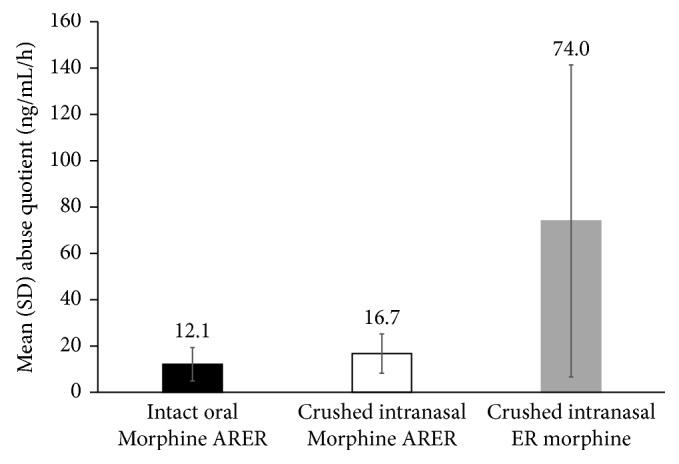
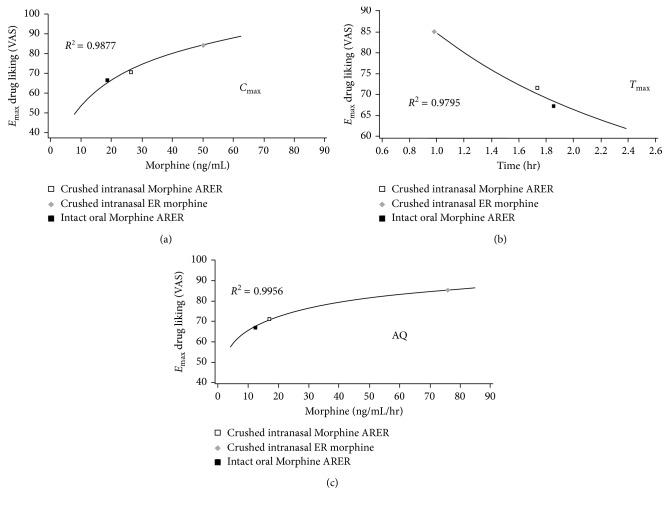
Mean maximum observed plasma concentration () for morphine was lower with crushed intranasal Morphine ARER (26.2 ng/mL) and intact oral Morphine ARER (18.6 ng/mL), compared with crushed intranasal ER morphine (49.5 ng/mL). The time to () was the same for intact oral and crushed intranasal Morphine ARER (1.6 hours) and longer for crushed intranasal morphine ER (1.1 hours). Higher mean maximum morphine , , and abuse quotient (/) were positively correlated with maximum effect for drug liking ( ≥ 0.9795).
CONCLUSION
These data suggest that Morphine ARER maintains its ER profile despite physical manipulation and intranasal administration, which may be predictive of a lower intranasal abuse potential compared with ER morphine.
目的
研究硫酸吗啡缓释、防滥用制剂吗啡ARER经口服和鼻内给药后的药代动力学(PK)。
方法
这项随机、双盲、双模拟、安慰剂对照、四交叉研究评估了非依赖型娱乐性阿片类药物使用者服用碾碎的鼻内吗啡ARER和完整的口服吗啡ARER后,吗啡及其活性代谢物M6G的药代动力学,并与碾碎的鼻内缓释吗啡进行比较。还评估了吗啡药代动力学与药物喜好这一滥用潜力指标的药效学参数之间的相关性。
结果
与碾碎的鼻内缓释吗啡(49.5 ng/mL)相比,碾碎的鼻内吗啡ARER(26.2 ng/mL)和完整的口服吗啡ARER(18.6 ng/mL)的吗啡平均最大观察血浆浓度()较低。完整口服和碾碎鼻内吗啡ARER达到()的时间相同(1.6小时),而碾碎鼻内缓释吗啡的时间更长(1.1小时)。较高的吗啡平均最大、和滥用商数(/)与药物喜好的最大效应呈正相关(≥0.9795)。
结论
这些数据表明,尽管吗啡ARER经过物理处理和鼻内给药,但其仍保持缓释特性,与缓释吗啡相比,这可能预示着鼻内滥用潜力较低。


 Zotero 插件