
嵌合抗原受体 T 细胞免疫疗法治疗实体瘤的展望。
Perspectives on Chimeric Antigen Receptor T-Cell Immunotherapy for Solid Tumors.
机构信息
Faculty of Life Sciences and Medicine, School of Cancer and Pharmaceutical Sciences, King's College London, Guy's Hospital, London, United Kingdom.
Department of Immunology, Eastbourne Hospital, Eastbourne, East Sussex, United Kingdom.
出版信息
Front Immunol. 2018 May 22;9:1104. doi: 10.3389/fimmu.2018.01104. eCollection 2018.
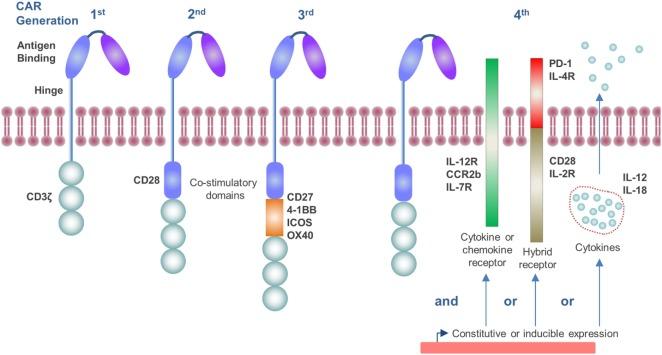
Chimeric antigen receptor (CAR) T-cell therapy entails the genetic engineering of a patient's T-cells to express membrane spanning fusion receptors with defined specificities for tumor-associated antigens. These CARs are capable of eliciting robust T-cell activation to initiate killing of the target tumor cells. This therapeutic approach has produced unprecedented clinical outcomes in the treatment of "liquid" hematologic cancers, but to date has not produced comparable responses in targeting solid malignancies. Advances in our understanding of the immunobiology of solid tumors have highlighted several hurdles which currently hinder the efficacy of this therapy. These barriers include the insufficient accumulation of CAR T-cells in the tumor due to poor trafficking or physical exclusion and the exposure of infiltrating CAR T-cells to a panoply of immune suppressive checkpoint molecules, cytokines, and metabolic stresses that are not conducive to efficient immune reactions and can thereby render these cells anergic, exhausted, or apoptotic. This mini-review summarizes these hurdles and describes some recent approaches and innovations to genetically re-engineer CAR T-cells to counter inhibitory influences found in the tumor microenvironment. Novel immunotherapy drug combinations to potentiate the activity of CAR T-cells are also discussed. As our understanding of the immune landscape of tumors improves and our repertoire of immunotherapeutic drugs expands, it is envisaged that the efficacy of CAR T-cells against solid tumors might be potentiated using combination therapies, which it is hoped may lead to meaningful improvements in clinical outcome for patients with refractory solid malignancies.
嵌合抗原受体 (CAR) T 细胞疗法需要对患者的 T 细胞进行基因工程改造,使其表达具有特定肿瘤相关抗原特异性的跨膜融合受体。这些 CAR 能够引发强大的 T 细胞激活,从而启动对靶肿瘤细胞的杀伤。这种治疗方法在治疗“液体”血液恶性肿瘤方面取得了前所未有的临床效果,但迄今为止,在靶向实体恶性肿瘤方面尚未产生可比的反应。我们对实体肿瘤免疫生物学的理解的进步强调了几个目前阻碍这种治疗效果的障碍。这些障碍包括由于不良运输或物理排斥导致 CAR T 细胞在肿瘤中的积累不足,以及浸润的 CAR T 细胞暴露于多种免疫抑制检查点分子、细胞因子和代谢应激下,这些都不利于有效的免疫反应,从而使这些细胞变得无反应、耗竭或凋亡。这篇迷你综述总结了这些障碍,并描述了一些最近的方法和创新,以对 CAR T 细胞进行基因重工程改造,以对抗肿瘤微环境中发现的抑制性影响。还讨论了增强 CAR T 细胞活性的新型免疫治疗药物组合。随着我们对肿瘤免疫景观的理解的提高和我们的免疫治疗药物库的扩大,可以预见,通过联合治疗可以增强 CAR T 细胞对实体肿瘤的疗效,希望这可能会导致对难治性实体恶性肿瘤患者的临床结果的显著改善。

 Zotero 插件