
替莫唑胺淋巴细胞清除增强嵌合抗原受体(CAR)丰度,并与针对已建立的胶质母细胞瘤的抗肿瘤疗效相关。
Temozolomide lymphodepletion enhances CAR abundance and correlates with antitumor efficacy against established glioblastoma.
作者信息
Suryadevara Carter M, Desai Rupen, Abel Melissa L, Riccione Katherine A, Batich Kristen A, Shen Steven H, Chongsathidkiet Pakawat, Gedeon Patrick C, Elsamadicy Aladine A, Snyder David J, Herndon James E, Healy Patrick, Archer Gary E, Choi Bryan D, Fecci Peter E, Sampson John H, Sanchez-Perez Luis
机构信息
Duke Brain Tumor Immunotherapy Program, Department of Neurosurgery, Duke University Medical Center, Durham, NC.
The Preston Robert Tisch Brain Tumor Center, Department of Neurosurgery, Duke University Medical Center, Durham, NC.
出版信息
Oncoimmunology. 2018 Feb 21;7(6):e1434464. doi: 10.1080/2162402X.2018.1434464. eCollection 2018.
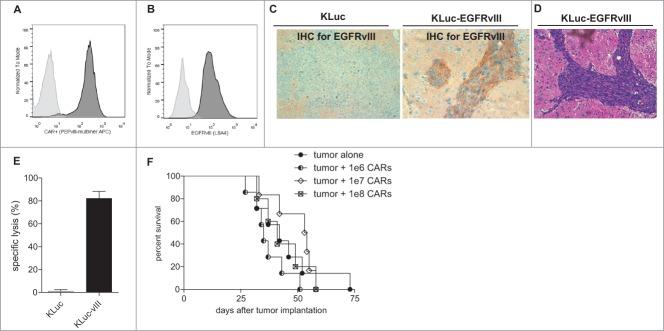
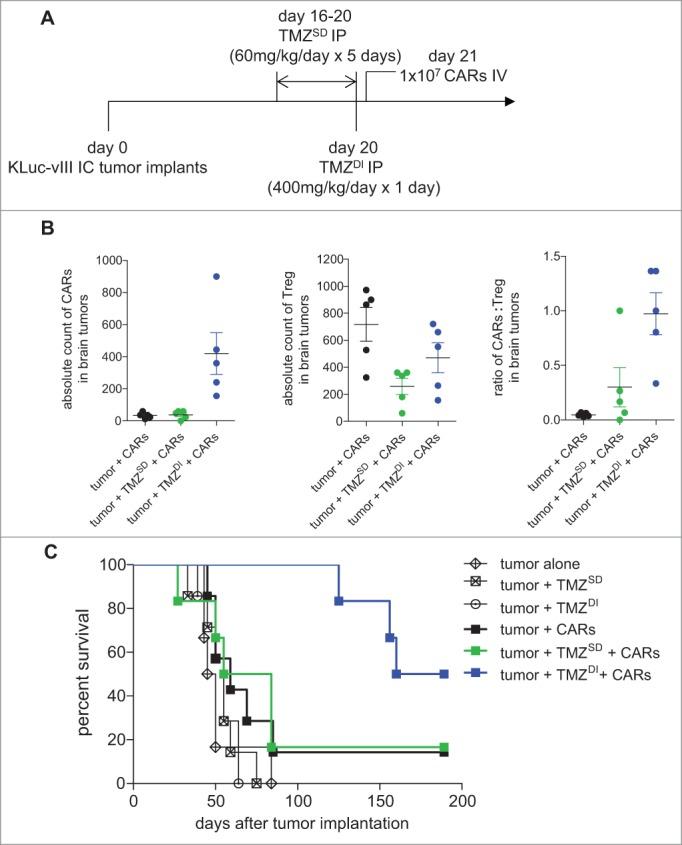
Adoptive transfer of T cells expressing chimeric antigen receptors (CARs) is an effective immunotherapy for B-cell malignancies but has failed in some solid tumors clinically. Intracerebral tumors may pose challenges that are even more significant. In order to devise a treatment strategy for patients with glioblastoma (GBM), we evaluated CARs as a monotherapy in a murine model of GBM. CARs exhibited poor expansion and survival in circulation and failed to treat syngeneic and orthotopic gliomas. We hypothesized that CAR engraftment would benefit from host lymphodepletion prior to immunotherapy and that this might be achievable by using temozolomide (TMZ), which is standard treatment for these patients and has lymphopenia as its major side effect. We modelled standard of care temozolomide (TMZ) and dose-intensified TMZ (TMZ) in our murine model. Both regimens are clinically approved and provide similar efficacy. Only TMZ pretreatment prompted dramatic CAR proliferation and enhanced persistence in circulation compared to treatment with CARs alone or TMZ + CARs. Bioluminescent imaging revealed that TMZ + CARs induced complete regression of 21-day established brain tumors, which correlated with CAR abundance in circulation. Accordingly, TMZ + CARs significantly prolonged survival and led to long-term survivors. These findings are highly consequential, as it suggests that GBM patients may require TMZ as first line chemotherapy prior to systemic CAR infusion to promote CAR engraftment and antitumor efficacy. On this basis, we have initiated a phase I trial in patients with newly diagnosed GBM incorporating TMZ as a preconditioning regimen prior to CAR immunotherapy (NCT02664363).
过继转移表达嵌合抗原受体(CAR)的T细胞是治疗B细胞恶性肿瘤的一种有效免疫疗法,但在一些实体瘤的临床治疗中却失败了。脑内肿瘤可能带来更为严峻的挑战。为了设计出针对胶质母细胞瘤(GBM)患者的治疗策略,我们在GBM小鼠模型中评估了CAR作为单一疗法的效果。CAR在循环系统中的扩增和存活情况较差,无法治疗同基因和原位胶质瘤。我们推测,在免疫治疗前进行宿主淋巴细胞清除将有利于CAR植入,而这或许可以通过使用替莫唑胺(TMZ)来实现,TMZ是这些患者的标准治疗药物,其主要副作用是淋巴细胞减少。我们在小鼠模型中模拟了标准治疗剂量的替莫唑胺(TMZ)和高剂量强度的TMZ。这两种方案均已获得临床批准且疗效相似。与单独使用CAR或TMZ + CAR治疗相比,只有TMZ预处理能促使CAR显著增殖并增强其在循环系统中的持久性。生物发光成像显示,TMZ + CAR可使已形成21天的脑肿瘤完全消退,这与循环系统中CAR的丰度相关。因此,TMZ + CAR显著延长了生存期,并产生了长期存活者。这些发现具有重大意义,因为这表明GBM患者在进行全身性CAR输注之前可能需要将TMZ作为一线化疗药物,以促进CAR植入和抗肿瘤疗效。在此基础上,我们已启动一项针对新诊断GBM患者的I期试验,在CAR免疫治疗之前将TMZ作为预处理方案(NCT02664363)。



 Zotero 插件