
临床试验设计与传播:2005 年以来对 ClinicalTrials.gov 和 PubMed 数据的综合分析。
Clinical trial design and dissemination: comprehensive analysis of clinicaltrials.gov and PubMed data since 2005.
机构信息
BenevolentBio Ltd, London NW1 1LW, UK.
Institute of Cardiovascular Science, University College London, London, UK.
出版信息
BMJ. 2018 Jun 6;361:k2130. doi: 10.1136/bmj.k2130.
OBJECTIVE
To investigate the distribution, design characteristics, and dissemination of clinical trials by funding organisation and medical specialty.
DESIGN
Cross sectional descriptive analysis.
DATA SOURCES
Trial protocol information from clinicaltrials.gov, metadata of journal articles in which trial results were published (PubMed), and quality metrics of associated journals from SCImago Journal and Country Rank database.
SELECTION CRITERIA
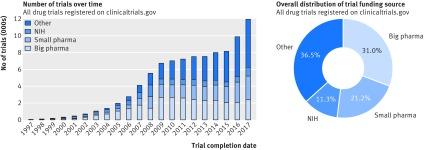
All 45 620 clinical trials evaluating small molecule therapeutics, biological drugs, adjuvants, and vaccines, completed after January 2006 and before July 2015, including randomised controlled trials and non-randomised studies across all clinical phases.
RESULTS
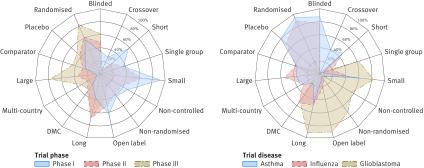
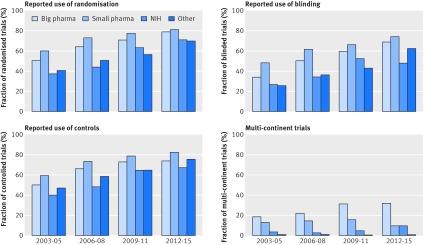
Industry was more likely than non-profit funders to fund large international randomised controlled trials, although methodological differences have been decreasing with time. Among 27 835 completed efficacy trials (phase II-IV), 15 084 (54.2%) had disclosed their findings publicly. Industry was more likely than non-profit trial funders to disseminate trial results (59.3% (10 444/17 627) 45.3% (4555/10 066)), and large drug companies had higher disclosure rates than small ones (66.7% (7681/11 508) 45.2% (2763/6119)). Trials funded by the National Institutes of Health (NIH) were disseminated more often than those of other non-profit institutions (60.0% (1451/2417) 40.6% (3104/7649)). Results of studies funded by large drug companies and NIH were more likely to appear on clinicaltrials.gov than were those from non-profit funders, which were published mainly as journal articles. Trials reporting the use of randomisation were more likely than non-randomised studies to be published in a journal article (6895/19 711 (34.9%) 1408/7748 (18.2%)), and journal publication rates varied across disease areas, ranging from 42% for autoimmune diseases to 20% for oncology.
CONCLUSIONS
Trial design and dissemination of results vary substantially depending on the type and size of funding institution as well as the disease area under study.
目的
研究按资助机构和医学专业分类的临床试验的分布、设计特点和传播情况。
设计
横断面描述性分析。
资料来源
来自 clinicaltrials.gov 的试验方案信息、已发表试验结果的期刊文章的元数据(PubMed),以及来自 SCImago Journal and Country Rank 数据库的相关期刊的质量指标。
选择标准
所有在 2006 年 1 月后至 2015 年 7 月前完成的小分子治疗药物、生物药物、佐剂和疫苗的临床试验,包括所有临床阶段的随机对照试验和非随机研究。
结果
尽管方法学差异随时间逐渐减少,但与非营利性资助者相比,工业界更有可能资助大型国际随机对照试验。在 27835 项已完成的疗效试验(II-IV 期)中,有 15084 项(54.2%)公开了研究结果。与非营利性试验资助者相比,工业界更有可能传播试验结果(59.3%(10444/17627)比 45.3%(4555/10066)),大型制药公司的披露率高于小型制药公司(66.7%(7681/11508)比 45.2%(2763/6119))。美国国立卫生研究院(NIH)资助的试验比其他非营利机构资助的试验更常被传播(60.0%(1451/2417)比 40.6%(3104/7649))。与非营利性资助者相比,主要在期刊文章中发表的大型制药公司和 NIH 资助的研究结果更有可能出现在 clinicaltrials.gov 上。报告随机分组使用情况的试验比非随机研究更有可能在期刊文章中发表(6895/19711(34.9%)比 1408/7748(18.2%)),并且期刊发表率因疾病领域而异,从自身免疫疾病的 42%到肿瘤学的 20%不等。
结论
试验设计和结果传播在很大程度上取决于资助机构的类型和规模以及研究的疾病领域。




 Zotero 插件