
一种正反馈放大器电路,可调节干扰素(IFN)刺激基因表达,并控制 I 型和 II 型 IFN 反应。
A Positive Feedback Amplifier Circuit That Regulates Interferon (IFN)-Stimulated Gene Expression and Controls Type I and Type II IFN Responses.
机构信息
Department of Human Molecular Genetics, Faculty of Biology, Institute of Molecular Biology and Biotechnology, Adam Mickiewicz University, Poznan, Poland.
Laboratory of High Throughput Technologies, Faculty of Biology, Institute of Molecular Biology and Biotechnology, Adam Mickiewicz University, Poznan, Poland.
出版信息
Front Immunol. 2018 May 28;9:1135. doi: 10.3389/fimmu.2018.01135. eCollection 2018.
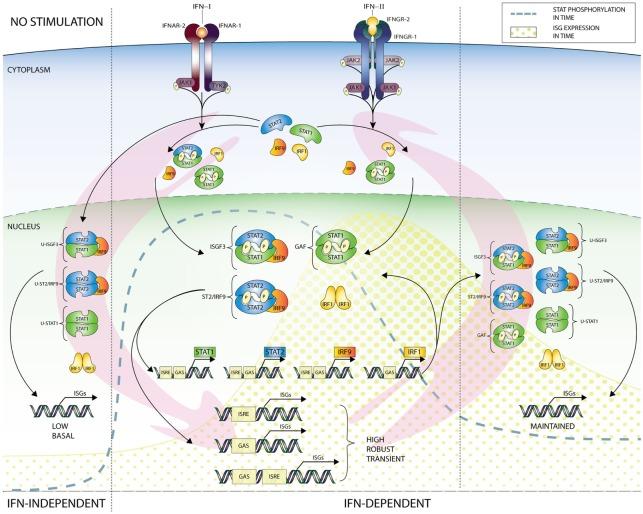
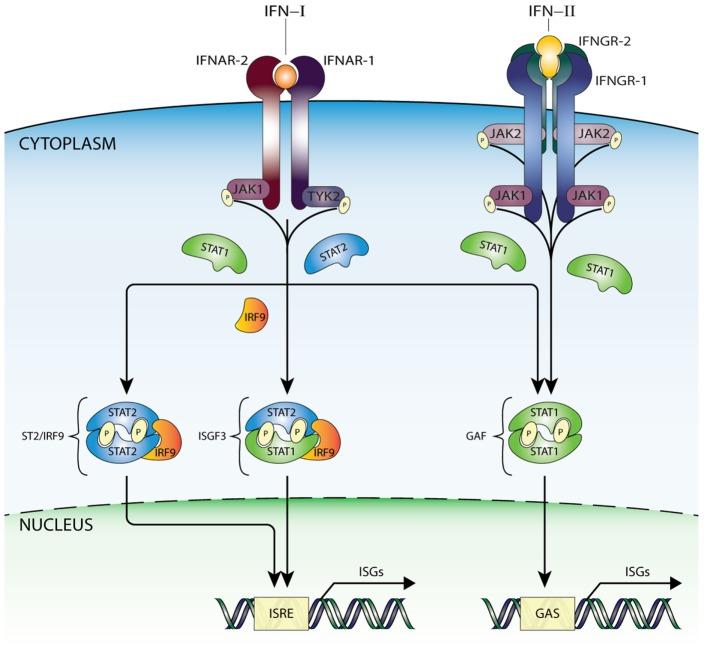
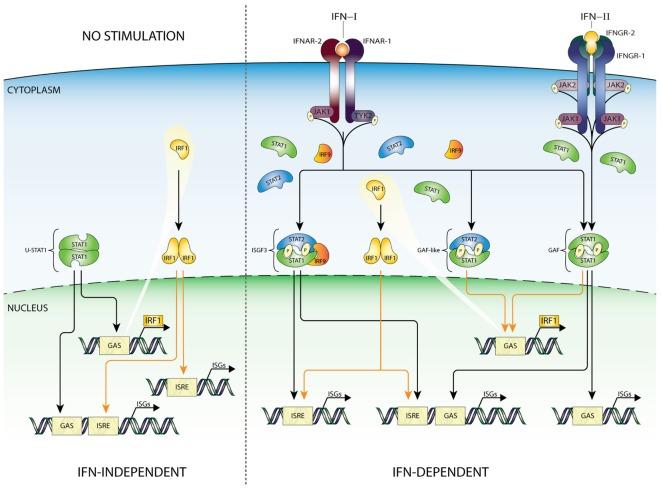
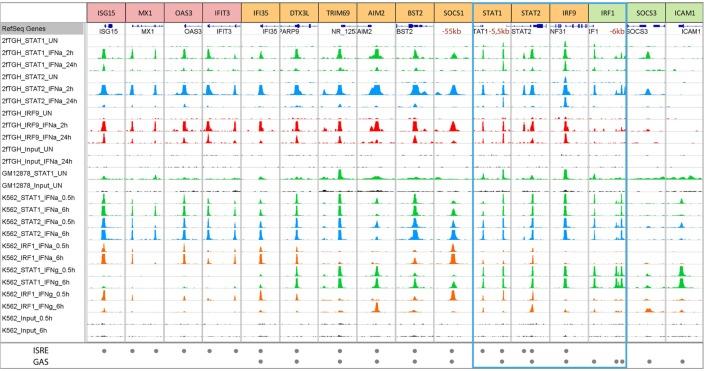
Interferon (IFN)-I and IFN-II both induce IFN-stimulated gene (ISG) expression through Janus kinase (JAK)-dependent phosphorylation of signal transducer and activator of transcription (STAT) 1 and STAT2. STAT1 homodimers, known as γ-activated factor (GAF), activate transcription in response to all types of IFNs by direct binding to IFN-II activation site (γ-activated sequence)-containing genes. Association of interferon regulatory factor (IRF) 9 with STAT1-STAT2 heterodimers [known as interferon-stimulated gene factor 3 (ISGF3)] or with STAT2 homodimers (STAT2/IRF9) in response to IFN-I, redirects these complexes to a distinct group of target genes harboring the interferon-stimulated response element (ISRE). Similarly, IRF1 regulates expression of ISGs in response to IFN-I and IFN-II by directly binding the ISRE or IRF-responsive element. In addition, evidence is accumulating for an IFN-independent and -dependent role of unphosphorylated STAT1 and STAT2, with or without IRF9, and IRF1 in basal as well as long-term ISG expression. This review provides insight into the existence of an intracellular amplifier circuit regulating ISG expression and controlling long-term cellular responsiveness to IFN-I and IFN-II. The exact timely steps that take place during IFN-activated feedback regulation and the control of ISG transcription and long-term cellular responsiveness to IFN-I and IFN-II is currently not clear. Based on existing literature and our novel data, we predict the existence of a multifaceted intracellular amplifier circuit that depends on unphosphorylated and phosphorylated ISGF3 and GAF complexes and IRF1. In a combinatorial and timely fashion, these complexes mediate prolonged ISG expression and control cellular responsiveness to IFN-I and IFN-II. This proposed intracellular amplifier circuit also provides a molecular explanation for the existing overlap between IFN-I and IFN-II activated ISG expression.
干扰素 (IFN)-I 和 IFN-II 均可通过依赖 Janus 激酶 (JAK) 的信号转导和转录激活因子 (STAT) 1 和 STAT2 的磷酸化诱导 IFN 刺激基因 (ISG) 的表达。STAT1 同源二聚体,称为 γ-激活因子 (GAF),通过直接结合 IFN-II 激活位点 (γ-激活序列) 包含的基因,对所有类型的 IFN 作出反应激活转录。干扰素调节因子 (IRF) 9 与 STAT1-STAT2 异源二聚体 [称为干扰素刺激基因因子 3 (ISGF3)] 或 STAT2 同源二聚体 (STAT2/IRF9) 结合,响应 IFN-I,将这些复合物重新定向到具有干扰素刺激反应元件 (ISRE) 的一组不同的靶基因。同样,IRF1 通过直接结合 ISRE 或 IRF 反应元件,调节 IFN-I 和 IFN-II 对 ISG 的表达。此外,越来越多的证据表明,未磷酸化的 STAT1 和 STAT2 及其与 IRF9 和 IRF1 的结合,在基础和长期 ISG 表达中具有 IFN 非依赖性和依赖性作用。本综述深入了解了调节 ISG 表达和控制 IFN-I 和 IFN-II 对细胞长期反应性的细胞内放大器电路的存在。在 IFN 激活的反馈调节和 ISG 转录以及 IFN-I 和 IFN-II 对细胞长期反应性的控制过程中,确切的时间步骤目前尚不清楚。基于现有文献和我们的新数据,我们预测存在一个多方面的细胞内放大器电路,该电路依赖于未磷酸化和磷酸化的 ISGF3 和 GAF 复合物以及 IRF1。这些复合物以组合和及时的方式介导延长的 ISG 表达并控制 IFN-I 和 IFN-II 对细胞的反应性。该提议的细胞内放大器电路还为 IFN-I 和 IFN-II 激活的 ISG 表达之间存在的重叠提供了分子解释。

 Zotero 插件