
利用电子健康记录数据开发深度学习模型的机遇与挑战:系统综述。
Opportunities and challenges in developing deep learning models using electronic health records data: a systematic review.
机构信息
AI for Healthcare, IBM Research, Cambridge, Massachusetts, USA.
School of Computational Science and Engineering, Georgia Institute of Technology, Atlanta, Georgia, USA.
出版信息
J Am Med Inform Assoc. 2018 Oct 1;25(10):1419-1428. doi: 10.1093/jamia/ocy068.
OBJECTIVE
To conduct a systematic review of deep learning models for electronic health record (EHR) data, and illustrate various deep learning architectures for analyzing different data sources and their target applications. We also highlight ongoing research and identify open challenges in building deep learning models of EHRs.
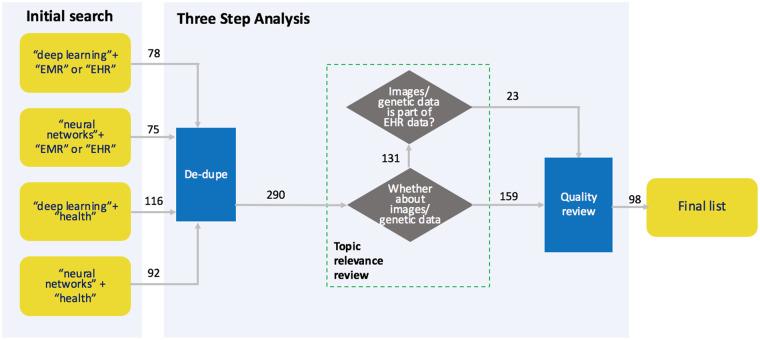
DESIGN/METHOD: We searched PubMed and Google Scholar for papers on deep learning studies using EHR data published between January 1, 2010, and January 31, 2018. We summarize them according to these axes: types of analytics tasks, types of deep learning model architectures, special challenges arising from health data and tasks and their potential solutions, as well as evaluation strategies.
RESULTS
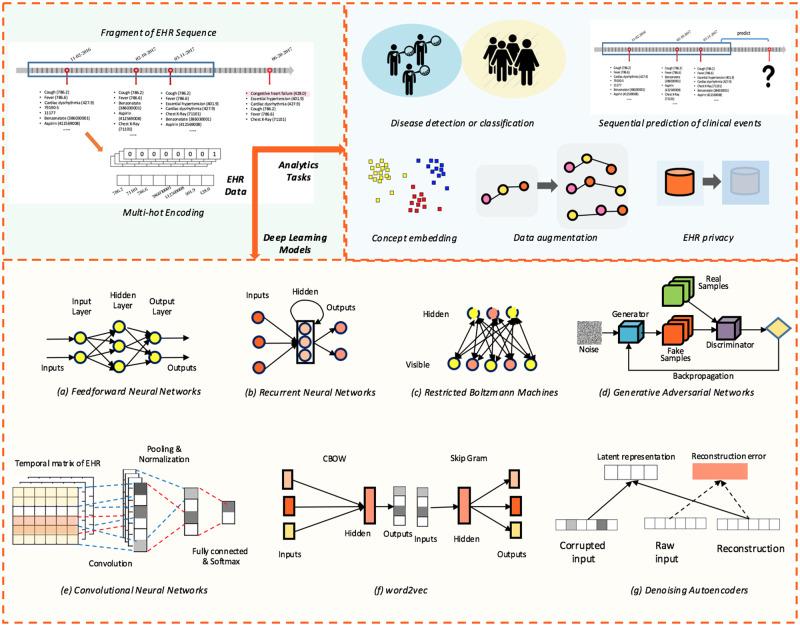
We surveyed and analyzed multiple aspects of the 98 articles we found and identified the following analytics tasks: disease detection/classification, sequential prediction of clinical events, concept embedding, data augmentation, and EHR data privacy. We then studied how deep architectures were applied to these tasks. We also discussed some special challenges arising from modeling EHR data and reviewed a few popular approaches. Finally, we summarized how performance evaluations were conducted for each task.
DISCUSSION
Despite the early success in using deep learning for health analytics applications, there still exist a number of issues to be addressed. We discuss them in detail including data and label availability, the interpretability and transparency of the model, and ease of deployment.
目的
对电子病历(EHR)数据的深度学习模型进行系统评价,并举例说明各种深度学习架构,用于分析不同的数据源及其目标应用。我们还强调了正在进行的研究,并确定了构建 EHR 深度学习模型的开放性挑战。
设计/方法:我们在 PubMed 和 Google Scholar 上搜索了 2010 年 1 月 1 日至 2018 年 1 月 31 日期间发表的使用 EHR 数据的深度学习研究论文。我们根据以下方面对它们进行了总结:分析任务类型、深度学习模型架构类型、健康数据和任务带来的特殊挑战及其潜在解决方案,以及评估策略。
结果
我们对我们发现的 98 篇文章进行了调查和分析,确定了以下分析任务:疾病检测/分类、临床事件的序列预测、概念嵌入、数据增强和 EHR 数据隐私。然后,我们研究了深度学习架构如何应用于这些任务。我们还讨论了从建模 EHR 数据中出现的一些特殊挑战,并回顾了几种流行的方法。最后,我们总结了每个任务的性能评估是如何进行的。
讨论
尽管在使用深度学习进行健康分析应用方面取得了早期成功,但仍存在许多需要解决的问题。我们详细讨论了这些问题,包括数据和标签的可用性、模型的可解释性和透明度,以及部署的简便性。
 Zotero 插件