
叶酸补充的细菌途径。
A bacterial route for folic acid supplementation.
机构信息
Department of Biosciences, Durham University, Stockton Road, Durham, DH1 3LE, UK.
Midwestern University, Illinois, Downers Grove, IL, 60515, USA.
出版信息
BMC Biol. 2018 Jun 15;16(1):67. doi: 10.1186/s12915-018-0534-3.
BACKGROUND
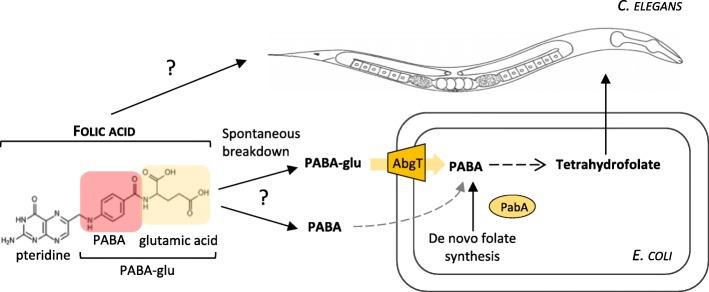
To prevent folate deficiencies, many countries supplement various foodstuffs with folic acid. This compound is a synthetic oxidised folate that differs from naturally occurring reduced folates in its metabolism and uptake. Notably, safety reviews of folic acid supplementation have not considered interactions with gut bacteria. Here, we use the Caenorhabditis elegans - Escherichia coli animal- microbe model to examine a possible bacterial route for folic acid uptake. It has been assumed that supplements are taken up directly by the worm, especially because E. coli is unable to take up folates. However, E. coli, like many other bacteria, can transport the folate breakdown product, para-aminobenzoate-glutamate (PABA-glu), via AbgT and use it for bacterial folate synthesis. This pathway may impact host health because inhibition of bacterial folate synthesis increases C. elegans lifespan.
RESULTS
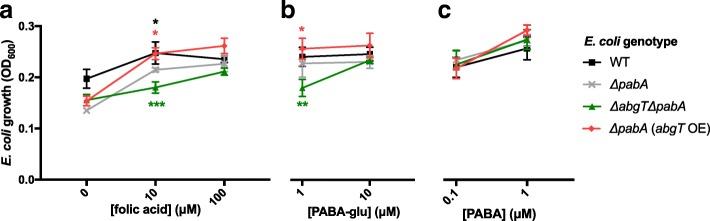
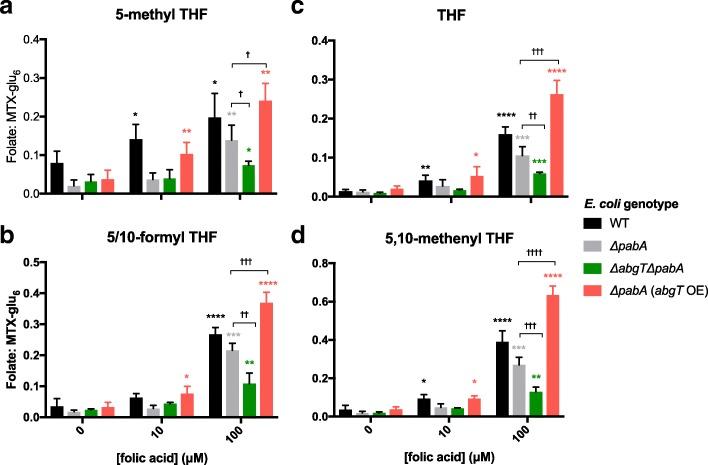
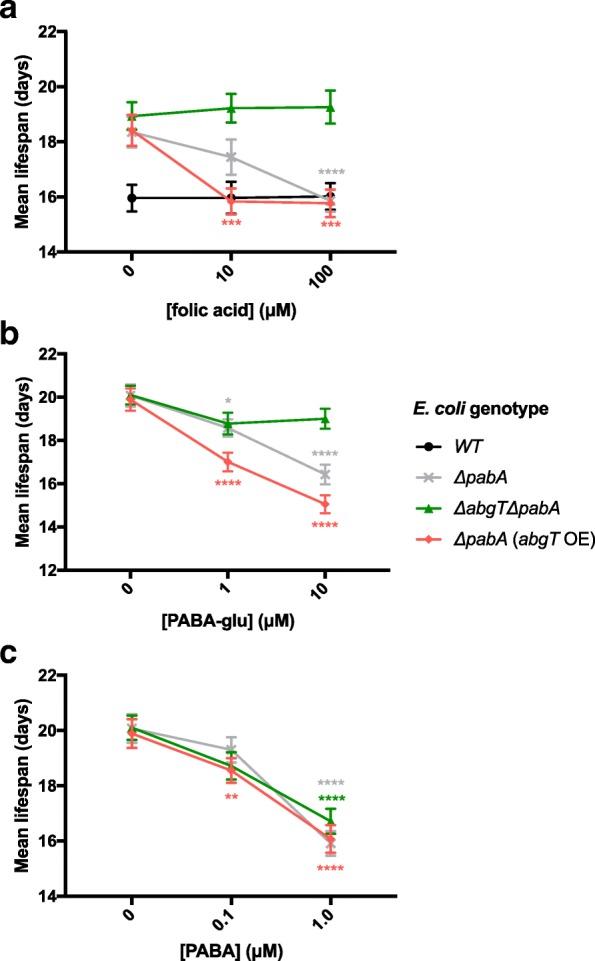
Folic acid supplementation was found to rescue a C. elegans developmental folate-deficient mutant; however, a much higher concentration was required compared to folinic acid, a reduced folate. Unlike folinic acid, the effectiveness of folic acid supplementation was dependent on the E. coli gene, abgT, suggesting a bacterial route with PABA-glu uptake by E. coli as a first step. Surprisingly, we found up to 4% PABA-glu in folic acid preparations, including in a commercial supplement. Via breakdown to PABA-glu, folic acid increases E. coli folate synthesis. This pathway restores folate synthesis in a bacterial mutant defective in PABA synthesis, reversing the ability of this mutant to increase C. elegans lifespan.
CONCLUSIONS
Folic acid supplementation in C. elegans occurs chiefly indirectly via bacterial uptake of breakdown products via E. coli AbgT, and can impact C. elegans development and longevity. Examining how folic acid supplementation affects bacterial folate synthesis in the human gut may help us to better understand the safety of folic acid supplementation.
背景
为了预防叶酸缺乏,许多国家在多种食品中添加叶酸。这种化合物是一种合成的氧化叶酸,其代谢和吸收与天然存在的还原叶酸不同。值得注意的是,叶酸补充剂的安全性评估并未考虑与肠道细菌的相互作用。在这里,我们使用秀丽隐杆线虫-大肠杆菌动物-微生物模型来研究叶酸摄取的一种可能的细菌途径。人们一直认为,补充剂是被蠕虫直接吸收的,尤其是因为大肠杆菌无法吸收叶酸。然而,与许多其他细菌一样,大肠杆菌可以通过 AbgT 转运叶酸分解产物对氨基苯甲酸谷氨酸(PABA-glu),并将其用于细菌叶酸合成。这条途径可能会影响宿主健康,因为抑制细菌叶酸合成会增加秀丽隐杆线虫的寿命。
结果
我们发现叶酸补充剂可以挽救秀丽隐杆线虫发育性叶酸缺乏突变体;然而,与还原叶酸叶酸啉酸相比,所需浓度要高得多。与叶酸啉酸不同,叶酸补充剂的有效性取决于大肠杆菌基因 abgT,这表明存在一种细菌途径,首先是大肠杆菌通过 PABA-glu 摄取。令人惊讶的是,我们发现高达 4%的 PABA-glu 存在于叶酸制剂中,包括商业补充剂中。通过分解为 PABA-glu,叶酸增加了大肠杆菌的叶酸合成。这条途径可以恢复在 PABA 合成缺陷型细菌突变体中的叶酸合成,从而逆转该突变体增加秀丽隐杆线虫寿命的能力。
结论
在秀丽隐杆线虫中,叶酸补充主要是通过大肠杆菌 AbgT 摄取分解产物间接发生的,这可能会影响秀丽隐杆线虫的发育和寿命。检查叶酸补充剂如何影响人类肠道中的细菌叶酸合成,可能有助于我们更好地理解叶酸补充剂的安全性。



 Zotero 插件