
高剂量利福平治疗缩短的潜力:肺结核患者药物暴露与治疗反应的关系。
The Potential for Treatment Shortening With Higher Rifampicin Doses: Relating Drug Exposure to Treatment Response in Patients With Pulmonary Tuberculosis.
机构信息
Department of Pharmacy, Radboud Institute for Health Sciences, Radboud University Medical Center, Nijmegen, The Netherlands.
Department of Pharmaceutical Biosciences, Uppsala University, Sweden.
出版信息
Clin Infect Dis. 2018 Jun 18;67(1):34-41. doi: 10.1093/cid/ciy026.
BACKGROUND
Tuberculosis remains a huge public health problem and the prolonged treatment duration obstructs effective tuberculosis control. Higher rifampicin doses have been associated with better bactericidal activity, but optimal dosing is uncertain. This analysis aimed to characterize the relationship between rifampicin plasma exposure and treatment response over 6 months in a recent study investigating the potential for treatment shortening with high-dose rifampicin.
METHODS
Data were analyzed from 336 patients with pulmonary tuberculosis (97 with pharmacokinetic data) treated with rifampicin doses of 10, 20, or 35 mg/kg. The response measure was time to stable sputum culture conversion (TSCC). We derived individual exposure metrics with a previously developed population pharmacokinetic model of rifampicin. TSCC was modeled using a parametric time-to-event approach, and a sequential exposure-response analysis was performed.
RESULTS
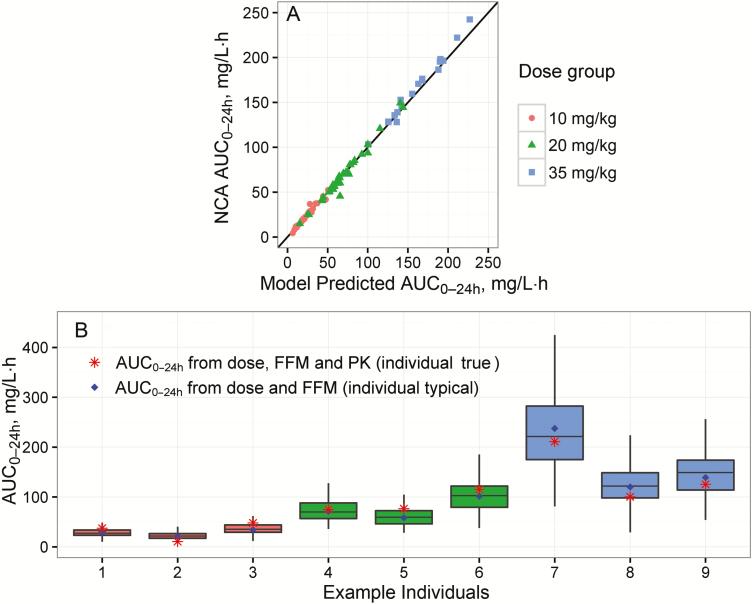
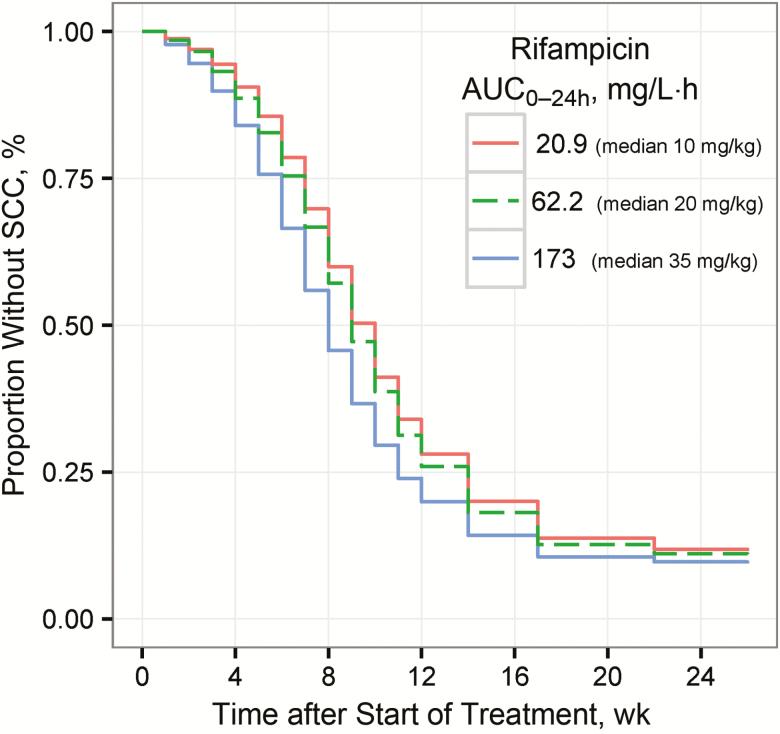
Higher rifampicin exposures increased the probability of early culture conversion. No maximal limit of the effect was detected within the observed range. The expected proportion of patients with stable culture conversion on liquid medium at week 8 was predicted to increase from 39% (95% confidence interval, 37%-41%) to 55% (49%-61%), with the rifampicin area under the curve increasing from 20 to 175 mg/L·h (representative for 10 and 35 mg/kg, respectively). Other predictors of TSCC were baseline bacterial load, proportion of culture results unavailable, and substitution of ethambutol for either moxifloxacin or SQ109.
CONCLUSIONS
Increasing rifampicin exposure shortened TSCC, and the effect did not plateau, indicating that doses >35 mg/kg could be yet more effective. Optimizing rifampicin dosage while preventing toxicity is a clinical priority.
背景
结核病仍然是一个巨大的公共卫生问题,而延长的治疗时间阻碍了有效的结核病控制。较高的利福平剂量与更好的杀菌活性相关,但最佳剂量不确定。本分析旨在描述最近一项研究中利福平血浆暴露与 6 个月治疗反应之间的关系,该研究旨在探讨高剂量利福平缩短治疗时间的潜力。
方法
对 336 例肺结核患者(97 例有药代动力学数据)进行了分析,他们接受了 10、20 或 35mg/kg 的利福平剂量治疗。反应测量是稳定痰培养转换(TSCC)的时间。我们使用先前开发的利福平群体药代动力学模型得出了个体暴露指标。使用参数时间事件方法对 TSCC 进行建模,并进行了序贯暴露-反应分析。
结果
较高的利福平暴露增加了早期培养转换的可能性。在观察到的范围内,未检测到效应的最大极限。预计在第 8 周时,液体培养基中稳定培养物转换的患者比例将从 39%(95%置信区间,37%-41%)增加到 55%(49%-61%),利福平 AUC 从 20 增加到 175mg/L·h(分别代表 10 和 35mg/kg)。TSCC 的其他预测因素包括基线细菌载量、无法获得培养结果的比例以及乙胺丁醇替代莫西沙星或 SQ109。
结论
增加利福平暴露缩短了 TSCC,并且该效果没有达到平台期,这表明剂量>35mg/kg 可能更有效。优化利福平剂量同时预防毒性是临床重点。


 Zotero 插件