
韩国肺癌的临床特征与预后因素:来自韩国全国肺癌登记处数据的初步研究
Clinical Characteristics and Prognostic Factors of Lung Cancer in Korea: A Pilot Study of Data from the Korean Nationwide Lung Cancer Registry.
作者信息
Kim Ho Cheol, Jung Chi Young, Cho Deog Gon, Jeon Jae Hyun, Lee Jeong Eun, Ahn Jin Seok, Kim Seung Joon, Kim Yeongdae, Kim Young Chul, Kim Jung Eun, Lee Boram, Won Young Joo, Choi Chang Min
机构信息
Department of Pulmonary and Critical Care Medicine, Asan Medical Center, University of Ulsan College of Medicine, Seoul, Korea.
Department of Internal Medicine, Catholic University of Daegu School of Medicine, Daegu, Korea.
出版信息
Tuberc Respir Dis (Seoul). 2019 Apr;82(2):118-125. doi: 10.4046/trd.2017.0128. Epub 2018 Jun 19.
BACKGROUND
Lung cancer is a leading cause of morbidity and mortality worldwide, and the incidence continues to rise. Although many prognostic factors have been identified, the clinical characteristics and outcomes in Korean lung cancer patients are not well defined.
METHODS
Of the 23,254 new lung cancer cases registered at the Korea Central Cancer Registry in 2013, total 489 patients from 19 hospitals were abstracted by the Korean Central Cancer Registry. The clinical data retrospectively analyzed, patients were followed up until December 2015.
RESULTS
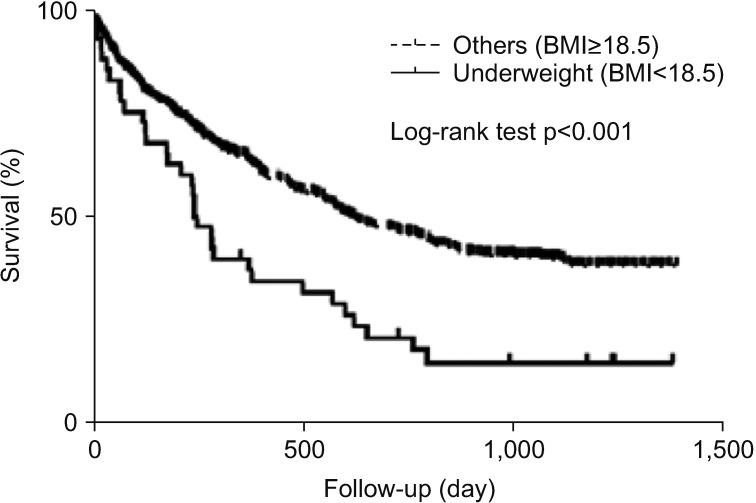
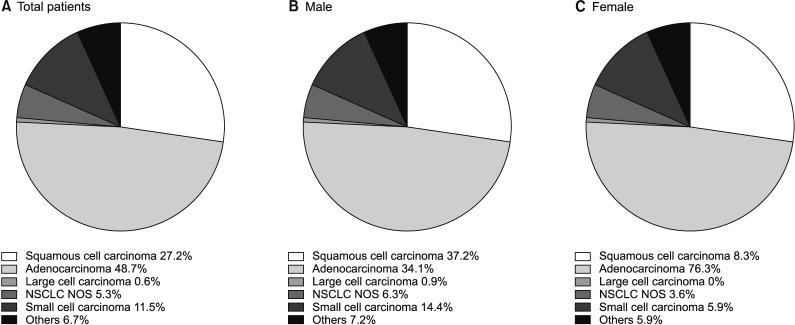
The median age was 69 years (interquartile range, 60-74 years); 65.4% were male and 62.1% were ever-smokers. Cough was the most common initial symptom (33.5%); 13.1% of patients were asymptomatic. While squamous cell carcinoma was the most common subtype in male patients (37.2%), adenocarcinoma was the most frequent histological type in all patients (48.7%) and females (76.3%). The majority of patients received treatment (76.5%), which included surgery, radiation therapy, and chemotherapy. Older age (hazard ratio [HR], 1.037), lower body mass index (HR, 0.904), ever-smoker (HR, 2.003), small cell lung cancer (HR, 1.627), and distant metastasis (HR, 3.990) were independent predictors of mortality. Patients without symptoms (HR, 0.387) and without treatment (HR, 0.364) were associated with a favorable outcome in multivariate Cox analysis.
CONCLUSION
Lung cancer in Korea occurs predominantly in elderly patients, with adenocarcinoma being the most frequent subtype. The prognosis was poorer in ever-smokers and older, malnourished, and untreated patients with advanced lung cancer.
背景
肺癌是全球发病和死亡的主要原因,且发病率持续上升。尽管已确定了许多预后因素,但韩国肺癌患者的临床特征和转归尚不明确。
方法
2013年韩国中央癌症登记处登记的23254例新发肺癌病例中,韩国中央癌症登记处从19家医院抽取了489例患者。对临床数据进行回顾性分析,对患者随访至2015年12月。
结果
中位年龄为69岁(四分位间距,60 - 74岁);65.4%为男性,62.1%为曾经吸烟者。咳嗽是最常见的初始症状(33.5%);13.1%的患者无症状。鳞状细胞癌是男性患者中最常见的亚型(37.2%),腺癌是所有患者(48.7%)和女性患者(76.3%)中最常见的组织学类型。大多数患者接受了治疗(76.5%),包括手术、放疗和化疗。年龄较大(风险比[HR],1.037)、体重指数较低(HR,0.904)、曾经吸烟者(HR,2.003)、小细胞肺癌(HR,1.627)和远处转移(HR,3.990)是死亡的独立预测因素。在多因素Cox分析中,无症状患者(HR,0.387)和未接受治疗的患者(HR,0.364)与良好转归相关。
结论
韩国肺癌主要发生在老年患者中,腺癌是最常见的亚型。曾经吸烟者以及年龄较大、营养不良且未接受治疗的晚期肺癌患者预后较差。
 Zotero 插件