
评价混合μ/δ激动剂吗啡-6--硫酸盐在大鼠中的类似吗啡效应:药物辨别和身体依赖。
Evaluation of morphine-like effects of the mixed mu/delta agonist morphine-6--sulfate in rats: Drug discrimination and physical dependence.
机构信息
Departments of Pharmaceutical Sciences University of Arkansas for Medical Sciences Little Rock Arkansas 72205.
Department of Pharmacology and Toxicology University of Arkansas for Medical Sciences Little Rock Arkansas 72205.
出版信息
Pharmacol Res Perspect. 2018 Jun 19;6(4):e00403. doi: 10.1002/prp2.403. eCollection 2018 Jul.
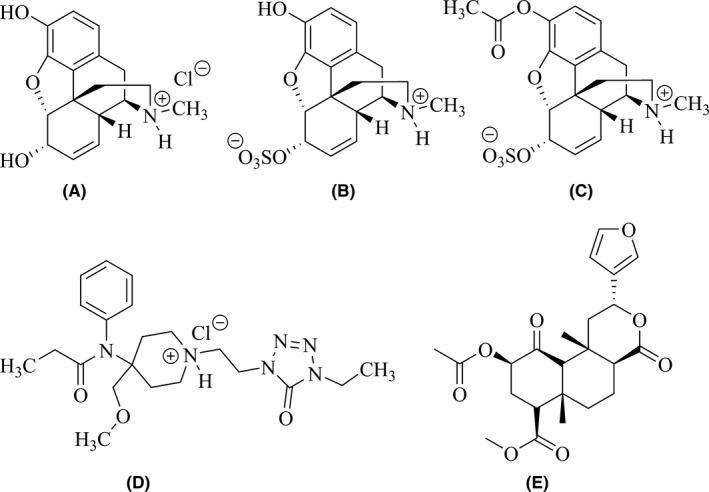
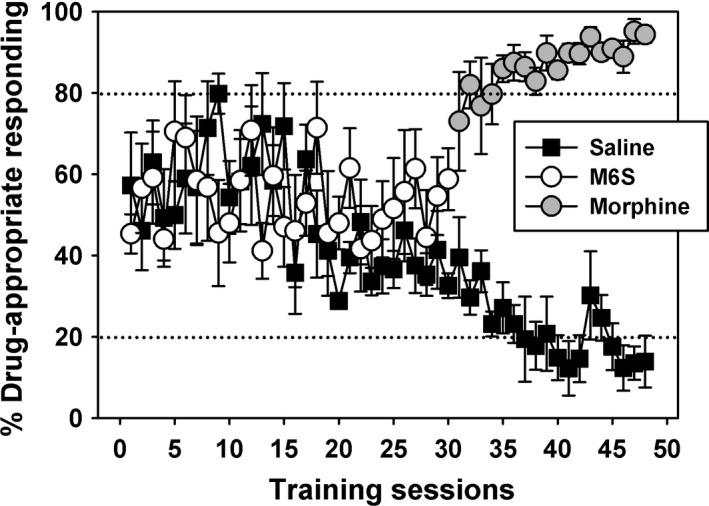
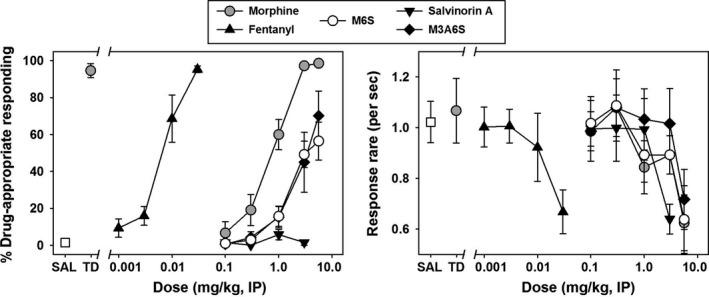
Morphine-6-O-sulfate (M6S) is as a mixed-action mu/delta (μ/δ) opioid receptor agonist with high potency and analgesic efficacy. These studies used assays of drug discrimination and schedule-controlled responding to assess abuse-liability, tolerance, and physical dependence as compared to morphine in rats. Attempts to train 0.3 mg/kg (IP) M6S from saline failed, but all rats rapidly acquired the discrimination when the training dose was changed to 3.0 mg/kg morphine, and substitution tests showed that morphine and fentanyl both fully substituted for the training dose, M6S and M3A6S (3-O-acetyl ester of M6S) only partially substituted, and salvinorin A did not elicit morphine-like effects. Tolerance to response rate-decreasing effects was studied in rats administered either 1.0 or 3.0 mg/kg morphine or M6S before food-reinforced operant sessions. At both unit doses, tolerance to M6S-elicited rate suppression developed more slowly than tolerance to morphine-induced reductions in response rates. To assess dependence, rats were maintained on 1.0 mg/kg morphine or 1.0 mg/kg M6S until food-reinforced response rates were stable for at least 5 days. Rats were then administered saline or increasing doses of the opioid antagonist naltrexone (NTX) (0.3, 1.0, 3.0, or 10.0 mg/kg) in order to determine antagonist-precipitated withdrawal. NTX precipitated withdrawal was similar in both morphine-maintained and M6S-maintained rats. In conclusion, the mixed μ/δ agonist activity of M6S failed to completely protect against the development of physical dependence, but delayed tolerance development to behavioral effects and resulted in decreased morphine-like subjective effects, perhaps implying a decreased abuse liability over μ agonists.
吗啡-6-O-硫酸盐(M6S)是一种混合作用的μ/δ(μ/δ)阿片受体激动剂,具有高效力和镇痛功效。这些研究使用药物辨别和时间控制反应的测定来评估与吗啡相比,在大鼠中滥用的可能性、耐受性和身体依赖性。尝试从盐水训练 0.3mg/kg(IP)的 M6S 失败,但当训练剂量改为 3.0mg/kg 吗啡时,所有大鼠都迅速获得了辨别,替代测试表明吗啡和芬太尼都完全替代了训练剂量,M6S 和 M3A6S(M6S 的 3-O-乙酰酯)仅部分替代,而萨利菌素 A 没有引起类似吗啡的作用。在进行食物强化操作性会话之前,用 1.0 或 3.0mg/kg 吗啡或 M6S 给大鼠给药,研究了对反应率降低作用的耐受性。在这两个单位剂量下,M6S 引起的抑制率的耐受性比吗啡诱导的反应率降低的耐受性发展得更慢。为了评估依赖性,将大鼠维持在 1.0mg/kg 吗啡或 1.0mg/kg M6S 上,直到食物强化反应率稳定至少 5 天。然后,给大鼠注射盐水或递增剂量的阿片拮抗剂纳曲酮(NTX)(0.3、1.0、3.0 或 10.0mg/kg),以确定阿片拮抗剂引发的戒断。吗啡维持和 M6S 维持的大鼠中,NTX 引发的戒断相似。总之,M6S 的混合μ/δ 激动剂活性未能完全防止身体依赖性的发展,但延迟了对行为作用的耐受性发展,并导致类似吗啡的主观作用减少,这可能意味着与μ 激动剂相比,滥用可能性降低。


 Zotero 插件