
功能性 III 型蛋白输出的重建与鞭毛组装的深入了解。
Reconstitution of Functional Type III Protein Export and Insights into Flagellar Assembly.
机构信息
Graduate School of Science, Osaka University, Toyonaka, Osaka, Japan.
Graduate School of Frontier Biosciences, Osaka University, Suita, Osaka, Japan.
出版信息
mBio. 2018 Jun 26;9(3):e00988-18. doi: 10.1128/mBio.00988-18.
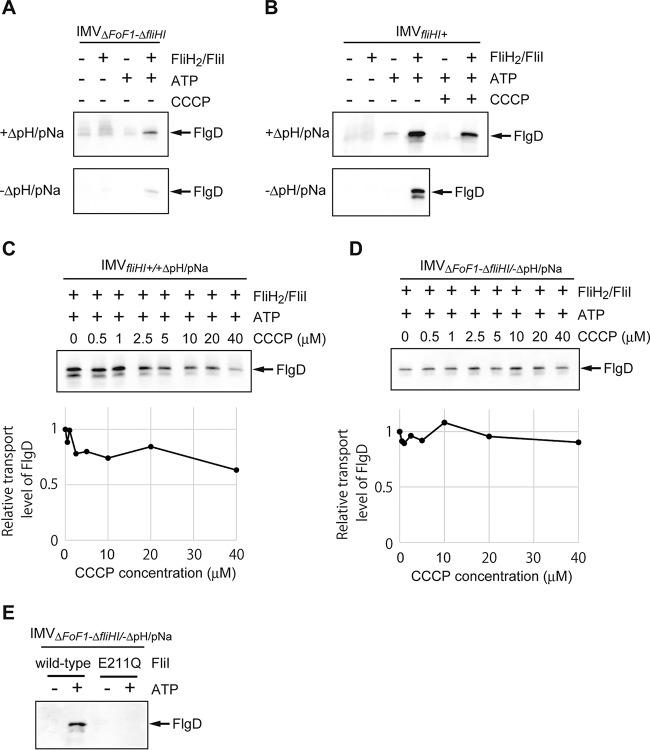
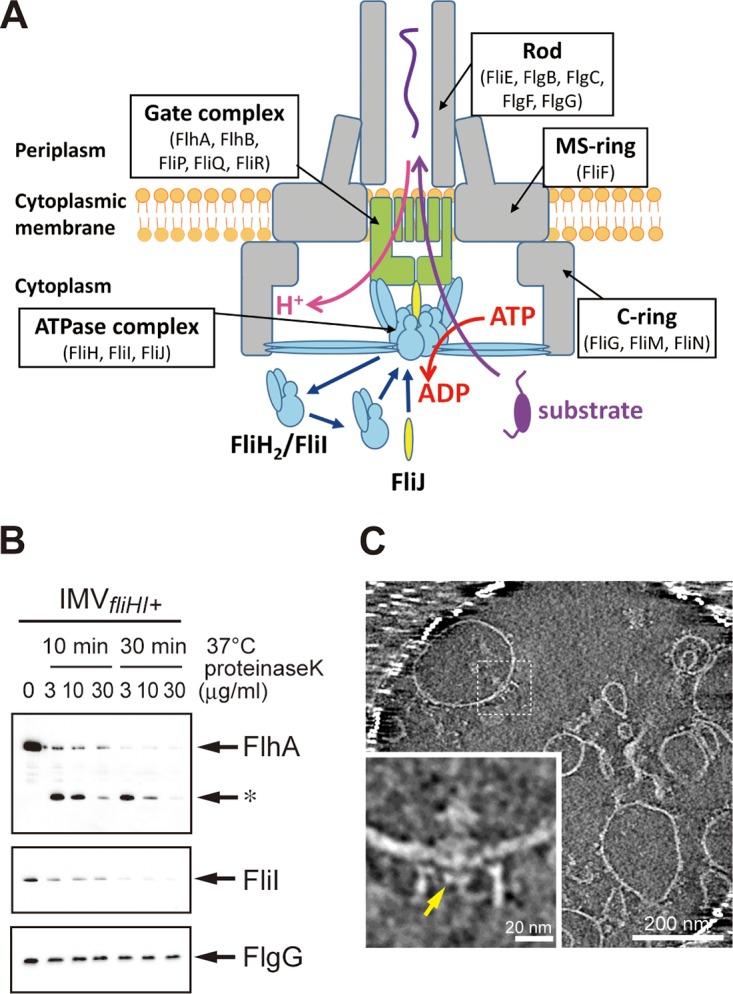
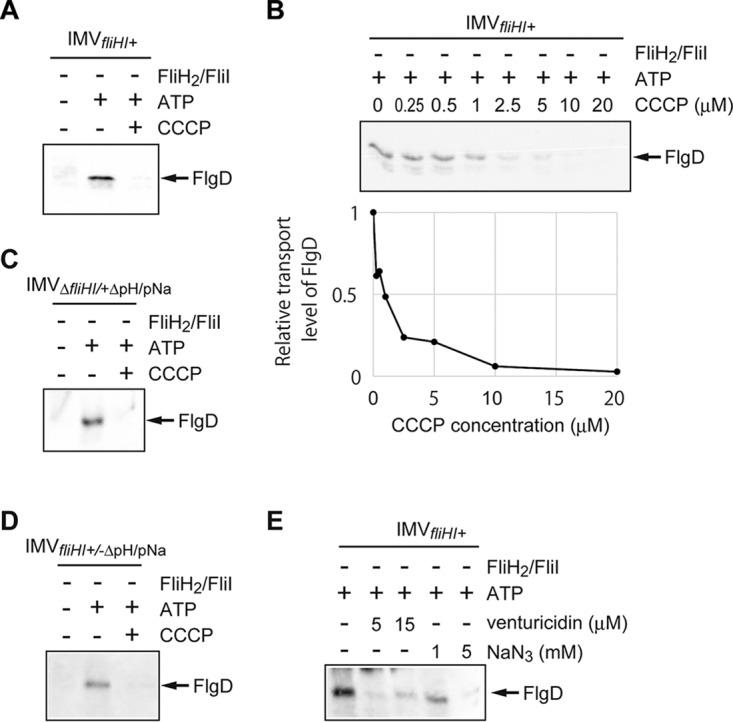
The type III secretion system (T3SS) forms the functional core of injectisomes, protein transporters that allow bacteria to deliver virulence factors into their hosts for infection, and flagella, which are critical for many pathogens to reach the site of infection. In spite of intensive genetic and biochemical studies, the T3SS protein export mechanism remains unclear due to the difficulty of accurate measurement of protein export Here, we developed an flagellar T3S protein transport assay system using an inverted cytoplasmic membrane vesicle (IMV) for accurate and controlled measurements of flagellar protein export. We show that the flagellar T3SS in the IMV fully retains export activity. The flagellar hook was constructed inside the lumen of the IMV by adding purified component proteins externally to the IMV solution. We reproduced the hook length control and export specificity switch in the IMV consistent with that seen in the native cell. Previous analyses showed that flagellar protein export is driven by proton motive force (PMF) and facilitated by ATP hydrolysis by FliI, a T3SS-specific ATPase. Our assay recapitulated these previous observations but furthermore clearly demonstrated that even ATP hydrolysis by FliI alone can drive flagellar protein export. Moreover, this assay showed that addition of the FliH/FliI complex to the assay solution at a concentration similar to that in the cell dramatically enhanced protein export, confirming that the FliH/FliI complex in the cytoplasm is important for effective protein transport. The type III secretion system (T3SS) is the functional core of the injectisome, a bacterial protein transporter used to deliver virulence proteins into host cells, and bacterial flagella, critical for many pathogens. The molecular mechanism of protein transport is still unclear due to difficulties in accurate measurements of protein transport under well-controlled conditions We succeeded in developing an transport assay system of the flagellar T3SS using inverted membrane vesicles (IMVs). Flagellar hook formation was reproduced in the IMV, suggesting that the export apparatus in the IMV retains a protein transport activity similar to that in the cell. Using this system, we revealed that ATP hydrolysis by the T3SS ATPase can drive protein export without PMF.
III 型分泌系统 (T3SS) 是 injectisomes 的功能核心,后者是一种细菌蛋白转运体,可将毒力蛋白输送到宿主细胞中进行感染;同时也是细菌鞭毛的关键组成部分,鞭毛对于许多病原体到达感染部位至关重要。尽管进行了大量的遗传和生化研究,但由于难以准确测量蛋白质的输出,T3SS 蛋白输出机制仍不清楚。在这里,我们开发了一种使用反向细胞质膜囊泡 (IMV) 的鞭毛 T3S 蛋白转运测定系统,用于准确和受控地测量鞭毛蛋白的输出。我们表明,在 IMV 中,鞭毛 T3SS 完全保留了输出活性。通过将纯化的组分蛋白添加到 IMV 溶液外部,在 IMV 的内腔中构建了鞭毛钩。我们在 IMV 中重现了钩长度控制和输出特异性开关,与在天然细胞中观察到的情况一致。先前的分析表明,鞭毛蛋白的输出是由质子动力势 (PMF) 驱动的,并由 T3SS 特异性 ATP 酶 FliI 的 ATP 水解来促进。我们的测定再现了这些先前的观察结果,但更进一步清楚地表明,即使仅由 FliI 水解 ATP 也可以驱动鞭毛蛋白的输出。此外,该测定还表明,将 FliH/FliI 复合物以类似于细胞中的浓度添加到测定溶液中会显著增强蛋白质的输出,从而证实细胞质中的 FliH/FliI 复合物对于有效的蛋白质转运很重要。III 型分泌系统 (T3SS) 是 injectisomes 的功能核心,后者是一种细菌蛋白转运体,用于将毒力蛋白输送到宿主细胞中,同时也是细菌鞭毛的关键组成部分,鞭毛对于许多病原体的感染至关重要。由于在严格控制的条件下准确测量蛋白质转运存在困难,因此蛋白质转运的分子机制仍不清楚。我们成功地使用反向膜囊泡 (IMV) 开发了一种鞭毛 T3SS 的转运测定系统。在 IMV 中重现了鞭毛钩的形成,这表明 IMV 中的出口装置保留了类似于细胞中的蛋白质转运活性。使用该系统,我们揭示了 T3SS ATP 酶的 ATP 水解可以在没有 PMF 的情况下驱动蛋白质输出。


 Zotero 插件