
人类成骨细胞在微结构钛表面对雌激素的反应存在性别二态性。
Human osteoblasts exhibit sexual dimorphism in their response to estrogen on microstructured titanium surfaces.
机构信息
Department of Biomedical Engineering, College of Engineering, Virginia Commonwealth University, 601 West Main Street, Richmond, VA, 23284-3068, USA.
Children's Healthcare of Atlanta, Atlanta, GA, 30332, USA.
出版信息
Biol Sex Differ. 2018 Jul 3;9(1):30. doi: 10.1186/s13293-018-0190-x.
BACKGROUND
Osseointegration is dependent on the implant surface, surrounding bone quality, and the systemic host environment, which can differ in male and female patients. Titanium (Ti) implants with microstructured surfaces exhibit greater pullout strength when compared to smooth-surfaced implants and exhibit enhanced osteogenic cellular responses in vitro. Previous studies showed that 1α,25-dihydroxyvitamin D3 [1α,25(OH)D] has a greater effect on rat osteoblast differentiation on microstructured Ti compared to smooth Ti surfaces and tissue culture polystyrene (TCPS). The stimulatory effect of 17β-estradiol (E) on differentiation is observed in female osteoblasts on micro-rough Ti, but it is not known if male osteoblasts behave similarly in response to E and microtopography. This study assessed whether human male and female osteoblasts exhibit sex-specific differences in response to E and 1α,25(OH)D when cultured on microstructured Ti surfaces.
METHODS
Osteoblasts from three male and three female human donors were cultured on Ti discs with varying surface profiles: a smooth pretreatment (PT), a coarse grit-blasted/acid-etched (SLA), and an SLA surface having undergone modification in a nitrogen environment and stored in saline to maintain hydrophilicity (modSLA). Cells cultured on these surfaces were treated with E or 1α,25(OH)D.
RESULTS
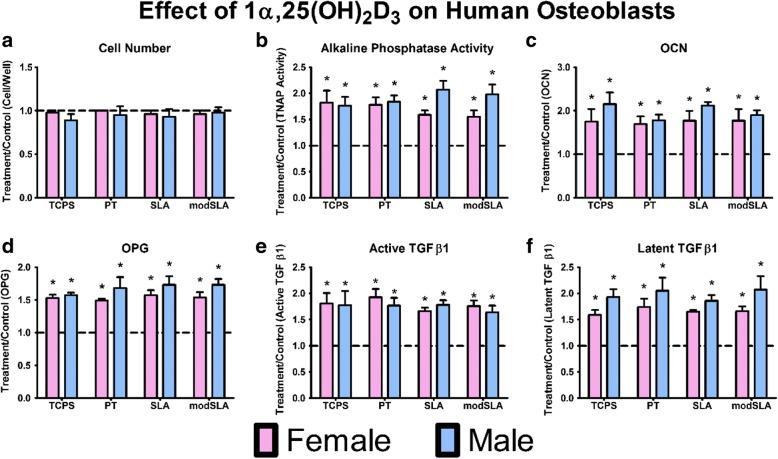
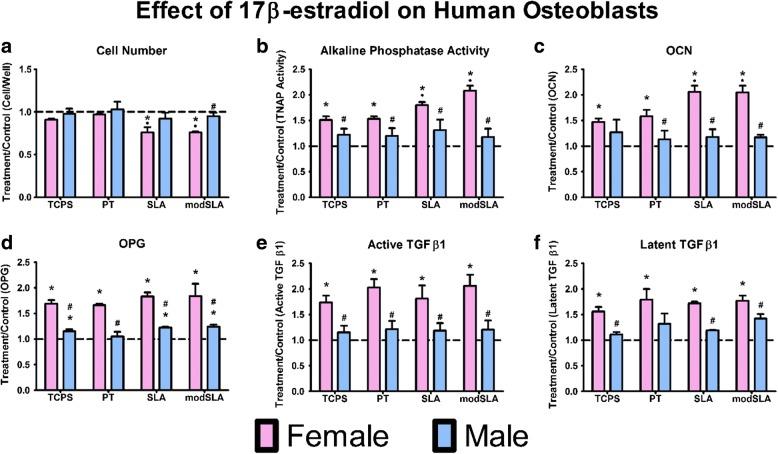
Male and female human osteoblasts responded similarly to microstructure although there were donor-specific differences; cell number decreased, and osteocalcin (OCN), osteoprotegerin (OPG), and latent and active transforming growth factor 1 increased on SLA and modSLA compared to TCPS. Female osteoblasts had higher alkaline phosphatase activity and OCN production than male counterparts but produced less OPG. Both sexes responded similarly to 1α,25(OH)D. E treatment reduced cell number and increased osteoblast differentiation and factor production only in female cells.
CONCLUSIONS
Male and female human osteoblasts respond similarly to microstructure and 1α,25(OH)D but exhibit sexual dimorphism in substrate-dependent responses to E. E affected female osteoblasts, suggesting that signaling is sex-specific and surface-dependent. Donor osteoblasts varied in response, demonstrating the need to test multiple donors when examining human samples. Understanding how male and female cells respond to orthopedic biomaterials will enable greater predictability post-implantation as well as therapies that are more patient-specific.
背景
骨整合依赖于植入物表面、周围骨质量和全身宿主环境,而男性和女性患者的这些因素可能存在差异。与光滑表面植入物相比,具有微结构表面的钛(Ti)植入物具有更大的拔出强度,并在体外表现出增强的成骨细胞反应。先前的研究表明,1α,25-二羟基维生素 D3 [1α,25(OH)D] 对微结构 Ti 上大鼠成骨细胞分化的影响大于光滑 Ti 表面和组织培养聚苯乙烯(TCPS)。17β-雌二醇(E)对微粗糙 Ti 上女性成骨细胞分化的刺激作用,但尚不清楚男性成骨细胞是否会对 E 和微形貌做出类似的反应。本研究评估了培养在微结构 Ti 表面上时,男性和女性成骨细胞对 E 和 1α,25(OH)D 的反应是否存在性别特异性差异。
方法
从三名男性和三名女性供体中培养成骨细胞,在具有不同表面轮廓的 Ti 圆盘上培养:预处理光滑(PT)、粗砂喷砂/酸蚀(SLA)和在氮气环境中进行改性并储存在盐水中以保持亲水性的 SLA 表面(modSLA)。在这些表面上培养的细胞用 E 或 1α,25(OH)D 处理。
结果
尽管存在供体特异性差异,但男性和女性人类成骨细胞对微结构的反应相似;与 TCPS 相比,SLA 和 modSLA 上的细胞数量减少,骨钙素(OCN)、骨保护素(OPG)和潜伏和活性转化生长因子 1 增加。女性成骨细胞的碱性磷酸酶活性和 OCN 产量高于男性,但 OPG 产量较低。两种性别对 1α,25(OH)D 的反应相似。E 处理仅降低女性细胞的细胞数量,并增加成骨细胞分化和因子产生。
结论
男性和女性人类成骨细胞对微结构和 1α,25(OH)D 的反应相似,但对 E 依赖于基质的反应表现出性别二态性。E 影响女性成骨细胞,表明信号传递是性别特异性和表面依赖性的。供体成骨细胞的反应不同,表明在检查人体样本时需要测试多个供体。了解男性和女性细胞对骨科生物材料的反应将使植入后的预测能力以及更针对患者的治疗方法得到提高。


 Zotero 插件