
沃尔巴克氏体改变黑腹果蝇的热偏好。
Wolbachia modifies thermal preference in Drosophila melanogaster.
作者信息
Truitt Amy M, Kapun Martin, Kaur Rupinder, Miller Wolfgang J
机构信息
Department of Environmental Science and Management, Portland State University, Portland, OR, USA.
Department of Biology, Université de Fribourg, Fribourg, Switzerland.
出版信息
Environ Microbiol. 2018 Jul 3;21(9):3259-68. doi: 10.1111/1462-2920.14347.
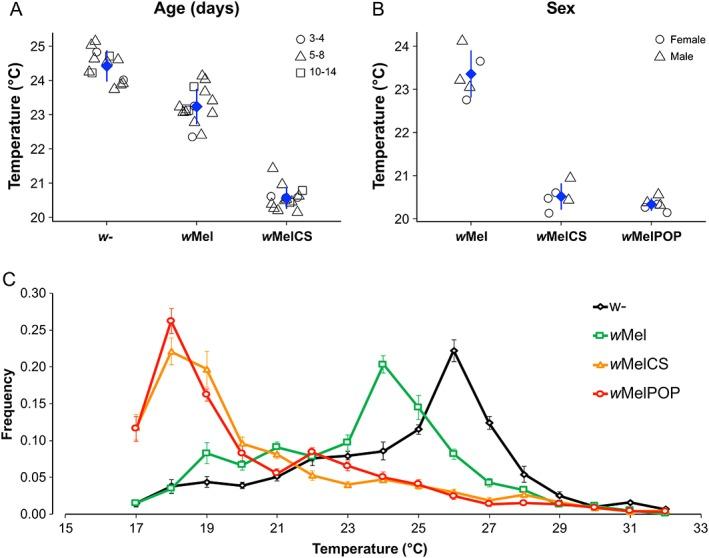
Environmental variation can have profound and direct effects on fitness, fecundity, and host-symbiont interactions. Replication rates of microbes within arthropod hosts, for example, are correlated with incubation temperature but less is known about the influence of host-symbiont dynamics on environmental preference. Hence, we conducted thermal preference (T ) assays and tested if infection status and genetic variation in endosymbiont bacterium Wolbachia affected temperature choice of Drosophila melanogaster. We demonstrate that isogenic flies infected with Wolbachia preferred lower temperatures compared with uninfected Drosophila. Moreover, T varied with respect to three investigated Wolbachia variants (wMel, wMelCS, and wMelPop). While uninfected individuals preferred 24.4°C, we found significant shifts of -1.2°C in wMel- and -4°C in flies infected either with wMelCS or wMelPop. We, therefore, postulate that Wolbachia-associated T variation within a host species might represent a behavioural accommodation to host-symbiont interactions and trigger behavioural self-medication and bacterial titre regulation by the host.
环境变化会对适应性、繁殖力以及宿主与共生体的相互作用产生深远而直接的影响。例如,节肢动物宿主体内微生物的复制速率与孵化温度相关,但宿主 - 共生体动态对环境偏好的影响却知之甚少。因此,我们进行了热偏好(T)测定,并测试内共生细菌沃尔巴克氏体的感染状态和基因变异是否会影响黑腹果蝇的温度选择。我们证明,感染沃尔巴克氏体的同基因果蝇与未感染的果蝇相比更喜欢较低的温度。此外,T因三种研究的沃尔巴克氏体变体(wMel、wMelCS和wMelPop)而有所不同。未感染个体偏好24.4°C,而我们发现感染wMel的果蝇温度偏好显著下降1.2°C,感染wMelCS或wMelPop的果蝇温度偏好下降4°C。因此,我们推测宿主物种内与沃尔巴克氏体相关的T变化可能代表了对宿主 - 共生体相互作用的行为适应,并触发宿主的行为自我治疗和细菌滴度调节。
 Zotero 插件