
OCT4 与 LEF1 表达的相关性对食管鳞癌的预后价值及其对上皮-间质转化、侵袭和迁移的影响。
Prognostic value of association of OCT4 with LEF1 expression in esophageal squamous cell carcinoma and their impact on epithelial-mesenchymal transition, invasion, and migration.
机构信息
Department of Thoracic Surgery, Changhai Hospital, Second Military Medical University, Shanghai, China.
Department of Vascular Surgery, Beijing Shijitan Hospital, Capital Medical University, Beijing, China.
出版信息
Cancer Med. 2018 Aug;7(8):3977-3987. doi: 10.1002/cam4.1641. Epub 2018 Jul 4.
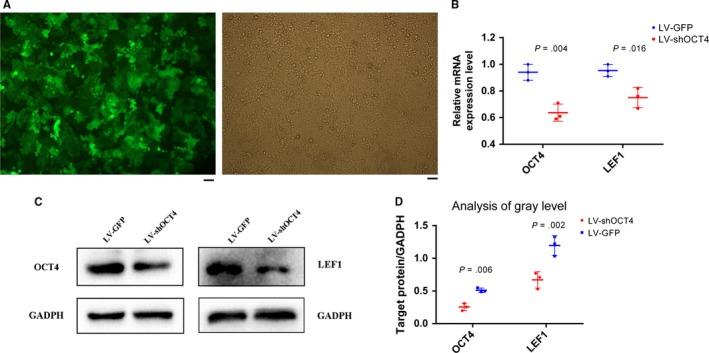
Esophageal squamous cell carcinoma (ESCC) is a malignant disease with poor prognosis. Because of early metastasis prior to diagnosis and therapeutic resistance, ESCC has become one of the leading causes of cancer-related death. Here, we investigated the clinicopathological significance of the association of octamer-binding transcription factor 4 (OCT4) with lymphoid enhancer-binding factor 1 (LEF1) expression and the potential molecular mechanism in the epithelial-mesenchymal transition (EMT), invasion, and migration of ESCC. The expression of OCT4 and LEF1 was detected via immunohistochemistry analysis. High levels of LEF1 expression were observed in 95 ESCC specimens and were obviously associated with aberrant clinicopathological features and poor patient prognosis. Our previous study showed that OCT4 expression level is elevated in ESCC, and statistical analysis showed that the elevated expression of OCT4 and LEF1 in ESCC was significantly associated with histologic grade, lymph node metastasis, TNM stage, and poor patient prognosis. The specific inhibition of OCT4 expression via a lentivirus encoding OCT4-shRNA (LV-shOCT4) in Eca109 cells led to decreased levels of OCT4 and LEF1 in vitro. Additionally, we applied a rescue strategy by infecting LV-shOCT4 Eca109 cells with a LEF1 overexpression plasmid (p-LEF1) and detected changes in EMT, migration, and invasion. Unsurprisingly, the p-LEF1 group exhibited greater EMT, invasion, and migration than did the LV-shOCT4 and negative control groups. This study demonstrates for the first time the relationship between OCT4 and LEF1 expression. The combination of high expression of OCT4 and LEF1 was associated with clinicopathological features of atypical patients, and this combination might be an ideal prognostic factor in ESCC. OCT4 positively regulated LEF1 expression, and LEF1 mediated the effects of OCT4 in cancer cell EMT, invasion, and migration. The data presented here suggest that the inhibition of OCT4-LEF1 signaling may be a new therapeutic target for the treatment of ESCC.
食管鳞状细胞癌 (ESCC) 是一种预后不良的恶性疾病。由于在诊断前发生早期转移和治疗耐药性,ESCC 已成为癌症相关死亡的主要原因之一。在这里,我们研究了八聚体结合转录因子 4 (OCT4) 与淋巴增强结合因子 1 (LEF1) 表达的临床病理意义,以及在 ESCC 上皮间质转化 (EMT)、侵袭和迁移中的潜在分子机制。通过免疫组织化学分析检测 OCT4 和 LEF1 的表达。在 95 个 ESCC 标本中观察到 LEF1 表达水平升高,并且与异常临床病理特征和患者预后不良明显相关。我们之前的研究表明,OCT4 在 ESCC 中的表达水平升高,统计学分析表明,OCT4 和 LEF1 在 ESCC 中的高表达与组织学分级、淋巴结转移、TNM 分期和患者预后不良显著相关。通过慢病毒载体编码的 OCT4-shRNA (LV-shOCT4) 在 Eca109 细胞中特异性抑制 OCT4 表达,导致 OCT4 和 LEF1 的表达水平降低。此外,我们通过感染 LV-shOCT4 Eca109 细胞的 LEF1 过表达质粒 (p-LEF1) 应用挽救策略,并检测 EMT、迁移和侵袭的变化。不出所料,p-LEF1 组比 LV-shOCT4 和阴性对照组表现出更强的 EMT、侵袭和迁移。这项研究首次证明了 OCT4 和 LEF1 表达之间的关系。OCT4 和 LEF1 高表达的组合与非典型患者的临床病理特征相关,并且这种组合可能是 ESCC 的理想预后因素。OCT4 正向调节 LEF1 的表达,而 LEF1 介导了 OCT4 在癌细胞 EMT、侵袭和迁移中的作用。本研究表明,抑制 OCT4-LEF1 信号可能是治疗 ESCC 的新治疗靶点。



 Zotero 插件