
探究1位和3位取代基:四氢吡嗪并稠合的水溶性黄嘌呤衍生物作为具有强效腺苷受体拮抗活性的多靶点药物
Probing Substituents in the 1- and 3-Position: Tetrahydropyrazino-Annelated Water-Soluble Xanthine Derivatives as Multi-Target Drugs With Potent Adenosine Receptor Antagonistic Activity.
作者信息
Koch Pierre, Brunschweiger Andreas, Namasivayam Vigneshwaran, Ullrich Stefan, Maruca Annalisa, Lazzaretto Beatrice, Küppers Petra, Hinz Sonja, Hockemeyer Jörg, Wiese Michael, Heer Jag, Alcaro Stefano, Kiec-Kononowicz Katarzyna, Müller Christa E
机构信息
PharmaCenter Bonn, Pharmaceutical Institute, Pharmaceutical Chemistry I, University of Bonn, Bonn, Germany.
Dipartimento di Scienze della Salute, Università degli Studi "Magna Græcia" di Catanzaro, Catanzaro, Italy.
出版信息
Front Chem. 2018 Jun 26;6:206. doi: 10.3389/fchem.2018.00206. eCollection 2018.
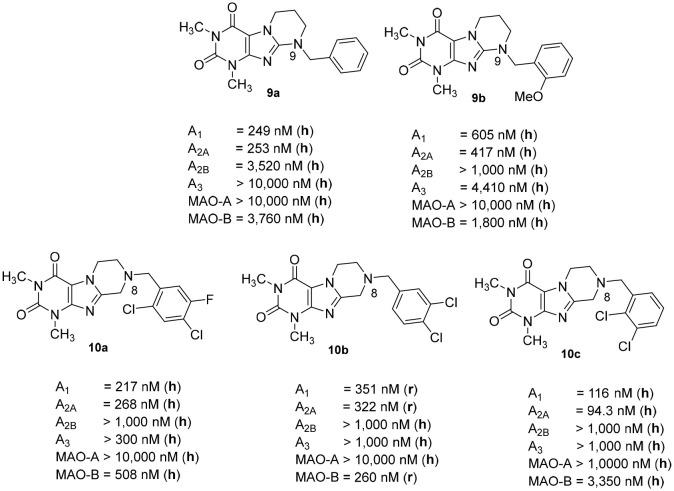
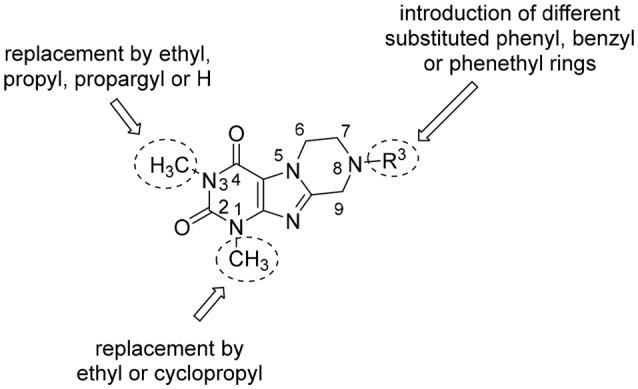
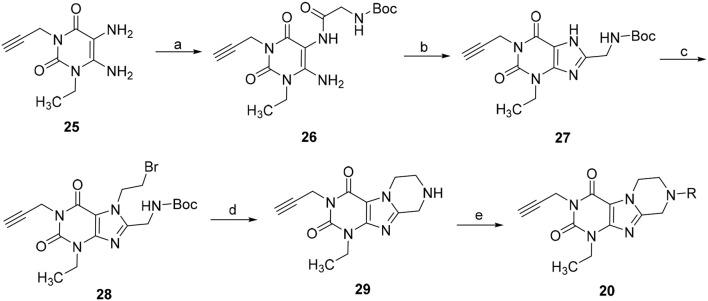
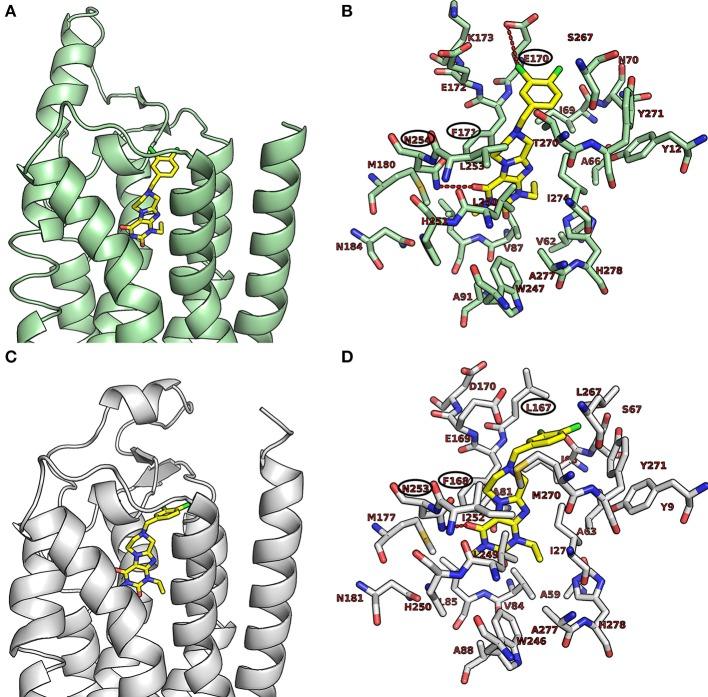
Tetrahydropyrazino-annelated theophylline (1,3-dimethylxanthine) derivatives have previously been shown to display increased water-solubility as compared to the parent xanthines due to their basic character. In the present study, we modified this promising scaffold by replacing the 1,3-dimethyl residues by a variety of alkyl groups including combinations of different substituents in both positions. Substituted benzyl or phenethyl residues were attached to the N8 of the resulting 1,3-dialkyl-tetrahydropyrazino[2,1- ]purinediones with the aim to obtain multi-target drugs that block human A and A adenosine receptors (ARs) and monoaminoxidase B (MAO-B). 1,3-Diethyl-substituted derivatives showed high affinity for A ARs, e.g., (PSB-18339, 8--bromobenzyl-substituted) displayed a K value of 13.6 nM combined with high selectivity. 1-Ethyl-3-propargyl-substituted derivatives exhibited increased A AR affinity. The 8-phenethyl derivative was selective for the A AR (K 149 nM), while the corresponding 8-benzyl-substituted compound (PSB-1869) blocked A and A ARs with equal potency (K A, 180 nM; A, 282 nM). The 1-ethyl-3-methyl-substituted derivative (PSB-18405) bearing a -dichlorobenzyl residue at N8 blocked all three targets, A ARs (K 396 nM), A ARs (K 1,620 nM), and MAO-B (IC 106 nM) with high selectivity vs. the other subtypes (A and A ARs, MAO-A), and can thus be considered as a multi-target drug. Our findings were rationalized by molecular docking studies based on previously published X-ray structures of the protein targets. The new drugs have potential for the treatment of neurodegenerative diseases, in particular Parkinson's disease.
四氢吡嗪并稠合的茶碱(1,3 - 二甲基黄嘌呤)衍生物先前已被证明,由于其碱性特征,与母体黄嘌呤相比具有更高的水溶性。在本研究中,我们通过用各种烷基取代1,3 - 二甲基残基来修饰这个有前景的骨架,包括在两个位置上不同取代基的组合。将取代的苄基或苯乙基残基连接到所得的1,3 - 二烷基 - 四氢吡嗪并[2,1 - ]嘌呤二酮的N8位,旨在获得阻断人A和A腺苷受体(ARs)以及单胺氧化酶B(MAO - B)的多靶点药物。1,3 - 二乙基取代的衍生物对A ARs表现出高亲和力,例如,(PSB - 18339,8 - 溴苄基取代)的K值为13.6 nM,同时具有高选择性。1 - 乙基 - 3 - 炔丙基取代的衍生物表现出更高的A AR亲和力。8 - 苯乙基衍生物对A AR具有选择性(K 149 nM),而相应的8 - 苄基取代化合物(PSB - 1869)以相同效力阻断A和A ARs(K A,180 nM;A,282 nM)。在N8位带有二氯苄基残基的1 - 乙基 - 3 - 甲基取代衍生物(PSB - 18405)以相对于其他亚型(A和A ARs,MAO - A)的高选择性阻断所有三个靶点,A ARs(K 396 nM),A ARs(K 1,620 nM)和MAO - B(IC 106 nM),因此可被视为一种多靶点药物。基于先前发表的蛋白质靶点X射线结构的分子对接研究对我们的发现进行了合理化解释。这些新药具有治疗神经退行性疾病,特别是帕金森病的潜力。






 Zotero 插件