
胰高血糖素样肽-1(GLP-1)受体激动剂刺激是否能减少酒精依赖患者的饮酒量:一项随机、双盲、安慰剂对照临床试验的研究方案。
Does glucagon-like peptide-1 (GLP-1) receptor agonist stimulation reduce alcohol intake in patients with alcohol dependence: study protocol of a randomised, double-blinded, placebo-controlled clinical trial.
机构信息
Psychiatric Centre Copenhagen, University Hospital of Copenhagen, Copenhagen, Denmark.
Department of Psychology, University of Copenhagen, Copenhagen, Denmark.
出版信息
BMJ Open. 2018 Jul 16;8(7):e019562. doi: 10.1136/bmjopen-2017-019562.
INTRODUCTION
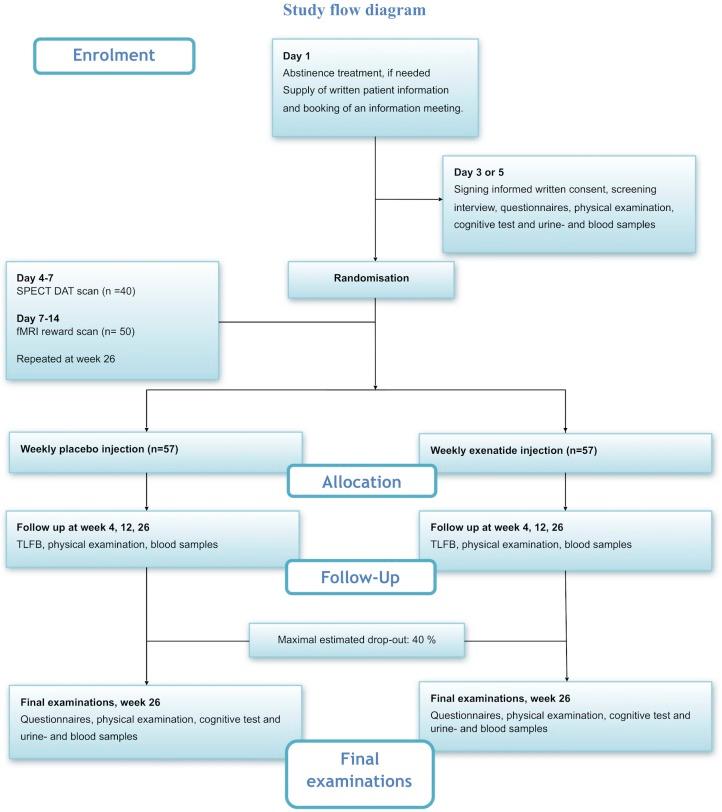
Alcohol dependence is a major public health problem. It is underdiagnosed and undertreated. Even when treated, more than 2/3 of patients in abstinence-oriented treatment will relapse within the first year. Thus, there is an urgent need for efficacious medical treatment of alcohol dependence. Glucagon-like peptide-1 (GLP-1) receptor stimulation has proven to reduce alcohol consumption in preclinical experiments. However, the effect of GLP-1 receptor agonists in humans has to our knowledge, not yet been investigated. METHODS AND ANALYSIS: : The effect of the once-weekly GLP-1-receptor-agonist exenatide will be investigated in a double-blinded, placebo-controlled, randomised clinical trial. 114 outpatients will be recruited and randomised to treatment with either placebo or exenatide once weekly for 26 weeks as a supplement to cognitive-behavioural therapy. is reduction in number of 'heavy drinking days'. include changes in total alcohol consumption, days without consumption, changes in brain activity and function, smoking status, cognition, measures of quality of life and changes in phosphatidylethanol as a biomarker of alcohol consumption from baseline to follow-up at week 26. : Currently recruiting patients.
ETHICS AND DISSEMINATION
Ethical approval has been obtained. Before screening, all patients will be provided oral and written information about the trial. The study results will be disseminated by peer-review publications and conference presentations and has the potential to reveal a completely new medical treatment of alcohol dependence.
简介
酒精依赖是一个主要的公共卫生问题。它的诊断和治疗不足。即使接受治疗,在以戒酒为目标的治疗中,超过 2/3 的患者在第一年都会复发。因此,迫切需要有效的酒精依赖医学治疗。胰高血糖素样肽-1(GLP-1)受体刺激已被证明可减少临床前实验中的酒精摄入量。然而,据我们所知,GLP-1 受体激动剂在人类中的效果尚未得到研究。方法和分析:每周一次的 GLP-1 受体激动剂艾塞那肽的效果将在一项双盲、安慰剂对照、随机临床试验中进行研究。将招募 114 名门诊患者,并将他们随机分为安慰剂或艾塞那肽治疗组,每周一次,共 26 周,作为认知行为疗法的补充。主要终点是减少“重度饮酒天数”。次要终点包括总饮酒量、无饮酒天数、大脑活动和功能变化、吸烟状况、认知、生活质量测量以及从基线到第 26 周随访时的乙醇磷脂作为酒精消耗的生物标志物的变化。目前正在招募患者。伦理和传播:已获得伦理批准。在筛选前,将向所有患者提供有关试验的口头和书面信息。研究结果将通过同行评审出版物和会议报告进行传播,并有可能揭示一种全新的酒精依赖医学治疗方法。
 Zotero 插件