
酰基链饱和度对一种短抗菌肽膜结合活性的影响
Influence of Acyl Chain Saturation on the Membrane-Binding Activity of a Short Antimicrobial Peptide.
作者信息
Ciumac Daniela, Campbell Richard A, Clifton Luke A, Xu Hai, Fragneto Giovanna, Lu Jian R
机构信息
Biological Physics Laboratory, School of Physics and Astronomy, University of Manchester, Oxford Road, Schuster Building, Manchester M13 9PL, U.K.
Institute of Laue Langevin, 71 Avenue des Martyrs, CS-20156, 38042 Grenoble, France.
出版信息
ACS Omega. 2017 Nov 30;2(11):7482-7492. doi: 10.1021/acsomega.7b01270. Epub 2017 Nov 1.
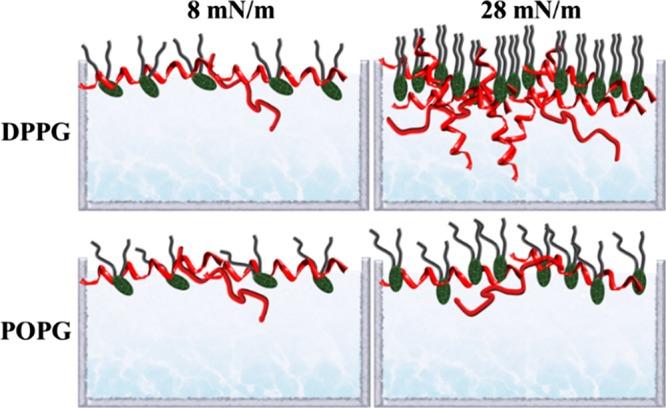
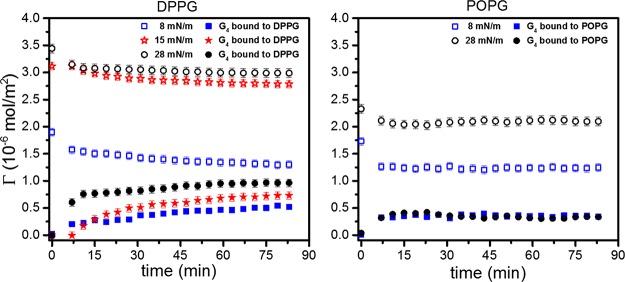
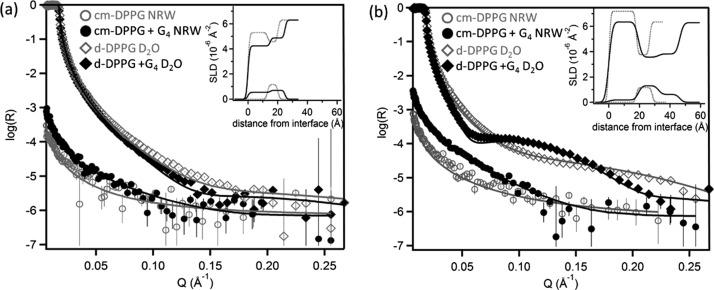
Different bacterial types and their living environments can lead to different saturations in the chains of their membrane lipids. Such structural differences may influence the efficacy of antibiotics that target bacterial membranes. In this work, the effects of acyl chain saturation on the binding of an antimicrobial peptide G have been examined as a function of the packing density of lipid monolayers by combining external reflection Fourier transform infrared (ER-FTIR) spectroscopy and neutron reflection (NR) measurements. Langmuir monolayers were formed from 1,2-dipalmitoyl--glycero-3-phospho-(1'--glycerol) (DPPG) and 1-palmitoyl-2-oleoyl--glycero-3-phospho-(1'--glycerol) (POPG), respectively, with the initial surface pressures controlled at 8 and 28 mN/m. A reduction in the order of the acyl chains associated with the increase in the layer thickness upon G binding was revealed from ER-FTIR spectroscopy, with peptide binding reaching equilibration faster in POPG than in DPPG monolayers. Whereas the dynamic DPPG-binding process displayed a steady increase in the amide I band area, the POPG-binding process showed little change in the amide area after the initial period. The peptide amide I area from ER-FTIR spectroscopy could be linearly correlated with the adsorbed G amount from NR, irrespective of time, initial pressure, or chain saturation, with clearly more peptide incorporated into the DPPG monolayer. Furthermore, NR revealed that although the peptide was associated with both POPG and DPPG lipid monolayers, it was more extensively distributed in the latter, showing that acyl chain saturation clearly promoted peptide binding and structural disruption.
不同的细菌类型及其生存环境会导致其膜脂链具有不同的饱和度。这种结构差异可能会影响针对细菌膜的抗生素的疗效。在这项工作中,通过结合外反射傅里叶变换红外(ER-FTIR)光谱和中子反射(NR)测量,研究了酰基链饱和度对抗菌肽G结合的影响,该影响是脂质单层堆积密度的函数。分别由1,2-二棕榈酰-sn-甘油-3-磷酸-(1'-rac-甘油)(DPPG)和1-棕榈酰-2-油酰-sn-甘油-3-磷酸-(1'-rac-甘油)(POPG)形成Langmuir单层,初始表面压力控制在8和28 mN/m。ER-FTIR光谱显示,随着G结合后层厚度增加,酰基链的有序性降低,且肽在POPG单层中的结合比在DPPG单层中更快达到平衡。动态的DPPG结合过程中酰胺I带面积稳步增加,而POPG结合过程在初始阶段后酰胺面积几乎没有变化。ER-FTIR光谱中的肽酰胺I面积与NR测得的吸附G量呈线性相关,与时间、初始压力或链饱和度无关,且明显有更多的肽掺入DPPG单层中。此外,NR显示,尽管肽与POPG和DPPG脂质单层都有关联,但它在后一种单层中分布更广泛,表明酰基链饱和度明显促进了肽的结合和结构破坏。



 Zotero 插件