
中国公共卫生服务的省际不平等:地方官员行为的视角。
Inter-provincial inequality of public health services in China: the perspective of local officials' behavior.
机构信息
School of Government, Sun Yat-sen University, Guangzhou, Guangdong, China.
Department of Public Administration, Nanfang College of Sun Yat-sen University, Guangzhou, Guangdong, China.
出版信息
Int J Equity Health. 2018 Jul 31;17(1):108. doi: 10.1186/s12939-018-0827-8.
BACKGROUND
After economic reform, China experienced rising public health services inequality between the eastern developed and mid-west undeveloped provinces. The fiscal transfer payment system which aims to shape the disparities was considered inefficient. However, there are only a few studies that address the political reason when analyzing the inter-provincial public health services inequality. And the previous studies did not consider a possible non-linear relationship between the fiscal transfer payments and the inter-provincial public health services equalization.
METHODS
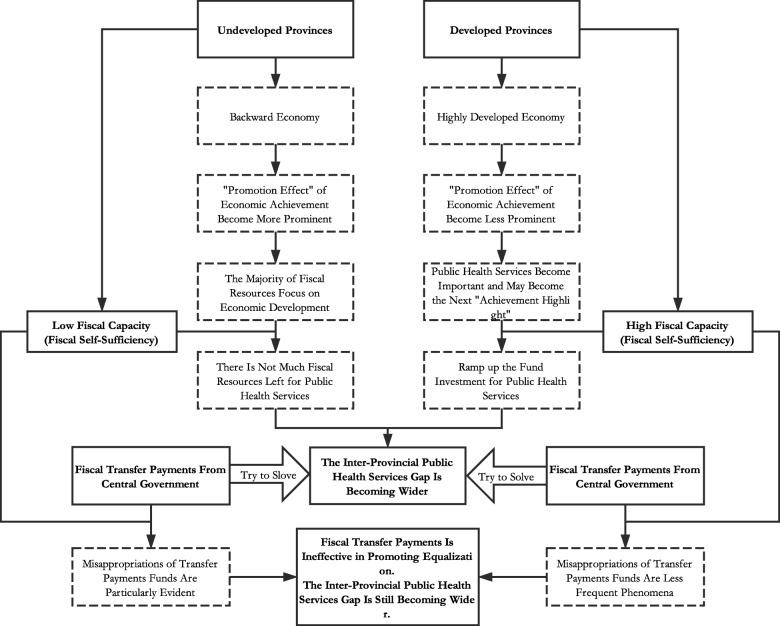
This paper argues that the local officials' fanatical pursuit of local economic growth which driven by the Political Promotion Tournament and the polarized fiscal self-sufficiency (fiscal capacities) of local governments are responsible for the inter-provincial inequality of public health services and the inefficiency of fiscal transfer payments. By constructing panel threshold regression models with fiscal self-sufficiency of local governments as threshold variable, this study tries to empirically investigate the optimal level of the local governments' self-sufficiency at which the fiscal transfer payments can effectively promote equalization.
RESULTS
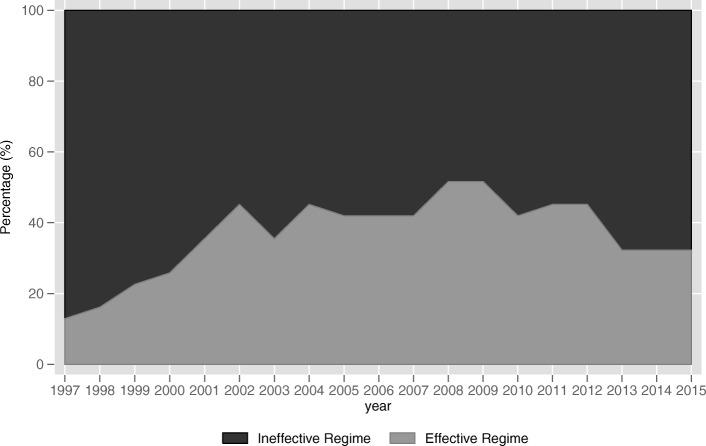
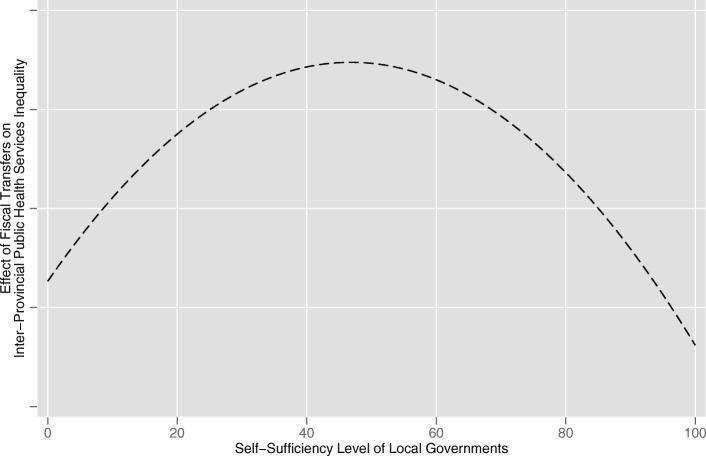
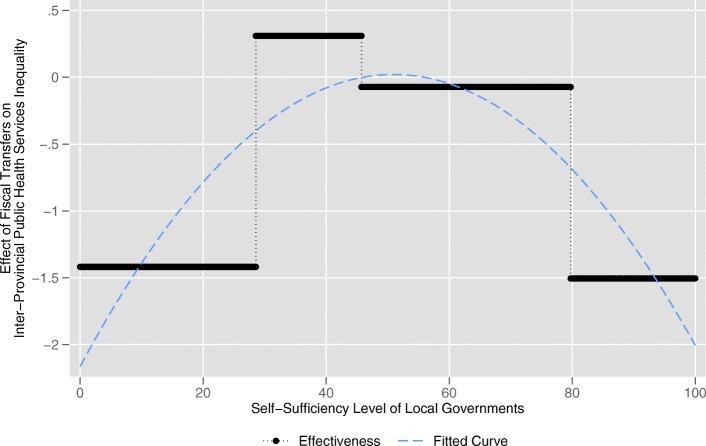
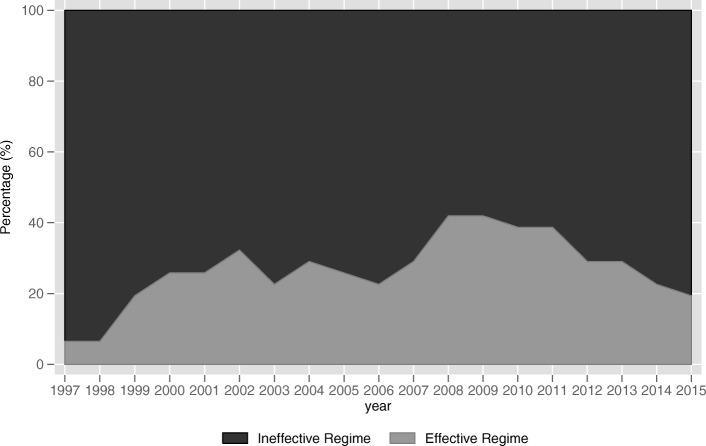
Threshold effects exist between fiscal transfer payments and inter-provincial public health services equalization. The effects on inter-provincial public health services equalization show trends that first increase and then decrease as the fiscal self-sufficiency of local governments increases. And there exist a range of fiscal self-sufficiency between 29.236 and 43.765% or between 28.575 and 45.746% for local governments where the fiscal transfer payments can effectively achieve equalization. Currently, the vast majority of provinces in China remain in the ineffective regime where the fiscal transfer payments are inefficient in shaping inequality.
CONCLUSIONS
This paper explains the reason of inequality in public health services and the inefficiency of fiscal transfer payment system from Chinese local officials' behavior aspect, and try to find out an effective solution by focusing on the local government's fiscal capacity. The effective way to narrow the inequality is to establish a flexible tax-sharing system to adjust local governments' fiscal capacities and give local governments with low fiscal self-sufficiency more fiscal resources. The new policy measures recently launched by Chinese central government coincide with our recommendations.
背景
经济改革后,中国东部发达省份和中西部欠发达省份之间的公共卫生服务不平等现象日益加剧。旨在缩小这种差距的财政转移支付制度被认为效率低下。然而,在分析省际公共卫生服务不平等问题时,只有少数研究涉及政治原因。并且以前的研究没有考虑财政转移支付与省际公共卫生服务均等化之间可能存在的非线性关系。
方法
本文认为,地方官员出于政治晋升锦标赛的动机,对地方经济增长的狂热追求,以及地方政府财政自给能力(财政能力)的两极分化,是造成省际公共卫生服务不平等和财政转移支付效率低下的原因。本文通过构建以地方政府财政自给能力为门槛变量的面板门槛回归模型,试图从实证上考察财政转移支付能够有效促进均等化的地方政府自给能力的最优水平。
结果
财政转移支付与省际公共卫生服务均等化之间存在门槛效应。随着地方政府财政自给能力的提高,财政转移支付对省际公共卫生服务均等化的影响呈现出先增加后减少的趋势。地方政府财政自给能力在 29.236%至 43.765%或 28.575%至 45.746%之间存在一个范围,在此范围内,财政转移支付能够有效地实现均等化。目前,中国绝大多数省份仍处于财政转移支付在塑造不平等方面效率低下的无效状态。
结论
本文从中国地方官员行为的角度解释了公共卫生服务不平等和财政转移支付制度效率低下的原因,并试图通过关注地方政府的财政能力找到一个有效的解决方案。缩小不平等的有效途径是建立一个灵活的税收分享制度,以调整地方政府的财政能力,并为财政自给能力较低的地方政府提供更多的财政资源。中国中央政府最近推出的新政策措施与我们的建议相吻合。

 Zotero 插件