
DNA 甲基化和表观遗传钟与老年人身体虚弱的关系:洛锡安出生队列 1936 年。
DNA methylation and the epigenetic clock in relation to physical frailty in older people: the Lothian Birth Cohort 1936.
机构信息
MRC Lifecourse Epidemiology Unit, Southampton General Hospital, University of Southampton, Southampton, SO16 6YD, UK.
Centre for Cognitive Ageing and Cognitive Epidemiology, University of Edinburgh, 7 George Square, Edinburgh, EH8 9JZ, UK.
出版信息
Clin Epigenetics. 2018 Aug 3;10(1):101. doi: 10.1186/s13148-018-0538-4.
BACKGROUND
The biological mechanisms underlying frailty in older people are poorly understood. There is some evidence to suggest that DNA methylation patterns may be altered in frail individuals.
METHODS
Participants were 791 people aged 70 years from the Lothian Birth Cohort 1936. DNA methylation was measured in whole blood. Biological age was estimated using two measures of DNA methylation-based age acceleration-extrinsic and intrinsic epigenetic age acceleration. We carried out an epigenome-wide association study of physical frailty, as defined by the Fried phenotype. Multinomial logistic regression was used to calculate relative risk ratios for being physically frail or pre-frail according to epigenetic age acceleration.
RESULTS
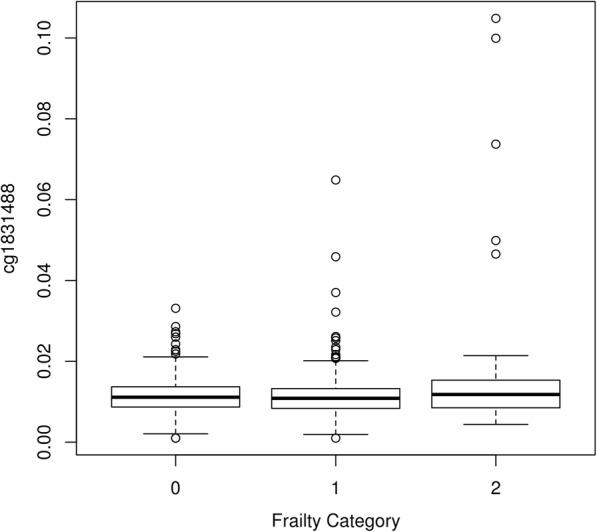
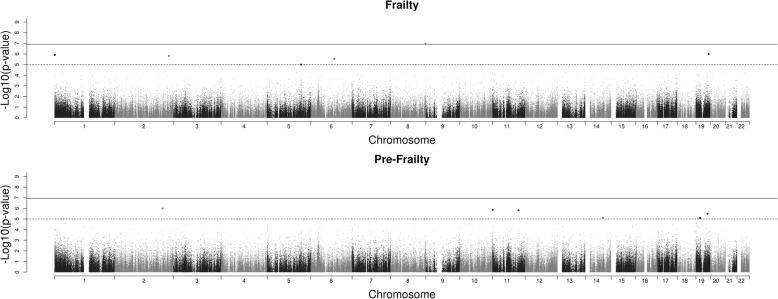
There was a single significant (P = 1.16 × 10⁻⁷) association in the epigenome-wide association study comparing frail versus not frail. The same CpG was not significant when comparing pre-frail versus not frail. Greater extrinsic epigenetic age acceleration was associated with an increased risk of being physically frail, but not of being pre-frail. For a year increase in extrinsic epigenetic age acceleration, age- and sex-adjusted relative risk ratios (95% CI) for being physically frail or pre-frail were 1.06 (1.02, 1.10) and 1.02 (1.00, 1.04), respectively. After further adjustment for smoking and chronic disease, the association with physical frailty remained significant. Intrinsic epigenetic age acceleration was not associated with physical frailty status.
CONCLUSIONS
People who are biologically older, as indexed by greater extrinsic epigenetic age acceleration, are more likely to be physically frail. Future research will need to investigate whether epigenetic age acceleration plays a causal role in the onset of physical frailty.
背景
老年人虚弱的生物学机制尚未完全清楚。有证据表明,脆弱个体的 DNA 甲基化模式可能发生改变。
方法
参与者为来自洛锡安出生队列 1936 年的 791 名 70 岁老年人。在全血中测量 DNA 甲基化。使用两种基于 DNA 甲基化的年龄加速——外在和内在表观遗传年龄加速来估计生物年龄。我们对身体虚弱(根据 Fried 表型定义)进行了全基因组关联研究。使用多项逻辑回归计算根据表观遗传年龄加速,身体虚弱或虚弱前的相对风险比。
结果
在比较虚弱与不虚弱的全基因组关联研究中,有一个单一的显著(P=1.16×10⁻⁷)关联。在比较虚弱前与不虚弱前时,相同的 CpG 没有意义。外在表观遗传年龄加速越大,身体虚弱的风险增加,但身体虚弱前的风险没有增加。外在表观遗传年龄加速增加 1 年,年龄和性别调整的相对风险比(95%CI)为身体虚弱或虚弱前分别为 1.06(1.02,1.10)和 1.02(1.00,1.04)。进一步调整吸烟和慢性疾病后,与身体虚弱的关联仍然显著。内在表观遗传年龄加速与身体虚弱状态无关。
结论
以更大的外在表观遗传年龄加速为指标的生物学上更老的人更容易出现身体虚弱。未来的研究需要调查表观遗传年龄加速是否在身体虚弱的发生中起因果作用。
 Zotero 插件