
评估治愈性苯硝唑治疗在预防慢性 Chagas 病实验模型中心脏病理的有效性。
Assessing the Effectiveness of Curative Benznidazole Treatment in Preventing Chronic Cardiac Pathology in Experimental Models of Chagas Disease.
机构信息
Department of Pathogen Molecular Biology, London School of Hygiene and Tropical Medicine, London, United Kingdom.
Department of Pathogen Molecular Biology, London School of Hygiene and Tropical Medicine, London, United Kingdom
出版信息
Antimicrob Agents Chemother. 2018 Sep 24;62(10). doi: 10.1128/AAC.00832-18. Print 2018 Oct.
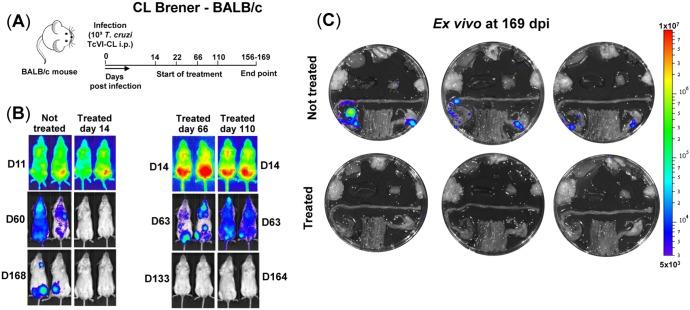
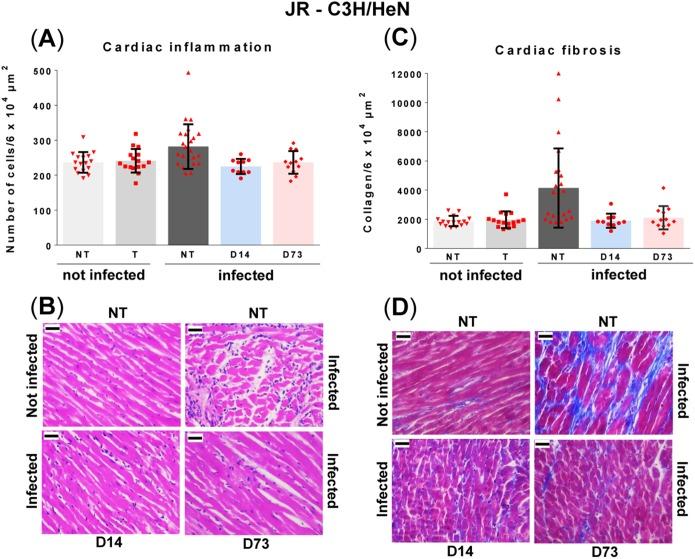
Chagasic heart disease develops in 30% of those infected with the protozoan parasite , but can take decades to become symptomatic. Because of this, it has been difficult to assess the extent to which antiparasitic therapy can prevent the development of pathology. We sought to address this question using experimental murine models, exploiting highly sensitive bioluminescent imaging to monitor curative efficacy. Mice were inoculated with bioluminescent parasites and then cured in either the acute or chronic stage of infection with benznidazole. At the experimental endpoint (5 to 6 months postinfection), heart tissue was removed and assessed for inflammation and fibrosis, two widely used markers of cardiac pathology. Infection of BALB/c and C3H/HeN mice with distinct lineages resulted in greatly increased myocardial collagen content at a group level, indicative of fibrotic pathology. When mice were cured by benznidazole in the acute stage, the development of pathology was completely blocked. However, if treatment was delayed until the chronic stage, cardiac fibrosis was observed in the BALB/c model, although the protective effect was maintained in the case of C3H/HeN mice. These experiments therefore demonstrate that curative benznidazole treatment early in murine infections can prevent the development of cardiac fibrosis. They also show that treatment during the chronic stage can block pathology but the effectiveness varies between infection models. If these findings are extendable to humans, it implies that widespread chemotherapeutic intervention targeted at early-stage infections could play a crucial role in reducing Chagas disease morbidity at a population level.
克氏锥虫感染后,30%的人会发展为克氏锥虫病,但可能需要数十年才会出现症状。正因为如此,评估抗寄生虫治疗在多大程度上可以预防病理发展一直很困难。我们使用实验性小鼠模型来解决这个问题,利用高度敏感的生物发光成像来监测治疗效果。用生物发光寄生虫感染小鼠,然后用苯硝唑在感染的急性期或慢性期进行治疗。在实验终点(感染后 5 至 6 个月),取出心脏组织,评估炎症和纤维化,这是两种广泛用于心脏病理的标志物。BALB/c 和 C3H/HeN 小鼠感染不同的系,导致心肌胶原含量在组水平上大大增加,表明存在纤维化病理。如果在急性阶段用苯硝唑治愈小鼠,病理的发展就会完全被阻断。然而,如果治疗延迟到慢性阶段,BALB/c 模型中会观察到心脏纤维化,但在 C3H/HeN 小鼠中仍然保持保护作用。因此,这些实验表明,在小鼠感染的早期阶段进行有治愈作用的苯硝唑治疗可以预防心脏纤维化的发展。它们还表明,在慢性阶段进行治疗可以阻断病理,但在不同的感染模型中效果不同。如果这些发现可以推广到人类,这意味着针对早期感染的广泛化学治疗干预可能在降低人群水平的克氏病发病率方面发挥关键作用。


 Zotero 插件