
饮食碳水化合物摄入量与死亡率:前瞻性队列研究和荟萃分析。
Dietary carbohydrate intake and mortality: a prospective cohort study and meta-analysis.
机构信息
Cardiovascular Division, Department of Medicine, Brigham and Women's Hospital, Boston, MA, USA.
Division of Epidemiology and Community Health, University of Minnesota, Minneapolis, MN, USA.
出版信息
Lancet Public Health. 2018 Sep;3(9):e419-e428. doi: 10.1016/S2468-2667(18)30135-X. Epub 2018 Aug 17.
BACKGROUND
Low carbohydrate diets, which restrict carbohydrate in favour of increased protein or fat intake, or both, are a popular weight-loss strategy. However, the long-term effect of carbohydrate restriction on mortality is controversial and could depend on whether dietary carbohydrate is replaced by plant-based or animal-based fat and protein. We aimed to investigate the association between carbohydrate intake and mortality.
METHODS
We studied 15 428 adults aged 45-64 years, in four US communities, who completed a dietary questionnaire at enrolment in the Atherosclerosis Risk in Communities (ARIC) study (between 1987 and 1989), and who did not report extreme caloric intake (<600 kcal or >4200 kcal per day for men and <500 kcal or >3600 kcal per day for women). The primary outcome was all-cause mortality. We investigated the association between the percentage of energy from carbohydrate intake and all-cause mortality, accounting for possible non-linear relationships in this cohort. We further examined this association, combining ARIC data with data for carbohydrate intake reported from seven multinational prospective studies in a meta-analysis. Finally, we assessed whether the substitution of animal or plant sources of fat and protein for carbohydrate affected mortality.
FINDINGS
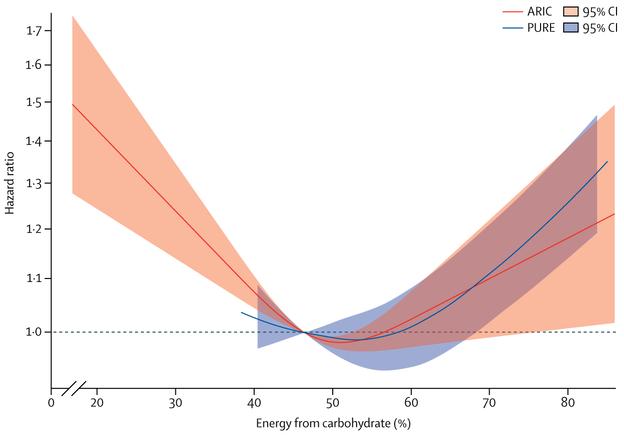
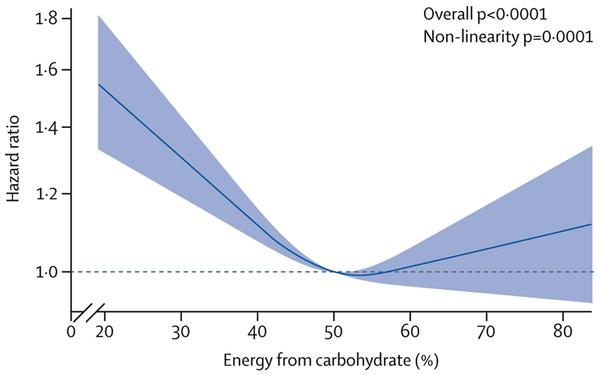
During a median follow-up of 25 years there were 6283 deaths in the ARIC cohort, and there were 40 181 deaths across all cohort studies. In the ARIC cohort, after multivariable adjustment, there was a U-shaped association between the percentage of energy consumed from carbohydrate (mean 48·9%, SD 9·4) and mortality: a percentage of 50-55% energy from carbohydrate was associated with the lowest risk of mortality. In the meta-analysis of all cohorts (432 179 participants), both low carbohydrate consumption (<40%) and high carbohydrate consumption (>70%) conferred greater mortality risk than did moderate intake, which was consistent with a U-shaped association (pooled hazard ratio 1·20, 95% CI 1·09-1·32 for low carbohydrate consumption; 1·23, 1·11-1·36 for high carbohydrate consumption). However, results varied by the source of macronutrients: mortality increased when carbohydrates were exchanged for animal-derived fat or protein (1·18, 1·08-1·29) and mortality decreased when the substitutions were plant-based (0·82, 0·78-0·87).
INTERPRETATION
Both high and low percentages of carbohydrate diets were associated with increased mortality, with minimal risk observed at 50-55% carbohydrate intake. Low carbohydrate dietary patterns favouring animal-derived protein and fat sources, from sources such as lamb, beef, pork, and chicken, were associated with higher mortality, whereas those that favoured plant-derived protein and fat intake, from sources such as vegetables, nuts, peanut butter, and whole-grain breads, were associated with lower mortality, suggesting that the source of food notably modifies the association between carbohydrate intake and mortality.
FUNDING
National Institutes of Health.
背景
低碳水化合物饮食通过限制碳水化合物的摄入,增加蛋白质或脂肪的摄入量,或者同时增加两者的摄入量,从而达到减肥的目的,这是一种广受欢迎的减肥策略。然而,碳水化合物限制对死亡率的长期影响存在争议,其影响可能取决于饮食中的碳水化合物是被植物性还是动物性脂肪和蛋白质所替代。本研究旨在探究碳水化合物摄入量与死亡率之间的关系。
方法
我们研究了来自美国四个社区的 15428 名年龄在 45-64 岁之间的成年人,这些参与者在动脉粥样硬化风险社区(ARIC)研究中(1987 年至 1989 年期间)入组时完成了饮食问卷,并且没有报告极端热量摄入(男性<600 千卡或>4200 千卡/天,女性<500 千卡或>3600 千卡/天)。主要结局是全因死亡率。我们调查了碳水化合物摄入量占总能量的百分比与全因死亡率之间的关系,同时考虑了该队列中可能存在的非线性关系。我们进一步在合并分析中结合了 ARIC 数据和来自七个跨国前瞻性研究的碳水化合物摄入量数据,对这一关系进行了检验。最后,我们评估了碳水化合物被动物或植物来源的脂肪和蛋白质替代是否会影响死亡率。
结果
在中位随访 25 年期间,ARIC 队列中有 6283 人死亡,所有队列研究中有 40181 人死亡。在 ARIC 队列中,经过多变量调整后,碳水化合物摄入占总能量的百分比(平均 48.9%,标准差 9.4%)与死亡率之间呈 U 型关系:碳水化合物摄入量占 50-55%的比例与最低的死亡率相关。在所有队列的合并分析(432179 名参与者)中,低碳水化合物摄入(<40%)和高碳水化合物摄入(>70%)均比中等摄入的死亡率风险更高,这与 U 型关系一致(低碳水化合物摄入的汇总风险比为 1.20,95%置信区间为 1.09-1.32;高碳水化合物摄入的汇总风险比为 1.23,95%置信区间为 1.11-1.36)。然而,结果因宏量营养素的来源而异:当用动物来源的脂肪或蛋白质替代碳水化合物时,死亡率会增加(1.18,1.08-1.29),而当用植物来源的脂肪和蛋白质替代碳水化合物时,死亡率会降低(0.82,0.78-0.87)。
结论
高碳水化合物和低碳水化合物饮食与死亡率的增加相关,碳水化合物摄入量为 50-55%时风险最小。低碳水化合物饮食模式偏好来自羊肉、牛肉、猪肉和鸡肉等动物来源的蛋白质和脂肪,与更高的死亡率相关,而偏好来自蔬菜、坚果、花生酱和全麦面包等植物来源的蛋白质和脂肪摄入的饮食模式,与更低的死亡率相关,这表明食物来源显著改变了碳水化合物摄入与死亡率之间的关系。
资助
美国国立卫生研究院。

 Zotero 插件