
2011-2012 年中国城乡居民社会经济地位与自我报告、筛查及确诊糖尿病患病率的关系:全国横断面研究
Socioeconomic status and self-reported, screen-detected and total diabetes prevalence in Chinese men and women in 2011-2012: a nationwide cross-sectional study.
机构信息
Usher Institute of Population Health Sciences and Informatics, University of Edinburgh, UK.
School of Public Health, Peking University, Beijing, China.
出版信息
J Glob Health. 2018 Dec;8(2):020501. doi: 10.7189/jogh.08.020501.
BACKGROUND
A rapid epidemiological transition is taking place in China and the association between socioeconomic status (SES) and diabetes prevalence is not clear and may vary by population characteristics and geography within the country. We describe the associations between educational level, annual household living expenditure (AHLE) and diabetes prevalence in a large middle-aged and elderly Chinese population using data from a nationwide cross-sectional study.
METHODS
We used data from the China Health and Retirement Longitudinal Study, which collected information from interviews and blood tests from a nationwide sample of people over 44 years of age in 2011-2012. We used multivariable logistic regression to describe the association between highest levels of education (high school or above compared to illiterate) or AHLE (top vs bottom quartile) and self-reported, screen-detected or total diabetes prevalence. We stratified by sex and adjusted for age, education or AHLE (as appropriate), urban, rural or migrant residence status and geographical area.
RESULTS
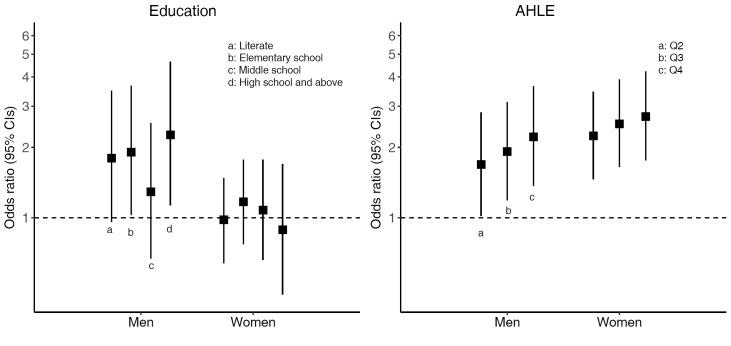
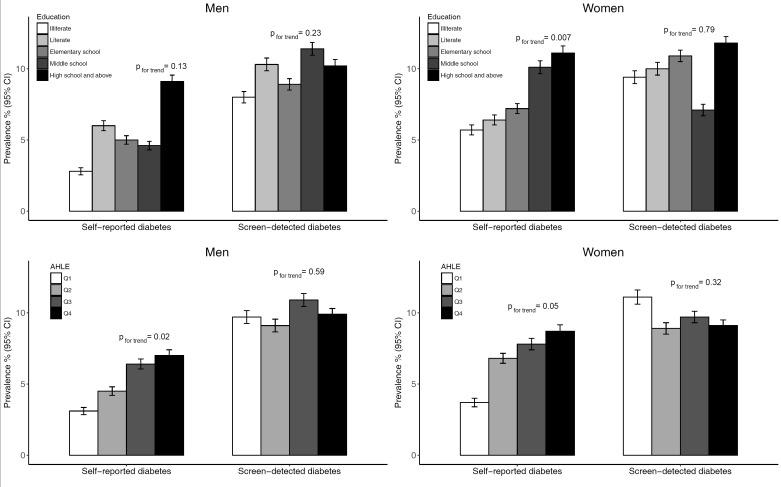
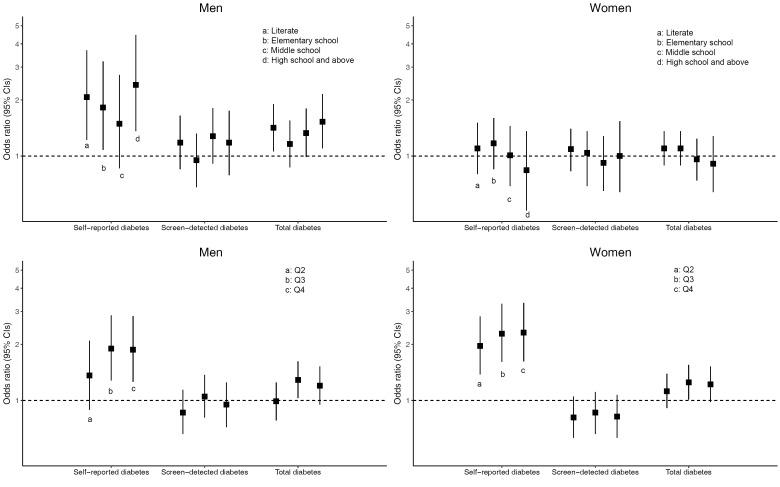
Complete data were available for 10 100 participants of whom 10.5% and 28.9% had the highest and the lowest levels of education respectively. Overall prevalence of self-reported diabetes was 6.0% and of screen-detected diabetes was 9.8%. Higher education level was associated with both self-reported diabetes (odds ratio (OR) = 2.41, 95% confidence interval CI = 1.36-4.46) and total diabetes (OR = 1.53 95%, CI = 1.10-2.15) only in men. AHLE was associated with self-reported diabetes in men (OR = 1.87, 95% CI = 1.26-2.84) and women (OR = 2.31, 95% CI = 1.62-3.34). There was no association between SES and screen-detected diabetes for men or women.
CONCLUSIONS
SES inequalities exist in prevalence of diabetes in China and can be used to inform approaches to prevention. Identification and appropriate intervention for people with undiagnosed diabetes is required for all SES groups.
背景
中国正在经历快速的流行病学转变,社会经济地位(SES)与糖尿病患病率之间的关系尚不清楚,且可能因人群特征和国内地域差异而有所不同。我们使用全国性横断面研究的数据,描述了在中国一个大型中老年人群中,教育程度、家庭年人均生活支出(AHLE)与糖尿病患病率之间的关系。
方法
我们使用了中国健康与退休纵向研究的数据,该研究在 2011-2012 年期间对全国范围内 44 岁以上人群进行了访谈和血液检测。我们使用多变量逻辑回归描述了最高教育水平(高中及以上与文盲相比)或 AHLE(最高与最低四分位相比)与自我报告、筛查发现或总糖尿病患病率之间的关系。我们按性别分层,并根据年龄、教育程度或 AHLE(视情况而定)、城乡或流动人口居住状况以及地理位置进行了调整。
结果
共有 10100 名参与者提供了完整的数据,其中 10.5%和 28.9%的参与者受教育程度最高和最低。自我报告糖尿病的总患病率为 6.0%,筛查发现糖尿病的患病率为 9.8%。较高的教育水平与男性的自我报告糖尿病(优势比(OR)=2.41,95%置信区间(CI)=1.36-4.46)和总糖尿病(OR=1.53,95%CI=1.10-2.15)均相关。AHLE 仅与男性(OR=1.87,95%CI=1.26-2.84)和女性(OR=2.31,95%CI=1.62-3.34)的自我报告糖尿病相关。SES 与男性或女性的筛查发现糖尿病均无关联。
结论
中国糖尿病患病率存在 SES 不平等,可用于为预防措施提供信息。所有 SES 群体都需要识别和适当干预未确诊的糖尿病患者。
 Zotero 插件