
枯草芽孢杆菌生物膜形成的选择压力:主调控因子 SinR 突变对双稳性的差异影响。
Selective Pressure for Biofilm Formation in Bacillus subtilis: Differential Effect of Mutations in the Master Regulator SinR on Bistability.
机构信息
Department of General Microbiology, Georg-August-University Göttingen, GZMB, Göttingen, Germany.
Institute for Cell and Molecular Biosciences, Newcastle University, Newcastle upon Tyne, United Kingdom.
出版信息
mBio. 2018 Sep 4;9(5):e01464-18. doi: 10.1128/mBio.01464-18.
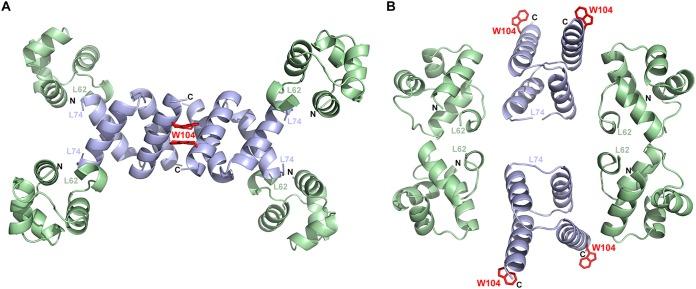
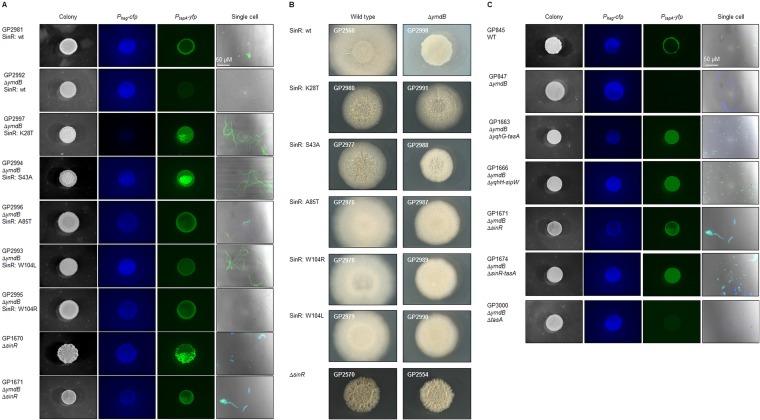
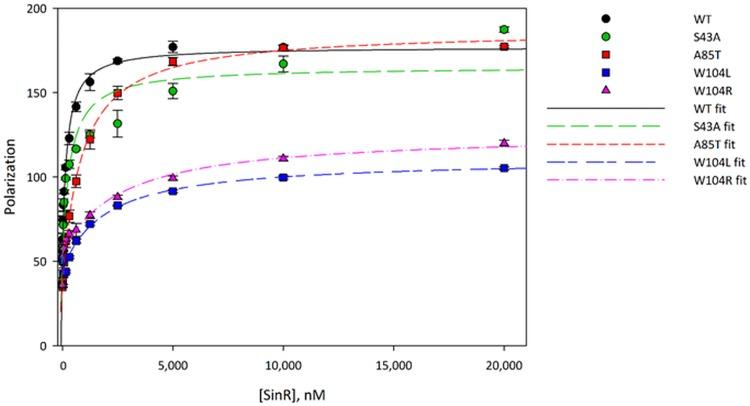
Biofilm formation by requires the expression of genes encoding enzymes for extracellular polysaccharide synthesis and for an amyloid-like protein. The master regulator SinR represses all the corresponding genes, and repression of these key biofilm genes is lifted when SinR interacts with its cognate antagonist proteins. The YmdB phosphodiesterase is a recently discovered factor that is involved in the control of SinR activity: cells lacking YmdB exhibit hyperactive SinR and are unable to relieve the repression of the biofilm genes. In this study, we have examined the dynamics of gene expression patterns in wild-type and mutant cells by microfluidic analysis coupled to time-lapse microscopy. Our results confirm the bistable expression pattern for motility and biofilm genes in the wild-type strain and the loss of biofilm gene expression in the mutant. Moreover, we demonstrated dynamic behavior in subpopulations of the wild-type strain that is characterized by switches in sets of the expressed genes. In order to gain further insights into the role of YmdB, we isolated a set of spontaneous suppressor mutants derived from mutants that had regained the ability to form complex colonies and biofilms. Interestingly, all of the mutations affected SinR. In some mutants, large genomic regions encompassing were deleted, whereas others had alleles encoding SinR variants. Functional and biochemical studies with these SinR variants revealed how these proteins allowed biofilm gene expression in the mutant strains. Many bacteria are able to choose between two mutually exclusive lifestyles: biofilm formation and motility. In the model bacterium , this choice is made by each individual cell rather than at the population level. The transcriptional repressor SinR is the master regulator in this decision-making process. The regulation of SinR activity involves complex control of its own expression and of its interaction with antagonist proteins. We show that the YmdB phosphodiesterase is required to allow the expression of SinR-repressed genes in a subpopulation of cells and that such subpopulations can switch between different SinR activity states. Suppressor analyses revealed that mutants readily acquire mutations affecting SinR, thus restoring biofilm formation. These findings suggest that cells experience selective pressure to form the extracellular matrix that is characteristic of biofilms and that YmdB is required for the homeostasis of SinR and/or its antagonists.
生物膜的形成需要表达编码细胞外多糖合成和淀粉样蛋白样蛋白的基因。主调控因子 SinR 抑制所有相应的基因,当 SinR 与其同源拮抗蛋白相互作用时,这些关键生物膜基因的抑制作用被解除。YmdB 磷酸二酯酶是一种新发现的因子,参与控制 SinR 活性:缺乏 YmdB 的细胞表现出过度活跃的 SinR,无法解除生物膜基因的抑制。在这项研究中,我们通过微流控分析与延时显微镜相结合,检查了野生型和突变细胞中基因表达模式的动力学。我们的结果证实了野生型菌株中运动和生物膜基因的双稳态表达模式,以及突变菌株中生物膜基因表达的丧失。此外,我们证明了野生型菌株亚群的动态行为,其特征是表达基因集的转换。为了进一步了解 YmdB 的作用,我们从突变体中分离出一组自发的抑制突变体,这些突变体恢复了形成复杂菌落和生物膜的能力。有趣的是,所有的突变都影响了 SinR。在一些突变体中,包含的大片段基因组缺失,而其他突变体则编码 SinR 变体。这些 SinR 变体的功能和生化研究揭示了这些蛋白质如何允许突变菌株中生物膜基因的表达。许多细菌能够在两种相互排斥的生活方式之间做出选择:生物膜形成和运动。在模式细菌中,这种选择是由每个细胞而不是由群体水平做出的。转录抑制剂 SinR 是这一决策过程中的主调控因子。SinR 活性的调节涉及到对其自身表达的复杂控制及其与拮抗蛋白的相互作用。我们表明,YmdB 磷酸二酯酶是允许细胞亚群中 SinR 抑制基因表达所必需的,并且这些亚群可以在不同的 SinR 活性状态之间切换。抑制分析表明,突变体很容易获得影响 SinR 的突变,从而恢复生物膜的形成。这些发现表明,细胞经历了选择性压力,形成了生物膜特有的细胞外基质,而 YmdB 是 SinR 和/或其拮抗物的体内平衡所必需的。




 Zotero 插件