
从理论到实践:将全基因组测序(WGS)转化为临床应用。
From Theory to Practice: Translating Whole-Genome Sequencing (WGS) into the Clinic.
机构信息
UCL Genetics Institute, University College London, Gower Street, London WC1E 6BT, UK; These authors made equal contributions.
Infectious Diseases and Environmental Health, Norwegian Institute of Public Health, Lovisenberggata 8, Oslo 0456, Norway; These authors made equal contributions.
出版信息
Trends Microbiol. 2018 Dec;26(12):1035-1048. doi: 10.1016/j.tim.2018.08.004. Epub 2018 Sep 4.
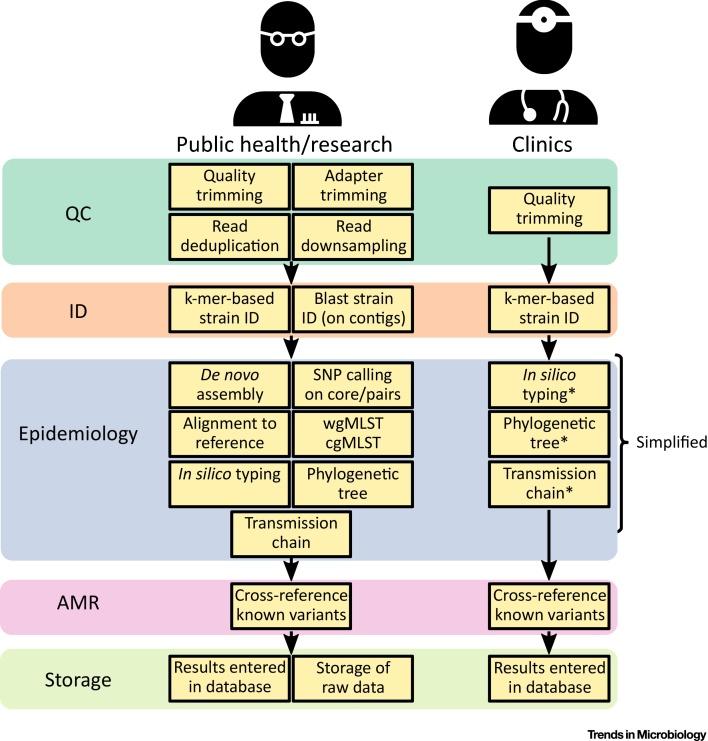
Hospitals worldwide are facing an increasing incidence of hard-to-treat infections. Limiting infections and providing patients with optimal drug regimens require timely strain identification as well as virulence and drug-resistance profiling. Additionally, prophylactic interventions based on the identification of environmental sources of recurrent infections (e.g., contaminated sinks) and reconstruction of transmission chains (i.e., who infected whom) could help to reduce the incidence of nosocomial infections. WGS could hold the key to solving these issues. However, uptake in the clinic has been slow. Some major scientific and logistical challenges need to be solved before WGS fulfils its potential in clinical microbial diagnostics. In this review we identify major bottlenecks that need to be resolved for WGS to routinely inform clinical intervention and discuss possible solutions.
全球各地的医院都面临着越来越多的难治性感染。为了限制感染并为患者提供最佳的药物治疗方案,需要及时识别菌株,以及进行毒力和耐药性分析。此外,基于对反复感染的环境来源(如污染水槽)的识别和传播链重建(即谁感染了谁)的预防性干预措施,可能有助于降低医院感染的发生率。全基因组测序(WGS)可能是解决这些问题的关键。然而,该技术在临床上的应用进展缓慢。在 WGS 充分发挥其在临床微生物诊断中的潜力之前,需要解决一些重大的科学和后勤挑战。在这篇综述中,我们确定了需要解决的主要瓶颈,以使 WGS 能够常规地为临床干预提供信息,并讨论了可能的解决方案。


 Zotero 插件