
球形核酸结构可提高聚阳离子介导的小干扰RNA递送效率。
Spherical Nucleic Acid Architecture Can Improve the Efficacy of Polycation-Mediated siRNA Delivery.
作者信息
Melamed Jilian R, Kreuzberger Nicole L, Goyal Ritu, Day Emily S
机构信息
Biomedical Engineering, University of Delaware, Newark, DE 19716, USA.
Biomedical Engineering, University of Delaware, Newark, DE 19716, USA; Materials Science & Engineering, University of Delaware, Newark, DE 19716, USA; Helen F. Graham Cancer Center and Research Institute, Newark, DE 19713, USA.
出版信息
Mol Ther Nucleic Acids. 2018 Sep 7;12:207-219. doi: 10.1016/j.omtn.2018.05.008. Epub 2018 Jun 2.
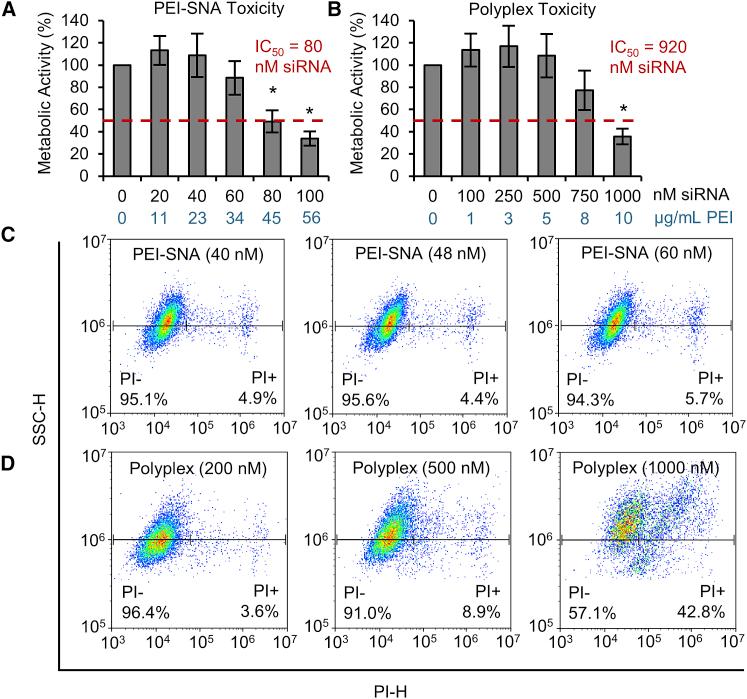
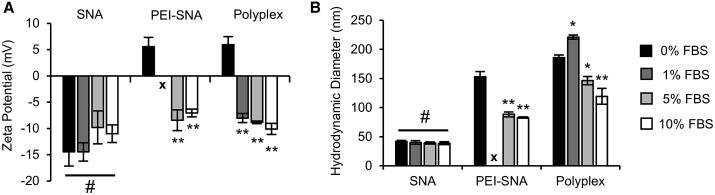
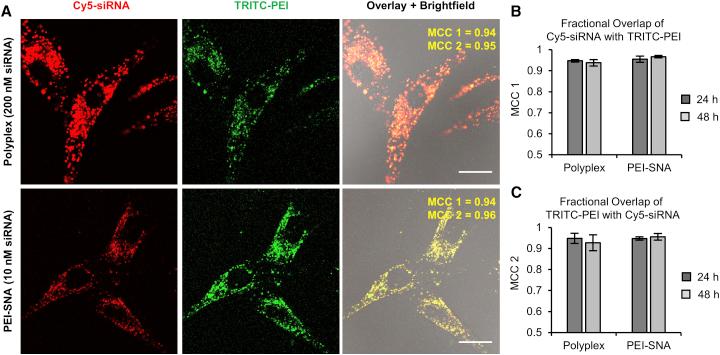
Clinical translation of small interfering RNA (siRNA) nanocarriers is hindered by limited knowledge regarding the parameters that regulate interactions between nanocarriers and biological systems. To address this, we investigated the influence of polycation-based nanocarrier architecture on intracellular siRNA delivery. We compared the cellular interactions of two polycation-based siRNA carriers that have similar size and surface charge but different siRNA orientation: (1) polyethylenimine-coated spherical nucleic acids (PEI-SNAs), in which polyethylenimine is wrapped around a spherical nucleic acid core containing radially oriented siRNA and (2) randomly assembled polyethylenimine-siRNA polyplexes that lack controlled architecture. We found that PEI-SNAs undergo enhanced and more rapid cellular uptake than polyplexes, suggesting a prominent role for architecture in cellular uptake. Confocal microscopy studies demonstrated that while PEI-SNAs and polyplexes exhibit similar intracellular stability, PEI-SNAs undergo decreased accumulation within lysosomes, identifying another advantage conferred by their architecture. Indeed, these advantageous cellular interactions enhanced the gene silencing potency of PEI-SNAs by 10-fold relative to polyplexes. Finally, cytocompatibility studies showed that PEI-SNAs exhibit decreased toxicity per PEI content relative to polyplexes, allowing the use of more polycation. Our studies provide critical insight into design considerations for engineering siRNA carriers and warrant future investigation of how nanocarrier architecture influences cellular-, organ-, and organism-level interactions.
由于对调节纳米载体与生物系统之间相互作用的参数了解有限,小干扰RNA(siRNA)纳米载体的临床转化受到阻碍。为了解决这一问题,我们研究了基于聚阳离子的纳米载体结构对细胞内siRNA递送的影响。我们比较了两种基于聚阳离子的siRNA载体的细胞相互作用,这两种载体大小和表面电荷相似,但siRNA取向不同:(1)聚乙烯亚胺包被的球形核酸(PEI-SNA),其中聚乙烯亚胺包裹在含有径向取向siRNA的球形核酸核心周围;(2)缺乏可控结构的随机组装的聚乙烯亚胺-siRNA多聚体。我们发现,PEI-SNA比多聚体具有更强且更快的细胞摄取能力,这表明结构在细胞摄取中起重要作用。共聚焦显微镜研究表明,虽然PEI-SNA和多聚体在细胞内表现出相似的稳定性,但PEI-SNA在溶酶体内的积累减少,这表明其结构赋予了另一个优势。事实上,这些有利的细胞相互作用使PEI-SNA的基因沉默效力相对于多聚体提高了10倍。最后,细胞相容性研究表明,相对于多聚体,PEI-SNA每单位PEI含量的毒性降低,从而可以使用更多的聚阳离子。我们的研究为设计siRNA载体提供了关键的见解,并为未来研究纳米载体结构如何影响细胞、器官和生物体水平的相互作用提供了依据。




 Zotero 插件