
驱虫对学龄儿童贫血患病率的影响:一项系统评价和荟萃分析。
The Effect of Deworming School Children on Anemia Prevalence: A Systematic Review and Meta-Analysis.
作者信息
Girum Tadele, Wasie Abebaw
机构信息
Department of Public health, college of Medicine and Health Sciences, Wolkite University, Wolkite City, Ethiopia.
出版信息
Open Nurs J. 2018 Jul 31;12:155-161. doi: 10.2174/1874434601812010155. eCollection 2018.
INTRODUCTION
High prevalence of anemia attributable to intestinal parasite infection occurs among children in developing countries. As a result mass treatment of all children with anti-helminthic drugs particularly in school setting is being implemented. There are few studies conducted to assess impact of deworming on anemia prevalence among school children with inconclusive finding. Therefore we aimed to conduct a systematic review on impact assessment of deworming on anemia prevalence or hemoglobin level of school children so that policy makers and other stalk holders could have pooled evidence on the direction to make decision.
METHODS
The review was conducted through a systematic literature search of articles published between 1998 and 2015. Five bibliographic databases and libraries: PubMed/Medline, Global Health Database, Embase, the Cochrane Library, and African Index Medicus were used. After cleaning and sorting, analysis was performed using STATA version 11. The pooled estimate was through a fixed-effects model. Heterogeneity was assessed by the I and publication bias through funnel plot.
RESULTS
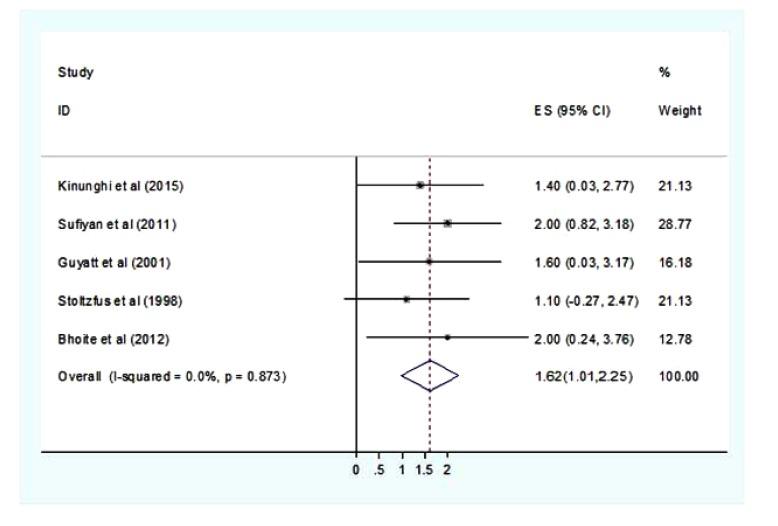
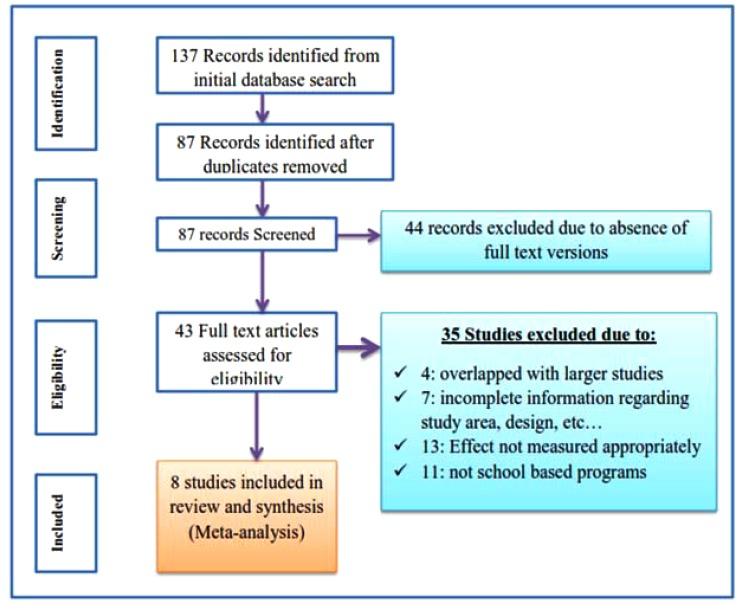
Eight studies were retained for final analysis which enrolled a total of 1,005,239 school children. The overall change in the hemoglobin level after deworming was 1.62(95%CI=1.01-2.25) gram/deciliter. There was no difference between the random effect model and the fixed effect model. The prevalence of anemia was markedly changed after the program, particularly in the studies which implemented deworming with hygiene program, co-administration of iron and retinol.
CONCLUSION AND RECOMMENDATION
School based deworming program decreases prevalence of anemia and will contribute to reduction of anemia in the community. Therefore the program should be expanded in all areas and integrated with other child care programs.
引言
在发展中国家,儿童中因肠道寄生虫感染导致的贫血患病率很高。因此,正在对所有儿童,特别是在校儿童实施大规模驱虫药物治疗。很少有研究评估驱虫对在校儿童贫血患病率的影响,结果尚无定论。因此,我们旨在对驱虫对在校儿童贫血患病率或血红蛋白水平的影响评估进行系统综述,以便政策制定者和其他利益相关者能够获得汇总证据,为决策提供方向。
方法
通过对1998年至2015年发表的文章进行系统文献检索来开展综述。使用了五个书目数据库和图书馆:PubMed/Medline、全球卫生数据库、Embase、Cochrane图书馆和非洲医学索引。清理和分类后,使用STATA 11版进行分析。汇总估计通过固定效应模型进行。通过I²评估异质性,并通过漏斗图评估发表偏倚。
结果
八项研究被保留用于最终分析,共纳入1,005,239名在校儿童。驱虫后血红蛋白水平的总体变化为1.62(95%CI=1.01-2.25)克/分升。随机效应模型和固定效应模型之间没有差异。该项目实施后贫血患病率有显著变化,特别是在那些将驱虫与卫生项目、铁和视黄醇联合给药相结合的研究中。
结论与建议
以学校为基础的驱虫项目可降低贫血患病率,并将有助于减少社区中的贫血现象。因此,该项目应在所有地区扩大,并与其他儿童保育项目相结合。
 Zotero 插件