
维生素 D 在肿瘤发生中的抗炎作用。
The Anti-Inflammatory Effects of Vitamin D in Tumorigenesis.
机构信息
College of Laboratory Medicine, Jilin Medical University, Jilin 132013, China.
Laboratory of Antibody Engineering, Jilin Medical University, Jilin 132013, China.
出版信息
Int J Mol Sci. 2018 Sep 13;19(9):2736. doi: 10.3390/ijms19092736.
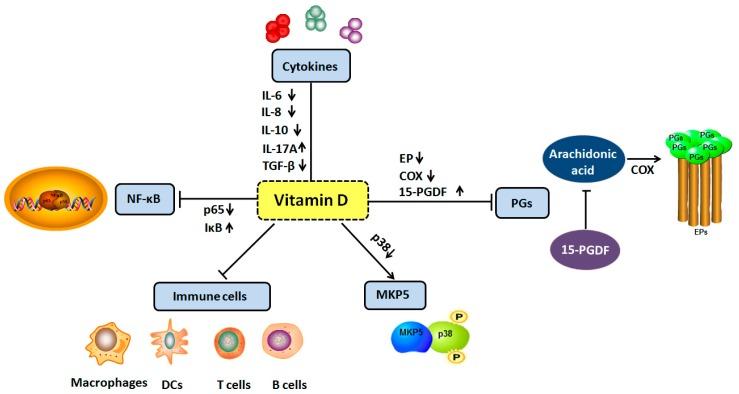
In conjunction with the classical functions of regulating intestinal, bone, and kidney calcium and phosphorus absorption, as well as bone mineralization of vitamin D, the population-based association between low vitamin D status and increased cancer risk is now generally accepted. Inflammation is causally related to oncogenesis. It is widely thought that vitamin D plays an important role in the modulation of the inflammation system by regulating the production of inflammatory cytokines and immune cells, which are crucial for the pathogenesis of many immune-related diseases. Mechanistic studies have shown that vitamin D influences inflammatory processes involved in cancer progression, including cytokines, prostaglandins, MAP kinase phosphatase 5 (MKP5), the nuclear factor kappa B (NF-κB) pathway, and immune cells. Multiple studies have shown that vitamin D has the potential to inhibit tumor development by interfering with the inflammation system. The present review summarizes recent studies of the mechanisms of vitamin D on regulating the inflammation system, which contributes to its potential for cancer prevention and therapy. This review helps answer whether inflammation mediates a causal relationship between vitamin D and tumorigenesis.
维生素 D 不仅具有调节肠道、骨骼和肾脏钙磷吸收以及骨矿化等经典功能,而且与癌症风险增加呈负相关,目前人们普遍认为维生素 D 状态低下与癌症风险增加之间存在关联。炎症与肿瘤的发生有关。人们普遍认为,维生素 D 通过调节炎症细胞因子和免疫细胞的产生来在炎症系统的调节中发挥重要作用,这对于许多与免疫相关的疾病的发病机制至关重要。机制研究表明,维生素 D 影响癌症进展中涉及的炎症过程,包括细胞因子、前列腺素、丝裂原活化蛋白激酶磷酸酶 5(MKP5)、核因子 kappa B(NF-κB)途径和免疫细胞。多项研究表明,维生素 D 通过干扰炎症系统具有抑制肿瘤发展的潜力。本综述总结了维生素 D 调节炎症系统的作用机制的最新研究,这有助于解释其在癌症预防和治疗中的潜在作用。该综述有助于回答炎症是否介导了维生素 D 与肿瘤发生之间的因果关系。
 Zotero 插件