
微生境变化驱动 pholcid 蜘蛛的多样化。
Microhabitat change drives diversification in pholcid spiders.
机构信息
Alexander Koenig Research Museum of Zoology, Adenauerallee 160, 53113, Bonn, Germany.
Center for Macroecology, Evolution and Climate, Natural History Museum of Denmark, University of Copenhagen, Copenhagen, Denmark.
出版信息
BMC Evol Biol. 2018 Sep 19;18(1):141. doi: 10.1186/s12862-018-1244-8.
BACKGROUND
Microhabitat changes are thought to be among the main drivers of diversification. However, this conclusion is mostly based on studies on vertebrates. Here, we investigate the influence of microhabitat on diversification rates in pholcid spiders (Araneae, Pholcidae). Diversification analyses were conducted in the framework of the largest molecular phylogeny of pholcid spiders to date based on three nuclear and three mitochondrial loci from 600 species representing more than 85% of the currently described pholcid genera.
RESULTS
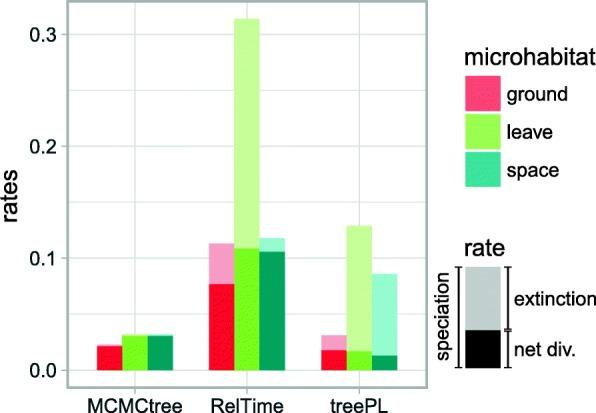
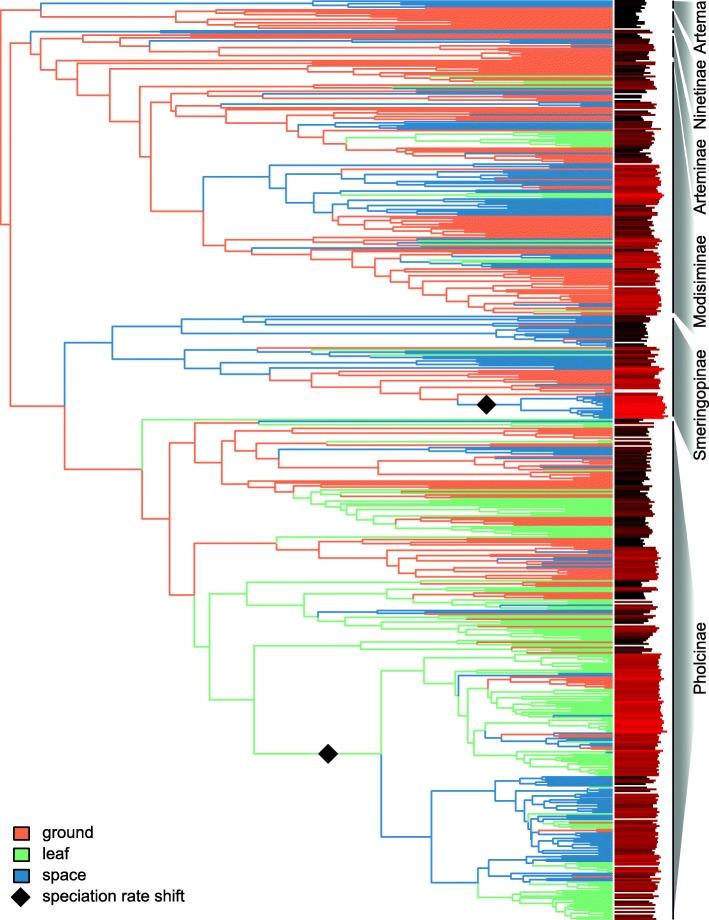
Assessments of ancestral microhabitat revealed frequent evolutionary change. In particular, within the largest subfamily Pholcinae, numerous changes from near-ground habitats towards leaves and back were found. In general, taxa occupying leaves and large sheltered spaces had higher diversification rates than ground-dwelling taxa. Shifts in speciation rate were found in leaf- and space-dwelling taxa.
CONCLUSIONS
Our analyses result in one of the most comprehensive phylogenies available for a major spider family and provide a framework for any subsequent studies of pholcid spider biology. Diversification analyses strongly suggest that microhabitat is an important factor influencing diversification patterns in pholcid spiders.
背景
微生境变化被认为是物种多样化的主要驱动因素之一。然而,这一结论主要基于对脊椎动物的研究。在这里,我们研究了微生境对盲蛛(蜘蛛目,盲蛛科)多样化速率的影响。在迄今为止最大的盲蛛分子系统发育框架内进行了多样化分析,该框架基于来自 600 种代表目前描述的盲蛛属的 85%以上的三种核和三种线粒体基因座。
结果
对祖先微生境的评估显示出频繁的进化变化。特别是在最大的亚科 Pholcinae 中,发现了从近地面栖息地向叶子和返回的许多变化。一般来说,占据叶子和大遮蔽空间的类群的多样化速率高于地面栖息的类群。在叶栖和空间栖类群中发现了物种形成率的变化。
结论
我们的分析结果为主要蜘蛛科之一提供了最全面的系统发育之一,并为盲蛛生物学的任何后续研究提供了框架。多样化分析强烈表明,微生境是影响盲蛛多样化模式的一个重要因素。


 Zotero 插件